
You are using an outdated browser and your browsing experience will not be optimal. Please update to the latest version of Microsoft Edge, Google Chrome or Mozilla Firefox. Install Microsoft Edge

March 2, 2021

Thailand’s Decriminalization of Cannabis Plants

Informed Counsel

The cannabis plant has fascinated many civilizations, societies, and individuals through the centuries with its unique properties, and many have learned how to benefit from these, finding a variety of therapeutic and industrial uses of the plant that, in turn, enhanced domestic economies worldwide. In Thailand, cannabis plants and their derivatives have been used since ancient times as treatment for many diseases, and the plant forms a key ingredient in many Thai traditional medicinal remedies. However, over the past few decades, cannabis usage was seen to change in a way that became incrementally more abusive, resulting in outright prohibition in almost all countries. Thailand was no exception, and in 1979 the Thai government officially enacted the Narcotics Act forbidding the use of cannabis and listing cannabis plants and their derivatives—most notably marijuana (cannabis with psychoactive properties) and hemp (cannabis with limited or no psychoactive properties)—as category 5 narcotics (i.e., prohibited substances).

Despite these restrictions, many Thais continued to use cannabis illegally, and some urged the government to legalize personal and commercial use of cannabis plants and their derivatives. Eventually, some in the Thai government agreed that it was time to consider steps toward legalization, As a result, the government has been taking action to delist cannabis plants from the list of prohibited narcotics since 2018, when a regulation allowed the cultivation of hemp for industrial and non-commercial purposes, such as household cooking and research and development.

The next significant step came in February 2019, when the Narcotics Act (No. 7) was amended, legalizing medical marijuana within certain limitations. In national elections the following month, the Bhumjaithai political party, whose election campaign included a pledge to decriminalize and legalize cannabis plants, won substantial support in parts of the country and chose to join the coalition government, with the Bhumjaithai party leader assuming control of the Ministry of Public Health (MOPH). Since then, the government, with cooperation from the MOPH and the Food and Drug Administration (FDA), has been working to reclassify cannabis products and to issue new regulatory pathways to accommodate these new “cash crops” to boost the domestic economy. Subsequently, a notification was issued in August 2019 that reclassified certain modern drugs, cosmeceuticals, nutraceuticals, cosmetics, and food containing hemp out of the scope of the Narcotics Act. At the same time, cannabis and hemp legalization were also taking a higher profile in the public sphere. For instance, the issue of cannabis legalization was raised and promoted in the election campaigns of early 2019 by one of the large political parties.

After a long interlude (caused primarily by government focus turning to the COVID-19 pandemic and other emergent priorities), a new MOPH notification was published in the Government Gazette on December 14, 2020, expanding the delisting of cannabis from the Narcotics Act to include nearly all parts of cannabis and hemp plants, as detailed in the table below.
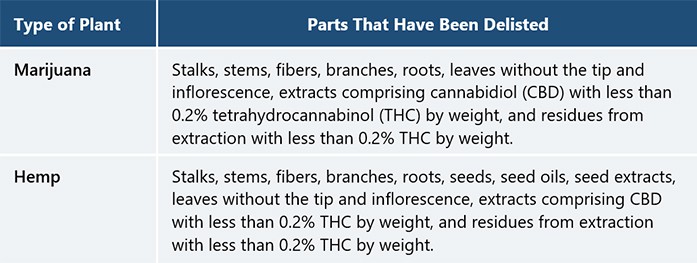
Anyone who wishes to participate in this emerging cannabis industry must be cautious and carefully review the Narcotics Act and its relevant notifications. Although many parts of the cannabis plant were delisted, there some parts remain on the narcotics list (e.g., marijuana seeds, buds, and leaves with cannabis inflorescence or complete cannabis flower head), and the limits on CBD and THC content must be strictly observed.

Importantly, this notification covers only cannabis cultivated in Thailand. Foreign participants are precluded from any participation in an approved cannabis business until a five-year ban on foreign participation—counting from the initial delisting in February 2019—has passed. This means that only the Thai government and its authorized partners have standing to apply for a commercial license until February 20, 2024, which is when foreign parties will be allowed to obtain a commercial cannabis license (subject to any extension or further imposition of restrictions). However, non-commercial licenses (e.g., for research and development) may be issued to Thai applicants.

Despite these limitations, the MOPH notification is another progressive step for driving cannabis research, development, and industry in Thailand. In addition, it delisted other plants that had been classified as category 5 narcotics, including kratom plants (a common plant in Southeast Asia with mild stimulant properties) such as Mitragyna speciosa (Korth.) Havil; opium plants such as Papaver somniferum L. and Papaver bracteatum Lindl.; and fungi of the species Psilocybe cubensis, which contain psilocybin or psilocin. Further notifications on these substances are expected to be issued soon.

The government quickly followed up on the December 14, 2020, notification by publishing another notification on December 30, establishing the criteria for filing applications for licenses to produce, import, export, distribute, and possess hemp (Cannabis sativa) in Thailand. Processing of these applications by the FDA opened on January 29, 2021, for interested Thai citizens and entities under Thai law. Industry operators are now waiting for the Thai FDA’s final promulgation of its own regulations for cannabis licensing to support this development.

Parties interested in entering into this emerging industry should closely monitor the ongoing development of the regulatory regime for cannabis plants in Thailand, as this regime is solidifying rapidly. Those who stay apprised of the situation and remain ready to act when opportunities arise will be able to take full advantage of the new regulatory changes, and in the process will help strengthen a nascent industry in Thailand.

RELATED INSIGHTS​ 

August 18, 2022
Practical Law has published an updated online version of Agricultural Law in Thailand, a Q&A-style guide that provides detailed overviews of Thailand’s agriculture laws and regulations. The Thailand overview is one of approximately twenty such guides to jurisdictions worldwide, covering key practical issues related to the legal environment for agricultural operations. The Thailand section, which was written by lawyers at Tilleke & Gibbins, covers the following topics: Agricultural policy Acquisition of agricultural companies Acquisition of agricultural land Crop seed business Plant variety rights Genetically modified crops Animal and animal welfare issues Agricultural safety and product liability Practical Law, produced by Thomson Reuters, is a comprehensive global legal resource for business lawyers. The platform features a wide range of guides covering hundreds of jurisdictions and practice areas. The full Agricultural Law in Thailand chapter can be accessed on the Practical Law website.
August 9, 2022
In late 2021, the government of Vietnam issued Decree 98 on the management of medical devices (Decree No. 98/2021/ND-CP dated November 8, 2021), which came into force on January 1, 2022. This is the primary legislation on medical devices in Vietnam. To provide necessary guidance and elaboration on the implementation of Decree 98, the Ministry of Health recently issued Circular No. 05/2022/TT/BYT dated August 1, 2022 (“Circular 05”), which took effect on the same day. The most notable aspect of Circular 05 is that it unifies, in a single legislative document, previous regulations on medical devices that were scattered in multiple circulars issued by the Ministry of Health (Circular No. 39/2016/TT-BYT dated October 28, 2106; Circular No. 46/2017/TT-BYT dated December 15, 2017, as amended by Circular No. 23/2021/TT-BYT dated December 9, 2021; and Circular No. 33/2020/TT-BYT dated December 31, 2020). The effectiveness of these circulars was terminated when Circular 05 took effect. Circular 05 sets out regulations and principles for the classification of medical devices, and adds or supplements the following lists: List of in vitro diagnostic medical devices (IVD) not subject to quality assessment by Vietnamese competent authorities when registering under the quick registration procedure. List of class B, C and D medical devices allowed to be traded as normal goods. List of medical devices required to be accredited for safety and technical functions before use. List of medical devices requiring import permit licenses. While Circular 05 does not introduce major changes to the previous regulations, the consolidation and up-to-date guidance on Decree 98 will simplify the task of registration and circulation for medical device companies doing business in Vietnam.
August 4, 2022
Cosmetics have become an essential feature of the modern lifestyle led by many consumers in Cambodia. Every day, a wide range of new cosmetic brands, variants, and formats enter the Cambodian market, catering to a growing consumer base. The market generally relies on the import of foreign cosmetic brands, making Cambodia an attractive market for overseas cosmetics companies, but local brands are on the rise as well. Alongside the significant growth of the cosmetics market in Cambodia, and the Royal Government’s continuing push to increase consumer protection in Cambodia, in 2022, the Ministry of Commerce (MOC) issued Prakas No. 0064 on the Requirements for Cosmetic Distribution (the Prakas). The Prakas applies to both locally manufactured and imported cosmetics, and both individual and businesses that trade in cosmetics. The Prakas aims to regulate cosmetics and cosmetic business activities, to ensure that cosmetics distributed in Cambodia are of good quality and safe for use.  The key points contained in the Prakas are summarized below. Legal Obligations for Trading Cosmetics Any person trading in cosmetics, including wholesale or retail, and those that offer cosmetics as gifts or for testing, must ensure that the products are safe and meet the legal labelling requirements. Anyone trading cosmetics must respect the Law on Consumer Protection, with the Prakas highlighting key aspects of that law and referring to the applicable penalties under that law. Online sellers of cosmetics must obtain an additional approval letter (for individuals) or a license (for legal entities) to operate an online business, issued by the MOC. In addition, they require a certificate for providing online services from the Ministry of Post and Telecommunications. Interestingly, the Prakas does not refer to the cosmetic business licensing required under regulations issued by the Ministry of Health. As the Prakas does not outright contradict these
July 20, 2022
What does “digital health” include within each jurisdiction? Thailand: For the most part, the idea of “digital health” or “telemedicine” has generally fallen within the area of medical device regulation in Thailand. The normal sort of digital health components you would think of—like software and device accessories for diagnosis, monitoring, prevention, or treatment of illnesses—would fall into medical device classification, so long as they do not achieve their intended function by immunological, metabolic, or pharmacological means. The “digital health” devices you commonly think of, like mobile medical apps, wearable technologies and software, fall mainly within this definition. After the last update to the Medical Device Act in 2008, Thailand next looked at digital health in 2019, with the Personal Data Protection Act (PDPA)—which is largely aligned with GDPR principles—and the Cybersecurity Act. These deal with important issues arising from “digital health” and “telemedicine” like personal data protection, consent to use and consent to transfer data, and privacy. Vietnam: Similarly, in Vietnam, while there’s not a clear definition of “digital health” in the law, it is understood to include various types of medical devices, software, and online services used for healthcare purposes—including diagnosis and treatment as well as medical records and telemedicine. There’s no law on digital health, per se, but many of these areas are covered by separate circulars issued by the Ministry of Health. There’s a circular (referred to as “Circular 49”) from late 2017 on telemedicine, for example, that actually uses the term “telemedicine” to identify the industry and sets out licensing and technical requirements. Indicators such as this show that Vietnam is definitely embracing the concept. Indonesia: In Indonesia, there is also no precise definition of “digital health.” Digital health is regulated under several laws and regulations, such as provisions concerning medical devices under the health