
You are using an outdated browser and your browsing experience will not be optimal. Please update to the latest version of Microsoft Edge, Google Chrome or Mozilla Firefox. Install Microsoft Edge

March 2, 2021

Thailand’s Decriminalization of Cannabis Plants

Informed Counsel

The cannabis plant has fascinated many civilizations, societies, and individuals through the centuries with its unique properties, and many have learned how to benefit from these, finding a variety of therapeutic and industrial uses of the plant that, in turn, enhanced domestic economies worldwide. In Thailand, cannabis plants and their derivatives have been used since ancient times as treatment for many diseases, and the plant forms a key ingredient in many Thai traditional medicinal remedies. However, over the past few decades, cannabis usage was seen to change in a way that became incrementally more abusive, resulting in outright prohibition in almost all countries. Thailand was no exception, and in 1979 the Thai government officially enacted the Narcotics Act forbidding the use of cannabis and listing cannabis plants and their derivatives—most notably marijuana (cannabis with psychoactive properties) and hemp (cannabis with limited or no psychoactive properties)—as category 5 narcotics (i.e., prohibited substances).

Despite these restrictions, many Thais continued to use cannabis illegally, and some urged the government to legalize personal and commercial use of cannabis plants and their derivatives. Eventually, some in the Thai government agreed that it was time to consider steps toward legalization, As a result, the government has been taking action to delist cannabis plants from the list of prohibited narcotics since 2018, when a regulation allowed the cultivation of hemp for industrial and non-commercial purposes, such as household cooking and research and development.

The next significant step came in February 2019, when the Narcotics Act (No. 7) was amended, legalizing medical marijuana within certain limitations. In national elections the following month, the Bhumjaithai political party, whose election campaign included a pledge to decriminalize and legalize cannabis plants, won substantial support in parts of the country and chose to join the coalition government, with the Bhumjaithai party leader assuming control of the Ministry of Public Health (MOPH). Since then, the government, with cooperation from the MOPH and the Food and Drug Administration (FDA), has been working to reclassify cannabis products and to issue new regulatory pathways to accommodate these new “cash crops” to boost the domestic economy. Subsequently, a notification was issued in August 2019 that reclassified certain modern drugs, cosmeceuticals, nutraceuticals, cosmetics, and food containing hemp out of the scope of the Narcotics Act. At the same time, cannabis and hemp legalization were also taking a higher profile in the public sphere. For instance, the issue of cannabis legalization was raised and promoted in the election campaigns of early 2019 by one of the large political parties.

After a long interlude (caused primarily by government focus turning to the COVID-19 pandemic and other emergent priorities), a new MOPH notification was published in the Government Gazette on December 14, 2020, expanding the delisting of cannabis from the Narcotics Act to include nearly all parts of cannabis and hemp plants, as detailed in the table below.
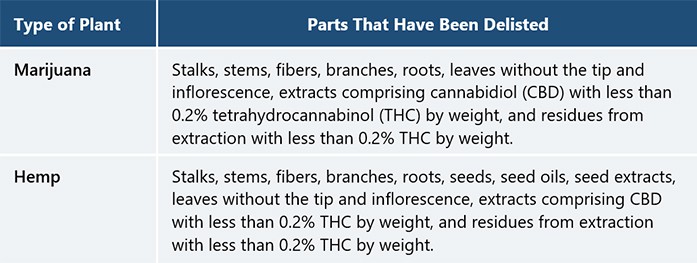
Anyone who wishes to participate in this emerging cannabis industry must be cautious and carefully review the Narcotics Act and its relevant notifications. Although many parts of the cannabis plant were delisted, there some parts remain on the narcotics list (e.g., marijuana seeds, buds, and leaves with cannabis inflorescence or complete cannabis flower head), and the limits on CBD and THC content must be strictly observed.

Importantly, this notification covers only cannabis cultivated in Thailand. Foreign participants are precluded from any participation in an approved cannabis business until a five-year ban on foreign participation—counting from the initial delisting in February 2019—has passed. This means that only the Thai government and its authorized partners have standing to apply for a commercial license until February 20, 2024, which is when foreign parties will be allowed to obtain a commercial cannabis license (subject to any extension or further imposition of restrictions). However, non-commercial licenses (e.g., for research and development) may be issued to Thai applicants.

Despite these limitations, the MOPH notification is another progressive step for driving cannabis research, development, and industry in Thailand. In addition, it delisted other plants that had been classified as category 5 narcotics, including kratom plants (a common plant in Southeast Asia with mild stimulant properties) such as Mitragyna speciosa (Korth.) Havil; opium plants such as Papaver somniferum L. and Papaver bracteatum Lindl.; and fungi of the species Psilocybe cubensis, which contain psilocybin or psilocin. Further notifications on these substances are expected to be issued soon.

The government quickly followed up on the December 14, 2020, notification by publishing another notification on December 30, establishing the criteria for filing applications for licenses to produce, import, export, distribute, and possess hemp (Cannabis sativa) in Thailand. Processing of these applications by the FDA opened on January 29, 2021, for interested Thai citizens and entities under Thai law. Industry operators are now waiting for the Thai FDA’s final promulgation of its own regulations for cannabis licensing to support this development.

Parties interested in entering into this emerging industry should closely monitor the ongoing development of the regulatory regime for cannabis plants in Thailand, as this regime is solidifying rapidly. Those who stay apprised of the situation and remain ready to act when opportunities arise will be able to take full advantage of the new regulatory changes, and in the process will help strengthen a nascent industry in Thailand.

RELATED INSIGHTS​ 

July 6, 2022
Patent is an essential piece of the amended Law on Intellectual Property (“Amended IP Law”), which was passed by the National Assembly of Vietnam on June 16, 2022, and will take effect on January 1, 2023 (except for the regulation on protection of experimental data for agrochemical products, which will take delayed effect on January 14, 2024). Among the amended and supplemented contents of the Amended IP Law, there are notable patent-related amendments to Article 60 on assessing the novelty of inventions and Article 96 on grounds for invalidating patent protection titles. We discuss these changes below. Secret Prior Art Under Article 60.1 A significant amendment to Clause 1, Article 60 of the Amended IP Law on the novelty of inventions is to broaden the scope under which an invention can be considered to have lost its novelty. For the first time in Vietnam, “secret prior art” –a patent application with an earlier filing date or priority date but published on or after the filing date or priority date of an examined patent application – is introduced as a prior art document. In the diagram above, at the time of filing of the A2 application, secret prior art A1 has been filed but not yet published, making it inaccessible to the public. At this point, only the A1 applicant and the IP Office are aware of the A1 application. Under the current provisions of the 2005 IP Law, as amended in 2009 and 2019, the A1 patent application is not eligible to be a prior art document when assessing the novelty of A2. However, based on the “first-to-file principle” and the principle of priority, the IP Office has still had other approaches to bar the patentability of an A2 patent application if there is such an A1 application. By
June 13, 2022
Thailand’s cannabis cultivation licensing scheme for the country’s transition toward legalization of the plant has now come to an end. The Ministry of Public Health (MOPH) announced in the Government Gazette that from June 9, 2022, “only cannabis extract with tetrahydrocannabinol (THC) of more than 0.2% by weight will be considered a narcotic.” This means that now anyone can grow, sell, or purchase cannabis seeds, plants, and inflorescence freely in Thailand, and licenses for the cultivation, possession, and distribution of cannabis are no longer required. Neither the number of cannabis plants nor the place of cultivation is restricted. It is thus the beginning of a new chapter for cannabis cultivation in Thailand, with many opining that now is a good time to enter this exciting and growing industry. The journey to this point began in 2019, when Thailand amended its laws on cannabis to allow for treatment for medical purposes, with one of the prerequisite conditions being that the cannabis must be grown in Thailand. The law was further amended to promote commercialization of the cannabis industry, allowing for cannabis to be added to food and beverages, cosmetics, and herbal products. In addition, three traditional cannabis-based formulas were listed in the universal healthcare coverage scheme, which means that almost all Thais have access to traditional cannabis recipes without cost. The successful launch of medical cannabis and its applications, and its viability as an economic industry, have become a national agenda and priority policy of the MOPH. In order to achieve the above outcomes, several legal frameworks and guidelines throughout the product’s lifecycle have been developed. For example, the Thai Food and Drug Administration (FDA) has so far granted licenses to cultivate cannabis (also known as a license to manufacture a narcotic) on more than 1,977 acres (around 800 hectares).
April 19, 2022
New technologies and production processes in the food industry have led to novel foods becoming increasingly important to both food manufacturers and the consuming public worldwide. This is very much the case across a number of jurisdictions in Southeast Asia. “Novel foods” refer to new food production processes, foods, and ingredients that have not yet been commonly used for human consumption, so these innovative foods require safety assessments before companies can produce and market them. While rules for these safety assessments are already part of novel food regulations in several other jurisdictions—such as the novel food regulations in the United Kingdom and European Union adopted in 2003, and the major reform of food safety laws in the United States passed in 2011 under the Food Modernization Act—similar rules governing the assessment of novel foods are relatively new or yet to be introduced in many parts of Asia. Nevertheless, it is important to understand the laws and practices that apply to safety assessments and the process of bringing novel foods to market in jurisdictions in the region. This article provides some clarity in this regard by summarizing important practical information on novel foods and the relevant required safety assessments in Indonesia, Thailand, and Vietnam.   Indonesia Regulator National Agency for Drug and Food Control (NADFC); frequently referred to as BPOM (Badan Pengawas Obat dan Makanan). Relevant Measures BPOM Regulation No. 27 Year 2018 concerning Public Service Standards in BPOM; Decision of the Director of Processed Food Standardization No. HK.02.02.51.511.06.21.21 Year 2021 concerning Public Service Standard Directorate Processed Food Standardization Definitions General “food ingredients” are basic fresh or processed ingredients that can be used to produce food; novel food is any food ingredient not listed in BPOM’s positive list of ingredients. Official Fees None   Process and Timeline Before submitting an
March 31, 2022
Since the onset of the COVID-19 pandemic and the ensuing safety measures, many Thai retailers have shifted their sales toward online platforms. Unsurprisingly, counterfeiters have followed suit. The online sale of counterfeit healthcare and other life sciences products (e.g., food, cosmetics, and medical devices) is an area of significant concern, as it is particularly prevalent, damaging, and complex in relation to Thailand’s laws. This article outlines this type of counterfeiting activity in Thailand and explains some important tools brand owners have for fighting it. Counterfeiting Operations Although illicit operations seek to avoid being identified by authorities and brand owners, investigations by law enforcement and Tilleke & Gibbins on behalf of clients have yielded some insights into how these illegitimate sellers typically operate. Often, consumers are first exposed to these counterfeit life sciences products by paid social media advertisements that link to social media accounts set up by sellers impersonating brand owners. This brand impersonation may include unauthorized use of a trademark or trade name as part of the account name, and unauthorized reproduction of official advertisement artwork or product descriptions, taken directly from the official social media account. From the fake social media account, consumers are usually directed to a merchant website that contains consumer reviews, which are entirely fabricated. While not every counterfeiting operation follows this exact blueprint, employing some variation of these methods lends counterfeiting platforms the ability to proliferate through multiple iterations, as well as believability in the eyes of consumers. How Brand Owners Can Take Action Life sciences brand owners often discover that their products have been targeted by counterfeiters when a counterfeit item injures or negatively impacts a consumer. Thinking that the product is genuine, the consumer may then complain to the brand owner, or worse, file a complaint with the authorities. Many times