
You are using an outdated browser and your browsing experience will not be optimal. Please update to the latest version of Microsoft Edge, Google Chrome or Mozilla Firefox. Install Microsoft Edge

March 2, 2021

Thailand’s Decriminalization of Cannabis Plants

Informed Counsel

The cannabis plant has fascinated many civilizations, societies, and individuals through the centuries with its unique properties, and many have learned how to benefit from these, finding a variety of therapeutic and industrial uses of the plant that, in turn, enhanced domestic economies worldwide. In Thailand, cannabis plants and their derivatives have been used since ancient times as treatment for many diseases, and the plant forms a key ingredient in many Thai traditional medicinal remedies. However, over the past few decades, cannabis usage was seen to change in a way that became incrementally more abusive, resulting in outright prohibition in almost all countries. Thailand was no exception, and in 1979 the Thai government officially enacted the Narcotics Act forbidding the use of cannabis and listing cannabis plants and their derivatives—most notably marijuana (cannabis with psychoactive properties) and hemp (cannabis with limited or no psychoactive properties)—as category 5 narcotics (i.e., prohibited substances).

Despite these restrictions, many Thais continued to use cannabis illegally, and some urged the government to legalize personal and commercial use of cannabis plants and their derivatives. Eventually, some in the Thai government agreed that it was time to consider steps toward legalization, As a result, the government has been taking action to delist cannabis plants from the list of prohibited narcotics since 2018, when a regulation allowed the cultivation of hemp for industrial and non-commercial purposes, such as household cooking and research and development.

The next significant step came in February 2019, when the Narcotics Act (No. 7) was amended, legalizing medical marijuana within certain limitations. In national elections the following month, the Bhumjaithai political party, whose election campaign included a pledge to decriminalize and legalize cannabis plants, won substantial support in parts of the country and chose to join the coalition government, with the Bhumjaithai party leader assuming control of the Ministry of Public Health (MOPH). Since then, the government, with cooperation from the MOPH and the Food and Drug Administration (FDA), has been working to reclassify cannabis products and to issue new regulatory pathways to accommodate these new “cash crops” to boost the domestic economy. Subsequently, a notification was issued in August 2019 that reclassified certain modern drugs, cosmeceuticals, nutraceuticals, cosmetics, and food containing hemp out of the scope of the Narcotics Act. At the same time, cannabis and hemp legalization were also taking a higher profile in the public sphere. For instance, the issue of cannabis legalization was raised and promoted in the election campaigns of early 2019 by one of the large political parties.

After a long interlude (caused primarily by government focus turning to the COVID-19 pandemic and other emergent priorities), a new MOPH notification was published in the Government Gazette on December 14, 2020, expanding the delisting of cannabis from the Narcotics Act to include nearly all parts of cannabis and hemp plants, as detailed in the table below.
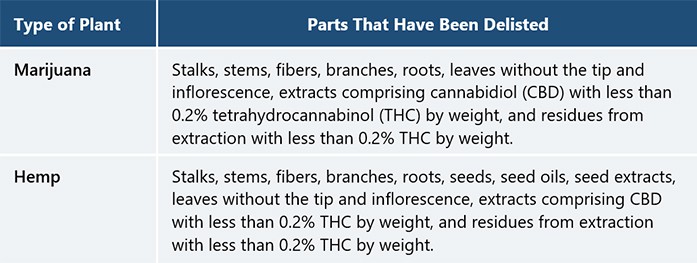
Anyone who wishes to participate in this emerging cannabis industry must be cautious and carefully review the Narcotics Act and its relevant notifications. Although many parts of the cannabis plant were delisted, there some parts remain on the narcotics list (e.g., marijuana seeds, buds, and leaves with cannabis inflorescence or complete cannabis flower head), and the limits on CBD and THC content must be strictly observed.

Importantly, this notification covers only cannabis cultivated in Thailand. Foreign participants are precluded from any participation in an approved cannabis business until a five-year ban on foreign participation—counting from the initial delisting in February 2019—has passed. This means that only the Thai government and its authorized partners have standing to apply for a commercial license until February 20, 2024, which is when foreign parties will be allowed to obtain a commercial cannabis license (subject to any extension or further imposition of restrictions). However, non-commercial licenses (e.g., for research and development) may be issued to Thai applicants.

Despite these limitations, the MOPH notification is another progressive step for driving cannabis research, development, and industry in Thailand. In addition, it delisted other plants that had been classified as category 5 narcotics, including kratom plants (a common plant in Southeast Asia with mild stimulant properties) such as Mitragyna speciosa (Korth.) Havil; opium plants such as Papaver somniferum L. and Papaver bracteatum Lindl.; and fungi of the species Psilocybe cubensis, which contain psilocybin or psilocin. Further notifications on these substances are expected to be issued soon.

The government quickly followed up on the December 14, 2020, notification by publishing another notification on December 30, establishing the criteria for filing applications for licenses to produce, import, export, distribute, and possess hemp (Cannabis sativa) in Thailand. Processing of these applications by the FDA opened on January 29, 2021, for interested Thai citizens and entities under Thai law. Industry operators are now waiting for the Thai FDA’s final promulgation of its own regulations for cannabis licensing to support this development.

Parties interested in entering into this emerging industry should closely monitor the ongoing development of the regulatory regime for cannabis plants in Thailand, as this regime is solidifying rapidly. Those who stay apprised of the situation and remain ready to act when opportunities arise will be able to take full advantage of the new regulatory changes, and in the process will help strengthen a nascent industry in Thailand.

RELATED INSIGHTS​ 

February 14, 2024
Thailand is preparing to implement new rules on drug importation for clinical studies. The Medicines Regulation Department of Thailand’s Food and Drug Administration (Thai FDA) first issued the Notification Re. Detailed Requirements for Drug Importation into Thailand for Clinical Studies almost a year ago, and the notification is expected to come into effect on March 1, 2024. Key Provisions The notification aims at enhancing the efficiency of conducting clinical studies while ensuring the protection of human subjects participating in such studies within Thailand. Some of its key provisions include: Definition of Clinical Study. The notification defines a “clinical study” as a study of a medicine involving human subjects, conducted to provide supporting evidence for the registration of a medicinal product in Thailand or other countries, including for additional indications or variations of a registration dossier. Compliance with ICH GCP. Clinical studies conducted in Thailand must adhere to the current edition of the International Council for Harmonization of Technical Requirements for Pharmaceuticals for Human Use (ICH) Good Clinical Practice (GCP) guidelines. Clinical Trial Application. Sponsors are required to submit a clinical trial application along with supporting documents to the Thai FDA for approval before commencing a clinical study. The permit remains valid for five years and is renewable. Supply of Investigational Drugs. Sponsors must obtain investigational drugs from manufacturers compliant with Good Manufacturing Practice (GMP) standards as recognized by the Thai FDA. Postapproval Obligations. The secretary-general of the Thai FDA may impose postapproval conditions or order investigators to conduct or suspend certain activities to ensure human subject protection and regulatory compliance. Regulatory Oversight. The Thai FDA is responsible for inspecting and overseeing the regulatory compliance of clinical studies, including during prestudy, ongoing, and poststudy phases. The Thai FDA may also conduct inspections of clinical studies conducted overseas. The Thai FDA
December 15, 2023
As part of its membership in Lex Mundi, Tilleke & Gibbins has published an updated edition of its Guide to Doing Business in Thailand for 2023. This guide outlines the key factors for starting and operating a business in the Thai market. Issues covered include: Investment incentives Financial facilities Exchange controls Import and export regulations Structures for doing business Requirements for the Establishment of a Business Operation of the Business Cessation or Termination of the Business Labor legislation, relations, and supply Tax Immigration requirements This publication is part of Lex Mundi’s Country Guides series prepared by member firms in more than 100 jurisdictions worldwide. The guides serve as a useful resource for planning international business strategy and researching new markets. The full Guide to Doing Business in Thailand is available through the button below.
December 6, 2023
New regulatory requirements for medical device registration and notification in Laos are set to enter into force in the coming weeks under the plan found in Notification No. 9606 to implement Decision No. 1470/MOH on Registration and Notification of Medical Devices (Decision 1470). The notification, issued on October 25, 2023, by the Food and Drug Department (FDD) under the Ministry of Health (MOH), outlines the FDD’s strategic plan for phased-in registration and notification requirements for medical devices. In the first phase, starting January 1, 2024, the FDD will initiate the registration process for class C (moderate-high risk) and D (high risk) medical devices. Meanwhile, operators dealing with class A (low risk) and B (low-moderate risk) devices can continue applying for import permits without having to register the devices or notify the FDD. In the subsequent phase, starting January 1, 2025, operators will have to notify the FDD about class A devices and complete the registration process for class B devices. To prepare for these requirements, import-export companies in the pharmaceutical and medical products sector must submit a list of medical devices, including their classification based on the country of manufacture, to the FDD by December 15, 2023. This measure is aimed at enabling the FDD to streamline the collection, guidance, and preparation processes to ensure efficient registration within the set time frame. While import-export companies can still submit their lists after either December 15, 2023, or January 1, 2024 (the registration commencement date), registration may be delayed since the FDD will prioritize those who submit their lists by the December 15 deadline. The list of medical devices should encompass medical devices imported in the past as well as those intended for future import permission applications. During the initial registration stage (i.e., from January 1, 2024), import-export companies that are
October 25, 2023
Cambodia’s Ministry of Health (MOH) continues to increase awareness among the public and private sector of the need for strict healthcare regulations and strict enforcement to advance the quality of the country’s healthcare sector. In April 2023, the MOH issued a notification letter reminding advertisers of health products that they need to obtain a permit before advertising their products in Cambodia. On October 12, 2023, the MOH issued two press releases on continued noncompliance in the healthcare sector. The two press releases address the illegal advertising of both healthcare products and private healthcare services. The releases also address unlicensed healthcare professionals and general noncompliance by private healthcare services. These releases indicate that the MOH, in cooperation with local authorities, will substantially increase its enforcement efforts across Cambodia. Since October 12, several private healthcare clinics have had their operations closed and licenses suspended or revoked, signaling the ministry’s intent to enforce the legal framework. Noncompliant Advertising of Health Products The first press release focuses on the continued illegal advertising of health products and the advertising of unregistered health products. Health products include modern medicines, traditional medicines, health supplements, medical devices, cosmetics, and other products that prevent or treat diseases. The release highlights that the MOH has noticed ongoing unauthorized and illegal advertising, commenting that these are often found online and on social media. The noncompliant advertising referenced in the release includes advertising of health products without the required advertising permit, advertising products that are not properly registered with the MOH, and advertising by unlicensed companies and individuals. The MOH also states in the release that some advertisements are using inappropriate and noncompliant content that is not based on medical science and exaggerates the qualities of the health products—specifically mentioning skin-whitening cosmetics. The ministry’s press release also informs the public of