
You are using an outdated browser and your browsing experience will not be optimal. Please update to the latest version of Microsoft Edge, Google Chrome or Mozilla Firefox. Install Microsoft Edge

March 2, 2021

Thailand’s Decriminalization of Cannabis Plants

Informed Counsel

The cannabis plant has fascinated many civilizations, societies, and individuals through the centuries with its unique properties, and many have learned how to benefit from these, finding a variety of therapeutic and industrial uses of the plant that, in turn, enhanced domestic economies worldwide. In Thailand, cannabis plants and their derivatives have been used since ancient times as treatment for many diseases, and the plant forms a key ingredient in many Thai traditional medicinal remedies. However, over the past few decades, cannabis usage was seen to change in a way that became incrementally more abusive, resulting in outright prohibition in almost all countries. Thailand was no exception, and in 1979 the Thai government officially enacted the Narcotics Act forbidding the use of cannabis and listing cannabis plants and their derivatives—most notably marijuana (cannabis with psychoactive properties) and hemp (cannabis with limited or no psychoactive properties)—as category 5 narcotics (i.e., prohibited substances).

Despite these restrictions, many Thais continued to use cannabis illegally, and some urged the government to legalize personal and commercial use of cannabis plants and their derivatives. Eventually, some in the Thai government agreed that it was time to consider steps toward legalization, As a result, the government has been taking action to delist cannabis plants from the list of prohibited narcotics since 2018, when a regulation allowed the cultivation of hemp for industrial and non-commercial purposes, such as household cooking and research and development.

The next significant step came in February 2019, when the Narcotics Act (No. 7) was amended, legalizing medical marijuana within certain limitations. In national elections the following month, the Bhumjaithai political party, whose election campaign included a pledge to decriminalize and legalize cannabis plants, won substantial support in parts of the country and chose to join the coalition government, with the Bhumjaithai party leader assuming control of the Ministry of Public Health (MOPH). Since then, the government, with cooperation from the MOPH and the Food and Drug Administration (FDA), has been working to reclassify cannabis products and to issue new regulatory pathways to accommodate these new “cash crops” to boost the domestic economy. Subsequently, a notification was issued in August 2019 that reclassified certain modern drugs, cosmeceuticals, nutraceuticals, cosmetics, and food containing hemp out of the scope of the Narcotics Act. At the same time, cannabis and hemp legalization were also taking a higher profile in the public sphere. For instance, the issue of cannabis legalization was raised and promoted in the election campaigns of early 2019 by one of the large political parties.

After a long interlude (caused primarily by government focus turning to the COVID-19 pandemic and other emergent priorities), a new MOPH notification was published in the Government Gazette on December 14, 2020, expanding the delisting of cannabis from the Narcotics Act to include nearly all parts of cannabis and hemp plants, as detailed in the table below.
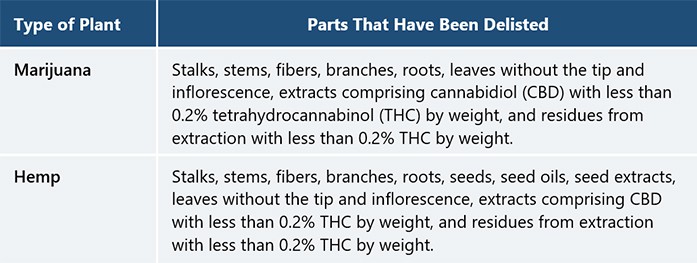
Anyone who wishes to participate in this emerging cannabis industry must be cautious and carefully review the Narcotics Act and its relevant notifications. Although many parts of the cannabis plant were delisted, there some parts remain on the narcotics list (e.g., marijuana seeds, buds, and leaves with cannabis inflorescence or complete cannabis flower head), and the limits on CBD and THC content must be strictly observed.

Importantly, this notification covers only cannabis cultivated in Thailand. Foreign participants are precluded from any participation in an approved cannabis business until a five-year ban on foreign participation—counting from the initial delisting in February 2019—has passed. This means that only the Thai government and its authorized partners have standing to apply for a commercial license until February 20, 2024, which is when foreign parties will be allowed to obtain a commercial cannabis license (subject to any extension or further imposition of restrictions). However, non-commercial licenses (e.g., for research and development) may be issued to Thai applicants.

Despite these limitations, the MOPH notification is another progressive step for driving cannabis research, development, and industry in Thailand. In addition, it delisted other plants that had been classified as category 5 narcotics, including kratom plants (a common plant in Southeast Asia with mild stimulant properties) such as Mitragyna speciosa (Korth.) Havil; opium plants such as Papaver somniferum L. and Papaver bracteatum Lindl.; and fungi of the species Psilocybe cubensis, which contain psilocybin or psilocin. Further notifications on these substances are expected to be issued soon.

The government quickly followed up on the December 14, 2020, notification by publishing another notification on December 30, establishing the criteria for filing applications for licenses to produce, import, export, distribute, and possess hemp (Cannabis sativa) in Thailand. Processing of these applications by the FDA opened on January 29, 2021, for interested Thai citizens and entities under Thai law. Industry operators are now waiting for the Thai FDA’s final promulgation of its own regulations for cannabis licensing to support this development.

Parties interested in entering into this emerging industry should closely monitor the ongoing development of the regulatory regime for cannabis plants in Thailand, as this regime is solidifying rapidly. Those who stay apprised of the situation and remain ready to act when opportunities arise will be able to take full advantage of the new regulatory changes, and in the process will help strengthen a nascent industry in Thailand.

RELATED INSIGHTS​ 

October 25, 2023
One significant development in the health sector in Indonesia is the use of information technology and communication in the implementation of health efforts—particularly digital health services such as telehealth and telemedicine integrated into the country’s National Health Information System. This development was addressed in a major new piece of legislation for the healthcare sector in Indonesia. Enacted in August 2023, Law No. 17 of 2023 concerning Health (the “Health Law”) provides the updates needed to support the development of healthcare services in Indonesia. Under the Health Law, health information system (HIS) providers must: Carry out processing of data and health information in the territory of Indonesia, except for certain limited and specific processing activities that may be conducted outside Indonesia when permitted by the relevant authorities and in compliance with relevant regulations. Ensure the reliability of its HIS, including availability, security, maintenance, and integration with Indonesia’s National Health Information System. Provide quality health data and information. Process data and health information, which includes planning, collection, storage, inspection, transfer, utilization, and destruction. Record its data- and information-processing history. Protect every person’s data and health information. Obtain approval from the relevant personal data subject or comply with relevant regulations if the processing of data and health information involves an individual’s health data. Inform the data owner if there is a failure to protect data and individual health information. The Health Law’s personal data protection requirements listed above appear to be aligned with the provisions in Law No. 27 of 2022 concerning Personal Data Protection (the “PDP Law”). Under this law, data and information relating to health are identified as “specific personal data,” the processing of which carries a high potential risk of impacting the relevant personal data subject. In the implementation of digital health services, patients’ personal data or medical records
October 19, 2023
Cambodia’s Law on Food Safety came into force on June 8, 2022. This law has been widely regarded as a major legal development of the food safety framework in Cambodia, providing new rules, clarifying existing rules, and setting a clear framework for its implementation and enforcement. In addressing some of the key features of this new law shortly after it was passed in 2022, we remarked that we eagerly await implementing regulations. Since then, various regulations have been adopted, such as two regulations (Sub-Decree No. 13 and Prakas No. 80) on food surveillance, recalls, and seizure. These implementing rules are essential in ensuring that enforcement officers can remove noncompliant and unsafe foods from the market. Another key aspect of the Law on Food Safety is that it requires Khmer-language labeling on prepackaged food products. There has been a notable increase in the inclusion of Khmer labeling on food products in the market since June 2022, but noncompliance is still considerable, especially for imported foods. Further interesting labeling rules set by the Law on Food Safety include a requirement to provide nutrition information. This requirement has not yet been widely adopted, with many in the industry highlighting that the details of this labeling requirement are not clear. Indeed, the relevant article of the Law on Food Safety itself only sets the requirement for food products to bear nutrition labeling and does not spell out what detailed information should be provided or in what manner. However, a prakas (ministerial regulation) adopted months prior to the Law on Food Safety does set out clear guidance on nutrition labeling. As long as this earlier regulation is not replaced or abrogated, and as far as it does not conflict with later laws or regulations, it can be relied upon for guidance. What are the
September 20, 2023
Thailand is preparing to open its first renewal period for drug marketing authorizations (MAs) since the passage of the Drug Act (No. 6) B.E. 2562 (2019). Before 2019, MAs for pharmaceuticals and vaccines in Thailand had lifelong validity. The 2019 Drug Act stipulated that all new MAs would be valid for seven years and could be renewed. The 2019 law also set out expiration dates for existing pharmaceutical products registered and approved prior to the implementation of the law (i.e., before October 13, 2019): Drug MAs issued before January 1, 1997, expire on October 13, 2024. Drug MAs approved between January 1, 1997, and December 31, 2007, expire on October 13, 2026. Drug MAs approved between January 1, 2008, and October 13, 2019, expire on October 13, 2028. Based on these dates, the first renewal period for drug MAs will commence in the fourth quarter of 2023. To facilitate the renewal process, the Thai Food and Drug Administration (FDA) has publicized draft regulations and notifications on the required application form and documents, the rules and conditions, and the process for renewing an MA. In May 2023, the Thai FDA issued Ministerial Regulation Re: Renewal of Drug MA Licenses B.E. 2566 (2023) to prescribe the essential requirements for filing a renewal application: To renew a drug MA, holders must submit their renewal application to the Thai FDA within the one-year period before the MA’s expiration date. Renewal applications can only be submitted online via the Thai FDA’s electronic system. The Thai FDA will grant approval for an MA renewal if the following conditions are satisfied: The documents in relation to efficacy and safety are up-to-date, accurate, and in accordance with academic principles. The specification and analytical method comply with the official pharmacopeias as prescribed in the Drug Act, as amended.
September 15, 2023
In May 2023, Thailand issued a regulation on conditional approval for emergency use of medicinal products, replacing a series of similar notifications that had been issued to aid mitigation efforts during the COVID-19 pandemic. During the pandemic, regulatory authorities worldwide—including the Thai Food and Drug Administration (FDA)—reshaped the approval pathway for emergency drugs intended for the treatment of COVID-19. The Thai FDA published five Notifications Re: Conditional Approval for the Emergency Use of Medicinal Products to outline the registration requirements and channels of distribution for drugs intended for the diagnosis, treatment, or prevention of COVID-19. As the threat from COVID-19 was receding, the Thai FDA saw fit to prepare for the potential emergence of other serious communicable diseases by enabling the supply of timely medications for disease diagnosis, treatment, and prevention. The Thai FDA therefore cancelled the five COVID-19-related emergency use notifications, which were published in 2020 and 2022, and replaced them with the Notification Re: Conditional Approval for Emergency Use of Medicinal Products published in May 2023. Under the May 2023 FDA notification on emergency use, conditional approval can be applied to drugs supported by empirical scientific evidence demonstrating their capacity to diagnose, treat, alleviate, cure, or prevent a serious communicable disease. The drugs eligible for approval under this new emergency pathway include novel drugs that are not yet approved in Thailand, as well as existing drugs approved in Thailand but recently discovered to have additional potential indications for the diagnosis, treatment, alleviation, cure, or prevention of a serious communicable disease. Distribution The 2023 FDA notification also clearly defines permissible distribution channels based on the dosage form of drug products: Vaccines can be distributed to governmental organizations that have a duty to prevent or treat diseases, such as the Thai Red Cross Society (TRCS), the Government Pharmaceutical Organization