
You are using an outdated browser and your browsing experience will not be optimal. Please update to the latest version of Microsoft Edge, Google Chrome or Mozilla Firefox. Install Microsoft Edge

March 2, 2021

Thailand’s Decriminalization of Cannabis Plants

Informed Counsel

The cannabis plant has fascinated many civilizations, societies, and individuals through the centuries with its unique properties, and many have learned how to benefit from these, finding a variety of therapeutic and industrial uses of the plant that, in turn, enhanced domestic economies worldwide. In Thailand, cannabis plants and their derivatives have been used since ancient times as treatment for many diseases, and the plant forms a key ingredient in many Thai traditional medicinal remedies. However, over the past few decades, cannabis usage was seen to change in a way that became incrementally more abusive, resulting in outright prohibition in almost all countries. Thailand was no exception, and in 1979 the Thai government officially enacted the Narcotics Act forbidding the use of cannabis and listing cannabis plants and their derivatives—most notably marijuana (cannabis with psychoactive properties) and hemp (cannabis with limited or no psychoactive properties)—as category 5 narcotics (i.e., prohibited substances).

Despite these restrictions, many Thais continued to use cannabis illegally, and some urged the government to legalize personal and commercial use of cannabis plants and their derivatives. Eventually, some in the Thai government agreed that it was time to consider steps toward legalization, As a result, the government has been taking action to delist cannabis plants from the list of prohibited narcotics since 2018, when a regulation allowed the cultivation of hemp for industrial and non-commercial purposes, such as household cooking and research and development.

The next significant step came in February 2019, when the Narcotics Act (No. 7) was amended, legalizing medical marijuana within certain limitations. In national elections the following month, the Bhumjaithai political party, whose election campaign included a pledge to decriminalize and legalize cannabis plants, won substantial support in parts of the country and chose to join the coalition government, with the Bhumjaithai party leader assuming control of the Ministry of Public Health (MOPH). Since then, the government, with cooperation from the MOPH and the Food and Drug Administration (FDA), has been working to reclassify cannabis products and to issue new regulatory pathways to accommodate these new “cash crops” to boost the domestic economy. Subsequently, a notification was issued in August 2019 that reclassified certain modern drugs, cosmeceuticals, nutraceuticals, cosmetics, and food containing hemp out of the scope of the Narcotics Act. At the same time, cannabis and hemp legalization were also taking a higher profile in the public sphere. For instance, the issue of cannabis legalization was raised and promoted in the election campaigns of early 2019 by one of the large political parties.

After a long interlude (caused primarily by government focus turning to the COVID-19 pandemic and other emergent priorities), a new MOPH notification was published in the Government Gazette on December 14, 2020, expanding the delisting of cannabis from the Narcotics Act to include nearly all parts of cannabis and hemp plants, as detailed in the table below.
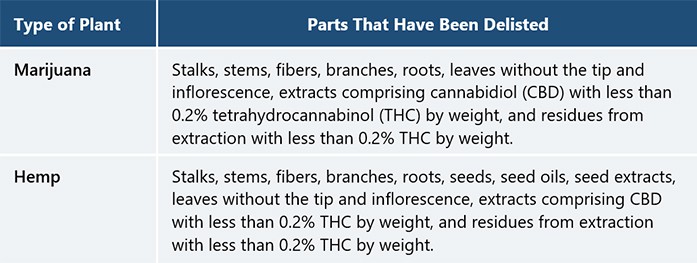
Anyone who wishes to participate in this emerging cannabis industry must be cautious and carefully review the Narcotics Act and its relevant notifications. Although many parts of the cannabis plant were delisted, there some parts remain on the narcotics list (e.g., marijuana seeds, buds, and leaves with cannabis inflorescence or complete cannabis flower head), and the limits on CBD and THC content must be strictly observed.

Importantly, this notification covers only cannabis cultivated in Thailand. Foreign participants are precluded from any participation in an approved cannabis business until a five-year ban on foreign participation—counting from the initial delisting in February 2019—has passed. This means that only the Thai government and its authorized partners have standing to apply for a commercial license until February 20, 2024, which is when foreign parties will be allowed to obtain a commercial cannabis license (subject to any extension or further imposition of restrictions). However, non-commercial licenses (e.g., for research and development) may be issued to Thai applicants.

Despite these limitations, the MOPH notification is another progressive step for driving cannabis research, development, and industry in Thailand. In addition, it delisted other plants that had been classified as category 5 narcotics, including kratom plants (a common plant in Southeast Asia with mild stimulant properties) such as Mitragyna speciosa (Korth.) Havil; opium plants such as Papaver somniferum L. and Papaver bracteatum Lindl.; and fungi of the species Psilocybe cubensis, which contain psilocybin or psilocin. Further notifications on these substances are expected to be issued soon.

The government quickly followed up on the December 14, 2020, notification by publishing another notification on December 30, establishing the criteria for filing applications for licenses to produce, import, export, distribute, and possess hemp (Cannabis sativa) in Thailand. Processing of these applications by the FDA opened on January 29, 2021, for interested Thai citizens and entities under Thai law. Industry operators are now waiting for the Thai FDA’s final promulgation of its own regulations for cannabis licensing to support this development.

Parties interested in entering into this emerging industry should closely monitor the ongoing development of the regulatory regime for cannabis plants in Thailand, as this regime is solidifying rapidly. Those who stay apprised of the situation and remain ready to act when opportunities arise will be able to take full advantage of the new regulatory changes, and in the process will help strengthen a nascent industry in Thailand.

RELATED INSIGHTS​ 

September 16, 2025
Since Thailand formally removed Mitragyna speciosa (kratom) from the list of narcotic drugs, the country has progressed from outright prohibition to a structured, license-based regime. While the Ministry of Public Health oversees cannabis plant regulation, the Ministry of Justice (MOJ) is the regulatory authority overseeing kratom plants. For the avoidance of doubt, separate Ministry of Public Health notifications prohibit the use of kratom as a food ingredient unless a food safety evaluation has been conducted; however, this restriction does not affect trade in unprocessed leaves per se. For businesses in Thailand dealing exclusively in kratom leaves, the most consequential development is the Ministerial Regulation on the Application for Permits and Notifications for the Importation and Exportation of Kratom Leaves B.E. 2568 (2025), a bylaw of the Kratom Plant Act 2022. The ministerial regulation establishes the following notable definitions: “Kratom leaves”: Fresh or dried leaves in their natural, unprocessed state (no extracts, concentrates, or infused products). “Import/Export”: Any act of bringing kratom leaves into or out of Thailand, whether for commercial sale, industrial processing abroad, or research. Import/Export Licensing Under the Kratom Plant Act, a license is mandatory for importing or exporting kratom leaves. Individuals, juristic persons, community enterprises, and state agencies in Thailand are eligible to obtain a license to import (or a license to export) kratom leaves. Licenses are available to qualified individuals and juristic persons. Individuals must satisfy the following qualifications to be eligible for a license: Thai nationality, ≥ 20 years old, resident in Thailand. Not incompetent, quasi-incompetent, or under legal guardianship. No license suspension currently in force under the Kratom Act or Narcotics Code. No license revocation in the previous two years. No conviction under the Kratom Act or Narcotics Code within the previous two years (unless fully released from punishment). Juristic persons must satisfy
September 4, 2025
With advancements in health technology, telemedicine has taken on a wider online presence in Thailand. Under the Medical Facility Act, licensed clinics and hospitals may now diagnose, prescribe, and issue electronic prescriptions during a video call, provided they maintain patient confidentiality and proper recordkeeping. As a complementary concept, a telepharmacy allows a pharmacist to verify prescriptions, counsel patients, and dispense medication from a remote site. Hospitals, clinic chains, and some retail pharmacy groups have adopted “drive-thru” or “locker” pick-up points where drugs are bagged only after a real-time video consultation with a registered pharmacist. The clear benefits of telehealth include shorter waiting times and broader access to specialists, which is in the public interest. Drug Distribution and Advertising in Thailand The online pharmacy ecosystem creates a legal bridge in that once a teleconsulting doctor issues an e-prescription, a licensed pharmacy can lawfully dispense and deliver the medicine prescribed to the patient’s door. Nonetheless, the critical compliance component remains the advertising of medicinal drugs. It is still not allowed to advertise prescription/pharmacy-dispensed drugs to the public in Thailand. Although Thailand’s Drug Act of 1967 was written more than half a century ago, it still governs the trading of every medicinal drug that makes its way to consumers in Thailand—whether bought at a pharmacy or delivered with a few taps on a smartphone. First and foremost, the pharmacy must hold a license to sell medicinal drugs as a retailer. It is also mandatory that arrangements be made for a pharmacist to be on duty during opening hours. Drugs are classified into three main categories: prescription drugs, pharmacy-dispensed drugs, and over-the-counter (OTC) drugs. The listing of OTC drugs with their prices via an online platform is allowed, as only OTC drugs may be advertised directly to the public. However, naming or showing
August 8, 2025
In response to persistent challenges in food safety management and recent high-profile incidents involving counterfeit supplemented foods, infant formula, and health supplements, the Ministry of Health of Vietnam is initiating comprehensive regulatory reforms. These reforms include proposed amendments to the Law on Food Safety and its implementing Decree No. 15/2018/ND-CP (Decree 15), introducing significant changes to the registration procedures for food products, especially supplemented food products and health supplements. While awaiting public consultation and approval of the amended Law on Food Safety, the Ministry of Health is developing an interim mechanism, which includes a draft decree to replace Decree 15 and a draft resolution to address urgent issues until the amended law becomes effective, expected in July 2026. To align with the new Law on Quality of Products and Goods, the draft resolution stipulates that the declaration and registration of food products will follow the following procedures: Declaration of applied standards for food products, which is currently known as the “self-declaration” procedure, applies to processed packaged foods, food additives, food processing aids, containers or utensils that come into direct contact with food, packaging materials in direct contact with food, and micronutrients. Granting of circulation numbers, which is the current “registration of product declaration” procedure, applies to specific categories of food including health supplements, medical nutrition foods, special dietary foods, nutritional products for children up to 36 months, and, especially, supplemented foods, which are currently subject to self-declaration but will be shifted to this registration procedure. In addition, the following new procedure is introduced in the draft decree: Registration of declaration of conformity, which applies to the same product category as in “declaration of applied standards” above, but is for products that are already subject to technical regulations covering both safety indicators and quality indicators. Changes to the Food Product
July 23, 2025
On June 26, 2025, the National Assembly of Vietnam adopted Resolution No. 216/2025/QH15 to extend the duration of agricultural land use tax exemption through December 31, 2030. This policy extension reaffirms the government’s ongoing efforts to support the agricultural sector, ensure national food security, and promote rural development. Key Takeaways Tax Exemption Period Extended: The new resolution continues the full exemption from agricultural land use tax as stipulated under Resolution No. 55/2010/QH12, as amended in 2016 and 2020. The tax exemption, which was originally set to expire at the end of 2025, will now remain in effect until December 31, 2030. Scope of Exemption: The exemption applies to all types of land currently eligible under the existing legal framework for agricultural land use tax relief. This typically includes land used by households, cooperatives, and non-commercial organizations for agricultural production, aquaculture, salt-making, and reforestation. Effective Date: Resolution 216 will take effect on January 1, 2026. During the interim period, tax exemption remains valid under existing laws and resolutions until the end of 2025. Implementation Guidance to Follow: The government is tasked with issuing detailed guidance to ensure effective implementation of this extended exemption. Businesses, cooperatives, and individuals engaged in agricultural activities should monitor upcoming regulations and instructions from relevant ministries. Outlook Vietnam’s extension of agricultural land use tax exemption demonstrates a strong policy commitment to rural economic stability and environmental sustainability. For land users, the exemption represents meaningful financial relief that can be reinvested into modernizing farming techniques, improving land efficiency, or transitioning to sustainable practices. While the extension itself is automatic, it is recommended that agricultural land users and stakeholders review their land use documentation and tax profiles to ensure alignment with eligibility requirements. Future implementation regulations may also introduce new compliance obligations that should be tracked closely.