
You are using an outdated browser and your browsing experience will not be optimal. Please update to the latest version of Microsoft Edge, Google Chrome or Mozilla Firefox. Install Microsoft Edge

March 2, 2021

Thailand’s Decriminalization of Cannabis Plants

Informed Counsel

The cannabis plant has fascinated many civilizations, societies, and individuals through the centuries with its unique properties, and many have learned how to benefit from these, finding a variety of therapeutic and industrial uses of the plant that, in turn, enhanced domestic economies worldwide. In Thailand, cannabis plants and their derivatives have been used since ancient times as treatment for many diseases, and the plant forms a key ingredient in many Thai traditional medicinal remedies. However, over the past few decades, cannabis usage was seen to change in a way that became incrementally more abusive, resulting in outright prohibition in almost all countries. Thailand was no exception, and in 1979 the Thai government officially enacted the Narcotics Act forbidding the use of cannabis and listing cannabis plants and their derivatives—most notably marijuana (cannabis with psychoactive properties) and hemp (cannabis with limited or no psychoactive properties)—as category 5 narcotics (i.e., prohibited substances).

Despite these restrictions, many Thais continued to use cannabis illegally, and some urged the government to legalize personal and commercial use of cannabis plants and their derivatives. Eventually, some in the Thai government agreed that it was time to consider steps toward legalization, As a result, the government has been taking action to delist cannabis plants from the list of prohibited narcotics since 2018, when a regulation allowed the cultivation of hemp for industrial and non-commercial purposes, such as household cooking and research and development.

The next significant step came in February 2019, when the Narcotics Act (No. 7) was amended, legalizing medical marijuana within certain limitations. In national elections the following month, the Bhumjaithai political party, whose election campaign included a pledge to decriminalize and legalize cannabis plants, won substantial support in parts of the country and chose to join the coalition government, with the Bhumjaithai party leader assuming control of the Ministry of Public Health (MOPH). Since then, the government, with cooperation from the MOPH and the Food and Drug Administration (FDA), has been working to reclassify cannabis products and to issue new regulatory pathways to accommodate these new “cash crops” to boost the domestic economy. Subsequently, a notification was issued in August 2019 that reclassified certain modern drugs, cosmeceuticals, nutraceuticals, cosmetics, and food containing hemp out of the scope of the Narcotics Act. At the same time, cannabis and hemp legalization were also taking a higher profile in the public sphere. For instance, the issue of cannabis legalization was raised and promoted in the election campaigns of early 2019 by one of the large political parties.

After a long interlude (caused primarily by government focus turning to the COVID-19 pandemic and other emergent priorities), a new MOPH notification was published in the Government Gazette on December 14, 2020, expanding the delisting of cannabis from the Narcotics Act to include nearly all parts of cannabis and hemp plants, as detailed in the table below.
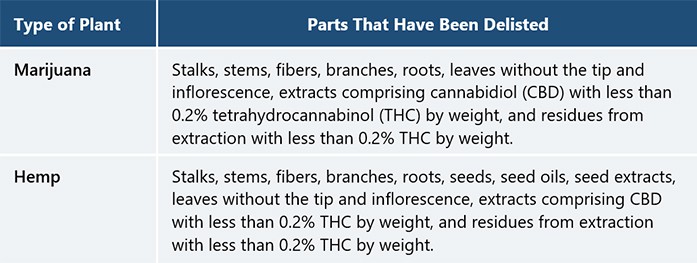
Anyone who wishes to participate in this emerging cannabis industry must be cautious and carefully review the Narcotics Act and its relevant notifications. Although many parts of the cannabis plant were delisted, there some parts remain on the narcotics list (e.g., marijuana seeds, buds, and leaves with cannabis inflorescence or complete cannabis flower head), and the limits on CBD and THC content must be strictly observed.

Importantly, this notification covers only cannabis cultivated in Thailand. Foreign participants are precluded from any participation in an approved cannabis business until a five-year ban on foreign participation—counting from the initial delisting in February 2019—has passed. This means that only the Thai government and its authorized partners have standing to apply for a commercial license until February 20, 2024, which is when foreign parties will be allowed to obtain a commercial cannabis license (subject to any extension or further imposition of restrictions). However, non-commercial licenses (e.g., for research and development) may be issued to Thai applicants.

Despite these limitations, the MOPH notification is another progressive step for driving cannabis research, development, and industry in Thailand. In addition, it delisted other plants that had been classified as category 5 narcotics, including kratom plants (a common plant in Southeast Asia with mild stimulant properties) such as Mitragyna speciosa (Korth.) Havil; opium plants such as Papaver somniferum L. and Papaver bracteatum Lindl.; and fungi of the species Psilocybe cubensis, which contain psilocybin or psilocin. Further notifications on these substances are expected to be issued soon.

The government quickly followed up on the December 14, 2020, notification by publishing another notification on December 30, establishing the criteria for filing applications for licenses to produce, import, export, distribute, and possess hemp (Cannabis sativa) in Thailand. Processing of these applications by the FDA opened on January 29, 2021, for interested Thai citizens and entities under Thai law. Industry operators are now waiting for the Thai FDA’s final promulgation of its own regulations for cannabis licensing to support this development.

Parties interested in entering into this emerging industry should closely monitor the ongoing development of the regulatory regime for cannabis plants in Thailand, as this regime is solidifying rapidly. Those who stay apprised of the situation and remain ready to act when opportunities arise will be able to take full advantage of the new regulatory changes, and in the process will help strengthen a nascent industry in Thailand.

RELATED INSIGHTS​ 

July 15, 2025
On July 1, 2025, Vietnam’s Ministry of Health issued Circular No. 30/2025/TT-BYT providing updated guidance on the application of drug quality standards, testing of drugs and pharmaceutical ingredients, and procedures for the recall and handling of noncompliant drugs (Circular 30). Circular 30 officially came into effect on the same day and replaces Circular No. 11/2018/TT-BYT and its amendments. Key highlights of Circular 30 are presented below. Drug and Pharmaceutical Ingredient Quality Standards Circular 30 maintains consistency with previous regulations regarding the selection of an applicable quality specification. Pharmaceutical businesses and drug preparation establishments may still choose to apply standards from the Vietnamese Pharmacopoeia, reference pharmacopoeias (including the United States Pharmacopoeia, the European Pharmacopoeia, the British Pharmacopoeia, the Japanese Pharmacopoeia, and the International Pharmacopoeia), or an in-house specification. Priority is given to the Vietnamese Pharmacopoeia and reference pharmacopoeias, encompassing quality indicators, quality levels, and testing methods. If alternative pharmacopoeias or in-house specifications are used, they must meet the requirements outlined in the corresponding monographs of the Vietnamese or reference pharmacopoeias. At the time of registration, the quality standards of drugs and pharmaceutical ingredients must comply with either the current version of the pharmacopoeia or a previous version of the pharmacopoeia that is no more than two years older than the current version. The requirement for updating quality specifications in line with the quality under the corresponding pharmacopoeia also applies to products that have already been granted marketing authorization. Testing Drugs and Pharmaceutical Ingredients in Quality Management Similar to the regulations under the previous circular, if pharmaceutical businesses disagree with the sample testing results, they may, within five working days of receiving the test report, request that the state quality inspection authority designate an alternative testing facility. The testing period for establishments listed as foreign drug manufacturers with quality violations remains
July 14, 2025
Life sciences specialists from Tilleke & Gibbins have updated the firm’s guide to pharmaceutical data exclusivity regulations and practices in Southeast Asia. This guide contains quick-reference information on the availability of data exclusivity protections and limitations in Cambodia, Indonesia, Laos, Malaysia, Myanmar, Thailand, and Vietnam. Developing and launching a new drug on a commercial scale requires an enormous amount of time and investment in research and development (R&D), including pre-clinical testing and clinical trials. When considering the aggregate amount of drug development costs, it is important to recognize that this includes not only the investment in developing new drugs that get approved by a government food and drug regulator and are successfully brought to market, but also the R&D expenditures on a large number of potential pharmaceutical compounds and products that never actually make it to market. In particular, considerable investment is required in order to conduct and produce clinical trial data—to prove safety, efficacy and effectiveness of a new drug—that would warrant marketing approval by the regulatory authority. Such data is proprietary in nature and highly valuable for a research-based pharmaceutical company that develops an original drug. On the other hand, patent law typically confers generic drug manufacturers with the ability to engage in various preparatory activities with a view to obtaining marketing approval for a generic product before the patent for the original drug expires (commonly known as a “Bolar provision”). Since a generic drug maker may submit an application for marketing approval of a generic product before the relevant patent expires, the extent to which the drug originator’s data submitted to the regulatory authority is protected—or in other words, the extent to which the generic company may rely on the drug originator’s previously filed data, which underpins the safety and efficacy of the drug, to support
July 8, 2025
On July 3, 2025, Vietnam’s Ministry of Health (MOH) issued Circular No. 34/2025/TT-BYT amending some articles of Circular No. 06/2011/TT-BYT on the management of cosmetics products (Circular 34), which provides the current regulations on the product notification process for cosmetics (cosmetic notification). Circular 34 will come into effect on August 18, 2025. Changes to Cosmetic Notification Some of the key stipulations of Circular 34 are outlined below. Addition of submission route for notification Circular 34 officially adds online submission via the National Public Service Portal as an accepted type of cosmetic notification, in addition to direct submission and submission via post. Clearer regulations on preparing cosmetic notification form Circular 34 provides clarification on the signing requirements for cosmetic notification forms. For online submissions, both e-signatures and digital signatures are accepted. For offline submissions, the circular explicitly states that stamped/generated signatures are not acceptable. There are no substantive changes to existing requirements regarding grouping of products in a single declaration, ingredient listing, or language used in the notification form. Circular 34 only introduces formatting adjustments to these provisions. Updated administrative procedures Circular 34 updates requirements on digital procedures and authentication for online submission with references to new government decrees. In addition, processing timelines for cosmetic notification are further clarified, in particular, five working days for feedback on incomplete dossiers and five working days for approval after receiving complete supplemental dossiers. Revised requirements for import of samples for testing and research An updated Appendix 14-MP form is introduced with Circular 34, in which the receiving authority is updated from the Drug Administration of Vietnam to the specialized health agency under the provincial People’s Committee. Both online and direct submission of the request are allowed. The approval timeline is three working days from the date of reviewing the request. Transition clause Notifications
July 8, 2025
On June 29, 2025, the government of Vietnam issued Decree No. 163/2025/ND-CP providing detailed guidance on the implementation of the amended Law on Pharmacy (Decree 163). Decree 163, like the amended Law on Pharmacy, took effect on July 1, 2025, officially replacing Decree No. 54/2017/ND-CP (Decree 54). The new decree introduces comprehensive regulations across key areas of pharmaceutical management such as pharmacy practice certificates, certificates of eligibility for pharmaceutical business, import and export of drugs and drug materials, GMP inspection of foreign manufacturers, drug and drug material recall, certificates of drug advertising content, and drug price management. Key Changes in Decree 163 Some outstanding changes and additions in Decree 163 are presented below. Destruction of Specially Controlled Drugs It is no longer required to obtain approval from the competent authority before the destruction of narcotic, psychotropic, and precursor drugs, and pharmaceutical ingredients that are narcotic or psychotropic substances, or precursors used in drugs. Instead, notification must be provided at least seven working days in advance, including the proposed destruction date and a detailed list of items to be destroyed. E-commerce in Pharmaceuticals Pharmaceutical businesses operating via e-commerce platforms must publicly disclose the following information to ensure transparency and consumer safety: (i) certificate of eligibility for pharmaceutical business, (ii) pharmacy practice certificate of the person responsible for pharmaceutical expertise, and (iii) drug information. Shelf-Life Requirements for Imported Products For drugs and ingredients with a total shelf life of nine months or less, at least one-third of the shelf life must remain at the time of customs clearance. Drugs with a shelf life of 30 days or less must still be within their shelf life at the time of clearance. Control of Imported Products Drugs subject to import control include all drugs with marketing authorization (MA), except for (i) drugs that