
You are using an outdated browser and your browsing experience will not be optimal. Please update to the latest version of Microsoft Edge, Google Chrome or Mozilla Firefox. Install Microsoft Edge

March 2, 2021

Thailand’s Decriminalization of Cannabis Plants

Informed Counsel

The cannabis plant has fascinated many civilizations, societies, and individuals through the centuries with its unique properties, and many have learned how to benefit from these, finding a variety of therapeutic and industrial uses of the plant that, in turn, enhanced domestic economies worldwide. In Thailand, cannabis plants and their derivatives have been used since ancient times as treatment for many diseases, and the plant forms a key ingredient in many Thai traditional medicinal remedies. However, over the past few decades, cannabis usage was seen to change in a way that became incrementally more abusive, resulting in outright prohibition in almost all countries. Thailand was no exception, and in 1979 the Thai government officially enacted the Narcotics Act forbidding the use of cannabis and listing cannabis plants and their derivatives—most notably marijuana (cannabis with psychoactive properties) and hemp (cannabis with limited or no psychoactive properties)—as category 5 narcotics (i.e., prohibited substances).

Despite these restrictions, many Thais continued to use cannabis illegally, and some urged the government to legalize personal and commercial use of cannabis plants and their derivatives. Eventually, some in the Thai government agreed that it was time to consider steps toward legalization, As a result, the government has been taking action to delist cannabis plants from the list of prohibited narcotics since 2018, when a regulation allowed the cultivation of hemp for industrial and non-commercial purposes, such as household cooking and research and development.

The next significant step came in February 2019, when the Narcotics Act (No. 7) was amended, legalizing medical marijuana within certain limitations. In national elections the following month, the Bhumjaithai political party, whose election campaign included a pledge to decriminalize and legalize cannabis plants, won substantial support in parts of the country and chose to join the coalition government, with the Bhumjaithai party leader assuming control of the Ministry of Public Health (MOPH). Since then, the government, with cooperation from the MOPH and the Food and Drug Administration (FDA), has been working to reclassify cannabis products and to issue new regulatory pathways to accommodate these new “cash crops” to boost the domestic economy. Subsequently, a notification was issued in August 2019 that reclassified certain modern drugs, cosmeceuticals, nutraceuticals, cosmetics, and food containing hemp out of the scope of the Narcotics Act. At the same time, cannabis and hemp legalization were also taking a higher profile in the public sphere. For instance, the issue of cannabis legalization was raised and promoted in the election campaigns of early 2019 by one of the large political parties.

After a long interlude (caused primarily by government focus turning to the COVID-19 pandemic and other emergent priorities), a new MOPH notification was published in the Government Gazette on December 14, 2020, expanding the delisting of cannabis from the Narcotics Act to include nearly all parts of cannabis and hemp plants, as detailed in the table below.
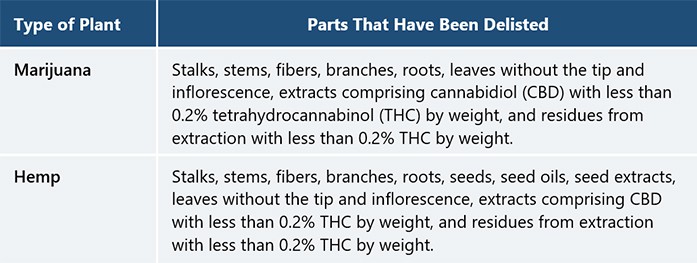
Anyone who wishes to participate in this emerging cannabis industry must be cautious and carefully review the Narcotics Act and its relevant notifications. Although many parts of the cannabis plant were delisted, there some parts remain on the narcotics list (e.g., marijuana seeds, buds, and leaves with cannabis inflorescence or complete cannabis flower head), and the limits on CBD and THC content must be strictly observed.

Importantly, this notification covers only cannabis cultivated in Thailand. Foreign participants are precluded from any participation in an approved cannabis business until a five-year ban on foreign participation—counting from the initial delisting in February 2019—has passed. This means that only the Thai government and its authorized partners have standing to apply for a commercial license until February 20, 2024, which is when foreign parties will be allowed to obtain a commercial cannabis license (subject to any extension or further imposition of restrictions). However, non-commercial licenses (e.g., for research and development) may be issued to Thai applicants.

Despite these limitations, the MOPH notification is another progressive step for driving cannabis research, development, and industry in Thailand. In addition, it delisted other plants that had been classified as category 5 narcotics, including kratom plants (a common plant in Southeast Asia with mild stimulant properties) such as Mitragyna speciosa (Korth.) Havil; opium plants such as Papaver somniferum L. and Papaver bracteatum Lindl.; and fungi of the species Psilocybe cubensis, which contain psilocybin or psilocin. Further notifications on these substances are expected to be issued soon.

The government quickly followed up on the December 14, 2020, notification by publishing another notification on December 30, establishing the criteria for filing applications for licenses to produce, import, export, distribute, and possess hemp (Cannabis sativa) in Thailand. Processing of these applications by the FDA opened on January 29, 2021, for interested Thai citizens and entities under Thai law. Industry operators are now waiting for the Thai FDA’s final promulgation of its own regulations for cannabis licensing to support this development.

Parties interested in entering into this emerging industry should closely monitor the ongoing development of the regulatory regime for cannabis plants in Thailand, as this regime is solidifying rapidly. Those who stay apprised of the situation and remain ready to act when opportunities arise will be able to take full advantage of the new regulatory changes, and in the process will help strengthen a nascent industry in Thailand.

RELATED INSIGHTS​ 

June 4, 2026
Indonesia’s Minister of Health has issued Decree No. HK.01.07/MENKES/301/2026 on the Affixation of Nutritional Labels and Health Information to Ready-to-Eat Processed Food Products. The decree came into force on April 14, 2026, and was issued to implement the Health Law and Minister of Health Regulation No. 3 of 2026 on Disease Control. The decree requires the inclusion of Nutri-Level labeling on the front-of-pack nutrition labeling (FOPNL) to indicate the product’s nutritional level based on the content of sugar, salt, and fat (“gula, garam dan lemak (GGL)”). Changes from 2024 Draft Regulation The Nutri-Level labeling was previously proposed in 2024 by the Indonesian FDA (BPOM) through a draft regulation concerning nutrition information. While the categories of Nutri-Level labeling remain the same in the issued decree, the content requirements of sugar, salt and fat in the decree are different from the earlier proposal introduced in the 2024 draft BPOM regulation. In addition, the decree has further specified that the content of fat in the Nutri-Level labeling is the content of saturated fat, not total fat as previously proposed in the 2024 draft. The decree requires Nutri-Level labeling to be implemented in beverage products, which is the same as previously proposed in the 2024 draft BPOM regulation. Other food products may gradually become subject to mandatory Nutri-Level labeling under future implementing regulations. Nutri-Level Labeling Food levels as shown by the Nutri-Level labeling are classified into four color-coded categories from A to D: Level A (lowest amount) in dark green Level B in light green Level C in yellow Level D (highest amount) in red The Nutri-Level labeling is represented by the following image. The requirements for each level for sugar, salt, and fat content, based on amounts per 100 milliliters of product in beverage form, are as follows. Nutri-Level information must be
May 29, 2026
Indonesia’s Food and Drug Authority (BPOM) has issued Regulation No. 7 of 2026 on Drug Promotion and Advertising, establishing an updated framework for promotional activities involving medicinal products in Indonesia. The regulation took effect on April 16, 2026, and supersedes BPOM Regulation No. 2 of 2021 on Drug Advertising Supervision. The new regulation maintains general principles for advertising content, including requirements that advertisements be objective, complete, and not misleading, as further detailed in its annex. It also confirms that advertisements for nonprescription drugs directed to the public must obtain prior approval from BPOM before publication and must be in Bahasa Indonesia. The regulation provides a more comprehensive framework governing how drug promotion is conducted, introducing several notable additions and changes, as described below. Procedure and Requirements for Drug Advertisement Approval To apply for a drug advertisement approval, applicants must create an online account through the dedicated portal SIAPIK. Advertisement approval is available only for registered drugs; unregistered drugs are not eligible for advertisement approval with BPOM. The application must include the advertisement design, along with a translation if the design contains any wording in a foreign language. The submission format varies by media type, requiring, for example, copies in the form of print advertisements for visual media, scripts for audio media, and storyboards for audiovisual media. For online media—including social media—submissions should include any captions, descriptions, and hashtags that form an integral part of the advertising material. The approval timeline takes approximately 3–4 months, as BPOM will generally request additional information or revisions during the verification and evaluation process. Applicants have 20 days to submit any such requested documents. BPOM may also conduct a reevaluation of advertisements that have already received approval, based on monitoring results or new information regarding the safety and quality of the advertised drug. This
May 11, 2026
Vietnam’s legal framework governing chemicals has undergone significant reform, with the Law on Chemicals No. 69/2025/QH15 (Law on Chemicals 2025) taking effect on January 1, 2026. Together with a comprehensive set of implementing instruments issued in January 2026, including three decrees (No. 24/2026/ND‑CP, No. 25/2026/ND‑CP, and No. 26/2026/ND‑CP) and two circulars (No. 01/2026/TT‑BCT and No. 02/2026/TT‑BCT), the Law on Chemicals 2025 has significantly reshaped chemical registration and management requirements. Determining What Constitutes a “New Chemical” Among the most notable changes introduced under the Law on Chemicals 2025 are the rules governing the registration and management of new chemicals, which must be registered with the authority before being placed on the Vietnam market. Although the concept of new chemical registration was first introduced under the Law on Chemicals 2007, the corresponding registration mechanism has remained largely dormant in practice. Under the Law on Chemicals 2025, a “new chemical” is defined as a substance that is not yet included in Vietnam’s National Chemical Inventory and the list of foreign chemical inventories recognized by the competent Vietnamese authority (List of Foreign Chemicals). On a literal reading, the definition in the new law may suggest that a substance qualifies as a new chemical only if it is absent from both lists. Accordingly, a chemical present in either list should be treated as an existing chemical without the registration burden. However, a different interpretation emerges from Decree 26, which specifically requires registration of “new chemicals” even where such substances already appear in the List of Foreign Chemicals. This implies that inclusion in a recognized foreign inventory does not automatically exempt a substance from new chemical registration in Vietnam. This inconsistency between the statutory definition in the Law on Chemicals 2025 and the implementing provisions of Decree 26 creates significant interpretative and compliance challenges. At
April 29, 2026
Effective June 22, 2026, Thai Industrial Standards (TIS) for food contact paper and cooking paper will be enforced as mandatory for sale in the Thai market. This move has important implications for product licensing and tightens hygiene, labeling, and chemical-safety requirements for food-contact and cooking paper products. Thailand is strengthening its regulatory framework for paper-based culinary materials against a backdrop of accelerating global commitments to ESG and sustainability, as such materials—particularly those derived from natural or recycled fibers—have emerged as key alternatives to plastics in food preparation, cooking, and packaging applications. As a result, regulators worldwide are tightening controls to ensure that sustainability initiatives do not compromise consumer safety, particularly regarding the potential migration of chemical substances into food. Regulatory Framework: Voluntary vs. Mandatory Standards Standards under the TIS regime are generally classified into two categories. Voluntary standards allow manufacturers or importers to apply for a product license and affix the TIS mark to demonstrate product quality and build consumer confidence, but compliance is not legally required. Mandatory standards, by contrast, require manufacturers and importers to obtain a product license and affix the TIS mark before placing products on the Thai market, and noncompliant products cannot be legally sold. Previously, the TIS standards for food contact paper (TIS 2948-2562) and cooking paper (TIS 3438-2022) fell under the voluntary standard regime, meaning that obtaining a TIS license and displaying the TIS mark was optional. However, due to the increasing use of paper in food preparation and cooking, the Thai Industrial Standards Institute has determined that upgrading these standards to mandatory status is necessary to enhance consumer safety. As a result, all paper intended for food contact or cooking purposes must now obtain a TIS product license prior to sale in Thailand. Scope of the Standards The primary distinction between the