
You are using an outdated browser and your browsing experience will not be optimal. Please update to the latest version of Microsoft Edge, Google Chrome or Mozilla Firefox. Install Microsoft Edge

January 8, 2026

Thailand’s Cannabis Reset: Dispensaries to Clinics

Thailand’s approach to cannabis regulation has moved quickly from broad access to a medical, prescription‑only system. The latest government regulation classifies the cannabis flower as a controlled herb under the Thai Traditional Medicine Wisdom Act.

The latest rules ban advertising and recreational sales, allow sales only to patients with prescriptions (up to 30 days), and require flowers to come from GACP‑certified (Good Agricultural and Collection Practices) farms. More importantly, cannabis dispensaries can only sell to patients presenting valid prescriptions issued by one of seven professions—medical doctors, Thai traditional practitioners, applied Thai traditional practitioners, traditional Chinese medicine practitioners, pharmacists, dentists, and folk healers—consistent with approved clinical indications. Noncompliance risks license suspension or revocation, and criminal penalties of up to one year’s imprisonment or a THB 20,000 fine.

The dispensary‑only model that proliferated in Thailand in recent years is expected to end soon, as the rules will push all cannabis dispensaries into medical settings or retail pharmacies. Dispensaries must convert into medical establishments—clinics, pharmacies, or traditional pharmacies—complete with on‑site licensed practitioners as well as budtenders; strong controls for storage, hygiene, odor, and smoke; and facilities for record-keeping. All flowers dispensed or exported must come from GACP‑certified farms.

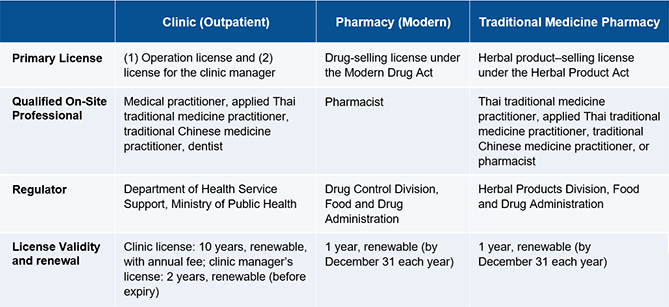
If the government ends dispensaries outright and forces a conversion to clinics or pharmacies, compensation will not be automatic at the outset. As a result, business operators should plan for compliance and repurposing under the Medical Facilities Act, Modern Drug Act, and Herbal Product Act, which regulate medical clinics, modern pharmacies, and traditional medicine pharmacies, respectively. The table below summarizes the required licenses for clinics, pharmacies, and traditional medicine pharmacies selling cannabis flowers in Thailand. Aside from the specific listed licenses, all three types of establishments must also obtain a license to sell a controlled herb (cannabis flowers) from the Department of Thai Traditional and Alternative Medicine. This license is valid for three years and is renewable.
Investors will also need to review contractual allocations of regulatory risk with landlords, lenders, and operators. For investors and operators, value will be concentrated in healthcare‑led platforms. Foreign participants should also account for persistent constraints under the Foreign Business Act when establishing clinics and retail pharmacies.

Outlook

Thailand’s trajectory on recreational cannabis has become volatile. The rules will now channel cannabis flowers into a medical‑only track, with uniform licensing and quality prerequisites. The immediate question for legacy dispensaries is not how long their paper license will remain valid but how quickly they can pivot to a clinic or pharmacy model with on‑site prescribers. Those who execute the pivot successfully will remain in the market, while those who do not adapt quickly enough will likely face suspension or be forced to exit the business.

RELATED INSIGHTS​ 

June 19, 2026
For the first time, Thailand’s Food and Drug Administration (FDA) has published a consolidated list identifying all substances that have successfully passed its novel food safety evaluation process. The list is a step forward in regulatory transparency, but it also highlights a feature of the Thai regime that food companies often overlook: each approval is tied exclusively to the company that applied for it. A substance’s appearance on the list does not give other companies the green light to use it. This article examines the structure of Thailand’s novel food approval framework, the implications of applicant exclusivity, and the strategic choices it requires of food companies looking to bring novel ingredients to the Thai market. Thai FDA Food Safety Evaluation Framework Notification No. 376 of the Ministry of Public Health requires novel food substances to undergo a food safety assessment, with an exemption only for novel foods manufactured exclusively for export. The framework also encompasses “foods that do not qualify as novel foods” but which present characteristics warranting a safety evaluation, such as differing quality standards, increased serving sizes, or applications in specific food categories, where such changes affect consumption levels, nutritional value, or consumer safety. The recently published list of foods that passed the safety evaluation by the Thai FDA is structured by substance category and identifies the approved company (domestic manufacturer or importer), country of origin, substance name and trade name, approved purpose of use, and date of the Thai FDA’s approval notification certificate. A notable feature of Thailand’s novel food regime is that the approval result is tied exclusively to the company that submitted the application. Publication of the consolidated list does not constitute a general authorization to use the approved substances. The Thai FDA’s approval certificate specifies the approved conditions of use and the requirements
June 17, 2026
Thailand’s new labeling requirements for medical devices, which include for the first time a unique device identification (UDI) requirement for software as a medical device (SaMD), take effect on June 20, 2026. The Notification of the Ministry of Public Health regarding Criteria, Methods, and Conditions on Labeling and Instructions for Use for Medical Devices 2025, which replaces a similar notification from 2020, was published in the Government Gazette on December 22, 2025. To ensure clarity, modernity, and patient safety, the regulation requires domestic manufacturers and importers to provide labels and instructions for use (IFU) that are clearly legible, complete, and free of false or misleading claims. It also permits IFU to be provided in electronic format, such as via QR codes, websites, or other digital channels—directly relevant to SaMD, where physical labels are impractical and electronic presentation is the natural medium. The notification distinguishes two categories for labeling language. Home-use medical devices (for lay users outside healthcare facilities) must have labels and IFU in Thai. Professional-use medical devices may display labels and documentation in either Thai or English. This distinction is significant for SaMD developers: software intended for clinical professionals may use English-language interfaces and IFU, while consumer-facing health applications must provide Thai-language content. Labeling and UDI Requirements Labels and IFU must include, at a minimum: Product name and intended purpose Quantity or volume Name and address of domestic manufacturer or importer Thai FDA approval number Lot, version, or serial number Manufacturing date and expiry date For SaMD, the version number requirement is particularly relevant. The regulation also mandates display of a UDI code for SaMD in risk category 2 (moderate-risk), category 3 (moderate- to high-risk), and category 4 (high-risk), according to Thailand’s medical device risk classification system (which complies with the ASEAN Medical Device Directive and the EU
June 5, 2026
On May 25, 2026, Vietnam’s Ministry of Health issued Circular No. 16/2026/TT-BYT governing free-of-charge medicine support programs for medical establishments (Circular 16). Circular 16 will take effect on July 10, 2026, replacing Circular No. 31/2018/TT-BYT, which currently regulates the same subject matter. Circular 16 introduces several significant changes compared to the existing legal framework. Removal of Prior Approval Requirement Under the current regulations, free-of-charge medicine support programs are divided into two categories: (1) entirely free-of-charge provision of medicines for all types of drugs and (2) partially free-of-charge provision applicable only to brand-name drugs under patent protection or drugs whose generic products with identical active ingredients and dosage forms are available in Vietnam. Under the current regulations, partially free-of-charge programs are subject to mandatory registration with the competent authority, while entirely free-of-charge programs could be implemented without prior approval. A key reform under Circular 16 is that it stipulates only entirely free-of-charge medicine support programs applicable to all types of medicines, thereby eliminating the partially free-of-charge category. In addition, free-of-charge medicine support programs may be carried out solely based on a written agreement between the pharmaceutical company and the medical establishment, without any requirement for prior approval from competent authorities prior to implementation. Written Agreement Requirements Circular 16 requires the pharmaceutical company and medical establishment to enter into a written agreement in accordance with a prescribed template. This agreement must include the following compulsory information: Information on the supported medicines Form of support (entirely free-of-charge provision to patients) Quantity of medicines provided Target patient groups and applicable indications Duration of the program Rights and obligations of each party Transitional provisions on the protection of patients’ rights upon completion of the program The agreement may contain other contents as agreed by the parties, provided that these do not contradict applicable laws.
June 4, 2026
Indonesia’s Minister of Health has issued Decree No. HK.01.07/MENKES/301/2026 on the Affixation of Nutritional Labels and Health Information to Ready-to-Eat Processed Food Products. The decree came into force on April 14, 2026, and was issued to implement the Health Law and Minister of Health Regulation No. 3 of 2026 on Disease Control. The decree requires the inclusion of Nutri-Level labeling on the front-of-pack nutrition labeling (FOPNL) to indicate the product’s nutritional level based on the content of sugar, salt, and fat (“gula, garam dan lemak (GGL)”). Changes from 2024 Draft Regulation The Nutri-Level labeling was previously proposed in 2024 by the Indonesian FDA (BPOM) through a draft regulation concerning nutrition information. While the categories of Nutri-Level labeling remain the same in the issued decree, the content requirements of sugar, salt and fat in the decree are different from the earlier proposal introduced in the 2024 draft BPOM regulation. In addition, the decree has further specified that the content of fat in the Nutri-Level labeling is the content of saturated fat, not total fat as previously proposed in the 2024 draft. The decree requires Nutri-Level labeling to be implemented in beverage products, which is the same as previously proposed in the 2024 draft BPOM regulation. Other food products may gradually become subject to mandatory Nutri-Level labeling under future implementing regulations. Nutri-Level Labeling Food levels as shown by the Nutri-Level labeling are classified into four color-coded categories from A to D: Level A (lowest amount) in dark green Level B in light green Level C in yellow Level D (highest amount) in red The Nutri-Level labeling is represented by the following image. The requirements for each level for sugar, salt, and fat content, based on amounts per 100 milliliters of product in beverage form, are as follows. Nutri-Level information must be