
You are using an outdated browser and your browsing experience will not be optimal. Please update to the latest version of Microsoft Edge, Google Chrome or Mozilla Firefox. Install Microsoft Edge

January 8, 2026

Thailand’s Cannabis Reset: Dispensaries to Clinics

Thailand’s approach to cannabis regulation has moved quickly from broad access to a medical, prescription‑only system. The latest government regulation classifies the cannabis flower as a controlled herb under the Thai Traditional Medicine Wisdom Act.

The latest rules ban advertising and recreational sales, allow sales only to patients with prescriptions (up to 30 days), and require flowers to come from GACP‑certified (Good Agricultural and Collection Practices) farms. More importantly, cannabis dispensaries can only sell to patients presenting valid prescriptions issued by one of seven professions—medical doctors, Thai traditional practitioners, applied Thai traditional practitioners, traditional Chinese medicine practitioners, pharmacists, dentists, and folk healers—consistent with approved clinical indications. Noncompliance risks license suspension or revocation, and criminal penalties of up to one year’s imprisonment or a THB 20,000 fine.

The dispensary‑only model that proliferated in Thailand in recent years is expected to end soon, as the rules will push all cannabis dispensaries into medical settings or retail pharmacies. Dispensaries must convert into medical establishments—clinics, pharmacies, or traditional pharmacies—complete with on‑site licensed practitioners as well as budtenders; strong controls for storage, hygiene, odor, and smoke; and facilities for record-keeping. All flowers dispensed or exported must come from GACP‑certified farms.

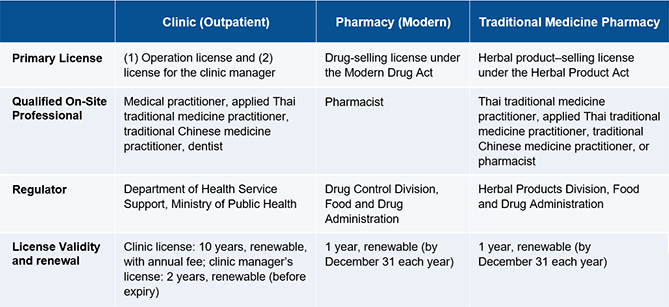
If the government ends dispensaries outright and forces a conversion to clinics or pharmacies, compensation will not be automatic at the outset. As a result, business operators should plan for compliance and repurposing under the Medical Facilities Act, Modern Drug Act, and Herbal Product Act, which regulate medical clinics, modern pharmacies, and traditional medicine pharmacies, respectively. The table below summarizes the required licenses for clinics, pharmacies, and traditional medicine pharmacies selling cannabis flowers in Thailand. Aside from the specific listed licenses, all three types of establishments must also obtain a license to sell a controlled herb (cannabis flowers) from the Department of Thai Traditional and Alternative Medicine. This license is valid for three years and is renewable.
Investors will also need to review contractual allocations of regulatory risk with landlords, lenders, and operators. For investors and operators, value will be concentrated in healthcare‑led platforms. Foreign participants should also account for persistent constraints under the Foreign Business Act when establishing clinics and retail pharmacies.

Outlook

Thailand’s trajectory on recreational cannabis has become volatile. The rules will now channel cannabis flowers into a medical‑only track, with uniform licensing and quality prerequisites. The immediate question for legacy dispensaries is not how long their paper license will remain valid but how quickly they can pivot to a clinic or pharmacy model with on‑site prescribers. Those who execute the pivot successfully will remain in the market, while those who do not adapt quickly enough will likely face suspension or be forced to exit the business.

RELATED INSIGHTS​ 

July 8, 2025
On July 3, 2025, Vietnam’s Ministry of Health (MOH) issued Circular No. 34/2025/TT-BYT amending some articles of Circular No. 06/2011/TT-BYT on the management of cosmetics products (Circular 34), which provides the current regulations on the product notification process for cosmetics (cosmetic notification). Circular 34 will come into effect on August 18, 2025. Changes to Cosmetic Notification Some of the key stipulations of Circular 34 are outlined below. Addition of submission route for notification Circular 34 officially adds online submission via the National Public Service Portal as an accepted type of cosmetic notification, in addition to direct submission and submission via post. Clearer regulations on preparing cosmetic notification form Circular 34 provides clarification on the signing requirements for cosmetic notification forms. For online submissions, both e-signatures and digital signatures are accepted. For offline submissions, the circular explicitly states that stamped/generated signatures are not acceptable. There are no substantive changes to existing requirements regarding grouping of products in a single declaration, ingredient listing, or language used in the notification form. Circular 34 only introduces formatting adjustments to these provisions. Updated administrative procedures Circular 34 updates requirements on digital procedures and authentication for online submission with references to new government decrees. In addition, processing timelines for cosmetic notification are further clarified, in particular, five working days for feedback on incomplete dossiers and five working days for approval after receiving complete supplemental dossiers. Revised requirements for import of samples for testing and research An updated Appendix 14-MP form is introduced with Circular 34, in which the receiving authority is updated from the Drug Administration of Vietnam to the specialized health agency under the provincial People’s Committee. Both online and direct submission of the request are allowed. The approval timeline is three working days from the date of reviewing the request. Transition clause Notifications
July 8, 2025
On June 29, 2025, the government of Vietnam issued Decree No. 163/2025/ND-CP providing detailed guidance on the implementation of the amended Law on Pharmacy (Decree 163). Decree 163, like the amended Law on Pharmacy, took effect on July 1, 2025, officially replacing Decree No. 54/2017/ND-CP (Decree 54). The new decree introduces comprehensive regulations across key areas of pharmaceutical management such as pharmacy practice certificates, certificates of eligibility for pharmaceutical business, import and export of drugs and drug materials, GMP inspection of foreign manufacturers, drug and drug material recall, certificates of drug advertising content, and drug price management. Key Changes in Decree 163 Some outstanding changes and additions in Decree 163 are presented below. Destruction of Specially Controlled Drugs It is no longer required to obtain approval from the competent authority before the destruction of narcotic, psychotropic, and precursor drugs, and pharmaceutical ingredients that are narcotic or psychotropic substances, or precursors used in drugs. Instead, notification must be provided at least seven working days in advance, including the proposed destruction date and a detailed list of items to be destroyed. E-commerce in Pharmaceuticals Pharmaceutical businesses operating via e-commerce platforms must publicly disclose the following information to ensure transparency and consumer safety: (i) certificate of eligibility for pharmaceutical business, (ii) pharmacy practice certificate of the person responsible for pharmaceutical expertise, and (iii) drug information. Shelf-Life Requirements for Imported Products For drugs and ingredients with a total shelf life of nine months or less, at least one-third of the shelf life must remain at the time of customs clearance. Drugs with a shelf life of 30 days or less must still be within their shelf life at the time of clearance. Control of Imported Products Drugs subject to import control include all drugs with marketing authorization (MA), except for (i) drugs that
May 28, 2025
Tilleke & Gibbins attorneys in Vietnam have contributed the 2025 edition of Doing Business in Vietnam, a comprehensive Q&A-style resource from Thomson Reuters Practical Law that provides essential insights for companies navigating business operations in Vietnam. The guide presents a detailed overview of the country’s legal framework and regulatory environment, reflecting recent updates in Vietnamese legislation and practice. This annually updated guide offers key information on the following areas: Legal system: Structure of the Vietnamese judiciary and the role of codified law. Foreign investment: Conditions for market access, licensing requirements, foreign ownership restrictions, and investment incentives. Business vehicles: Formation and operation of legal entities, including limited liability companies, joint-stock companies, and representative offices. Employment: Employment contracts, social insurance, labor rights, and procedures for hiring foreign nationals. Tax: Overview of corporate income tax, personal income tax, value-added tax, and other tax obligations. Intellectual property: Procedures for protecting and enforcing patents, trademarks, copyrights, and other IP rights. Data protection: Compliance requirements under Vietnam’s data privacy laws, including the Personal Data Protection Decree. Competition law: Antitrust rules and regulatory oversight under the Law on Competition. Anti-bribery and corruption: Legal framework and enforcement practices aimed at curbing corrupt activities. E-commerce and digital business: Regulations governing online platforms, digital content, and cross-border services. Marketing and advertising: Laws and guidelines on advertising standards and consumer protection. Product regulation and liability: Safety requirements, product liability issues, and roles of relevant authorities. Doing Business in Vietnam is part of Practical Law’s global series of legal guides designed to support international practitioners and businesses. To access the most recent edition of the Vietnam guide, visit the Practical Law website and sign up for a free trial.
May 28, 2025
Thailand’s Food and Drug Administration (FDA) has launched a strategic collaboration with leading e-commerce platforms Lazada and Shopee to strengthen regulatory oversight of health-related products sold online. This partnership is part of a broader initiative to enhance consumer protection, enforce compliance with Thai health regulations, and foster a safer digital marketplace for health products. As part of this initiative, the Thai FDA is urging all sellers—particularly cross-border vendors—to secure proper FDA registration for their products before market entry. The objective is to ensure that only legally authorized, safe, and quality-assured healthcare products are available to Thai consumers. In pursuit of this goal, the FDA has been working closely with Lazada and Shopee to implement proactive surveillance mechanisms aimed at identifying and removing noncompliant, substandard, or unregistered products. This collaboration has already yielded measurable results. Between September 2023 and 2024, Lazada supported regulatory enforcement by removing 9,454 noncompliant listings and delisting 30 vendors. In addition, 134 sellers were subjected to legal proceedings for regulatory violations. Shopee has taken a similarly rigorous stance, committing to the immediate removal of products found to be in breach of FDA regulations. The platform has also provided educational materials for merchants and implemented consumer complaint mechanisms to enhance accountability. Looking ahead, the Thai FDA plans to roll out a data integration system utilizing API technology, enabling seamless and secure exchange of regulatory data between the agency and e-commerce platforms. This system will be supported by comprehensive training for both Thai FDA officials and e-commerce staff, with a particular focus on the use of the Thai government’s Law Enforcement Request Portal, a secure communication channel for coordinating enforcement actions between government agencies and platform operators. Additionally, a joint product inspection framework is currently under development in partnership with Lazada and Shopee. This framework will incorporate strict