
You are using an outdated browser and your browsing experience will not be optimal. Please update to the latest version of Microsoft Edge, Google Chrome or Mozilla Firefox. Install Microsoft Edge

January 8, 2026

Thailand’s Cannabis Reset: Dispensaries to Clinics

Thailand’s approach to cannabis regulation has moved quickly from broad access to a medical, prescription‑only system. The latest government regulation classifies the cannabis flower as a controlled herb under the Thai Traditional Medicine Wisdom Act.

The latest rules ban advertising and recreational sales, allow sales only to patients with prescriptions (up to 30 days), and require flowers to come from GACP‑certified (Good Agricultural and Collection Practices) farms. More importantly, cannabis dispensaries can only sell to patients presenting valid prescriptions issued by one of seven professions—medical doctors, Thai traditional practitioners, applied Thai traditional practitioners, traditional Chinese medicine practitioners, pharmacists, dentists, and folk healers—consistent with approved clinical indications. Noncompliance risks license suspension or revocation, and criminal penalties of up to one year’s imprisonment or a THB 20,000 fine.

The dispensary‑only model that proliferated in Thailand in recent years is expected to end soon, as the rules will push all cannabis dispensaries into medical settings or retail pharmacies. Dispensaries must convert into medical establishments—clinics, pharmacies, or traditional pharmacies—complete with on‑site licensed practitioners as well as budtenders; strong controls for storage, hygiene, odor, and smoke; and facilities for record-keeping. All flowers dispensed or exported must come from GACP‑certified farms.

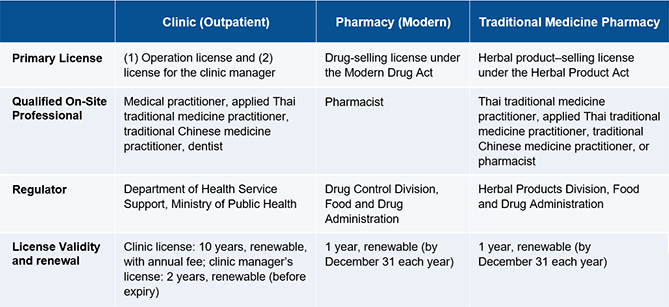
If the government ends dispensaries outright and forces a conversion to clinics or pharmacies, compensation will not be automatic at the outset. As a result, business operators should plan for compliance and repurposing under the Medical Facilities Act, Modern Drug Act, and Herbal Product Act, which regulate medical clinics, modern pharmacies, and traditional medicine pharmacies, respectively. The table below summarizes the required licenses for clinics, pharmacies, and traditional medicine pharmacies selling cannabis flowers in Thailand. Aside from the specific listed licenses, all three types of establishments must also obtain a license to sell a controlled herb (cannabis flowers) from the Department of Thai Traditional and Alternative Medicine. This license is valid for three years and is renewable.
Investors will also need to review contractual allocations of regulatory risk with landlords, lenders, and operators. For investors and operators, value will be concentrated in healthcare‑led platforms. Foreign participants should also account for persistent constraints under the Foreign Business Act when establishing clinics and retail pharmacies.

Outlook

Thailand’s trajectory on recreational cannabis has become volatile. The rules will now channel cannabis flowers into a medical‑only track, with uniform licensing and quality prerequisites. The immediate question for legacy dispensaries is not how long their paper license will remain valid but how quickly they can pivot to a clinic or pharmacy model with on‑site prescribers. Those who execute the pivot successfully will remain in the market, while those who do not adapt quickly enough will likely face suspension or be forced to exit the business.

RELATED INSIGHTS​ 

January 5, 2026
On December 31, 2025, Vietnam’s Ministry of Health (MOH) issued Circular No. 57/2025/TT-BYT providing guidance on the classification of medical devices according to technical standards and quality requirements (Circular 57), applicable to procurement activities for medical devices in Vietnam. According to the MOH, the purpose of the classification is to establish a principle-based legal framework and regulations that enable purchasers to easily identify groups of medical devices aligned with their professional requirements and financial capacity. Some of the key stipulations of Circular 57 are outlined below. Basis for Determining Technical Standards and Quality Under Circular 57, the technical standards of medical devices are determined in accordance with Vietnamese laws on standards and technical regulations, through the following means: Certification of conformity with standards in accordance with Vietnamese laws on standards and technical regulations; Results of conformity assessment conducted by an internationally recognized conformity assessment organization or a legally established domestic or foreign conformity assessment organization operating in Vietnam; and Documentation evidencing compliance provided by the medical device owner. The quality of medical devices is determined based on whether the device has been approved for circulation by the relevant marketing authority of one or more jurisdictions. Classification of Medical Devices Circular 57 classifies medical devices into six groups (from Group 1 to Group 6) based on technical standards and quality. Medical devices subject to classification must simultaneously meet technical standards and quality requirements in accordance with professional specifications and user needs, and must be lawfully marketed in Vietnam. Medical devices manufactured in Vietnam may participate in all corresponding groups, provided they meet the technical standards required by the user and are lawfully marketed in Vietnam. Outlook Circular No. 57 will take effect on February 15, 2026, while the classification requirements will become effective on January 1, 2027. Holders of medical
December 30, 2025
The Intellectual Property Office of Vietnam (IP Office), with support from the Japan International Cooperation Agency (JICA), is drafting additional annexes to its Guidelines for Patent Examination, focusing on the examination of patent applications in the pharmaceutical and biotechnology sectors. The new annexes are expected to be officially issued in early 2026 as Annexes III and IV, following the successful issuance in 2023 of Annexes I and II addressing computer program-related inventions. The IP Office recently organized a seminar to gather feedback on the draft annexes from intellectual property representatives, academic institutions, research institutes, and other interested parties, emphasizing its intention to receive further constructive opinions to refine the guidelines for pharmaceuticals and biotechnology. Why These Guidelines Matter Patent examination in Vietnam has traditionally relied on the Guidelines for Patent Examination issued under Decision No. 487/QD-SHTT (2010), recently supplemented by Annexes I and II. While these documents provide a solid foundation, they do not fully address practical challenges in examining pharmaceutical and biotech inventions, particularly issues related to clarity, sufficiency of disclosure, enablement, features of function and utility, combination therapies, and inventions involving artificial intelligence (AI) applications in these fields. Annexes III and IV aim to close these gaps by introducing structured principles and illustrative examples. Guidance on Patent Specification Requirements Annex III provides detailed guidance on the requirements for patent specifications in pharmaceuticals and biotechnology, covering two main parts: Part A addresses sufficiency of disclosure, clarity of specifications, and consistency between claims and descriptions. Part B covers inventions related to Markush-type compounds, claims containing exclusion statements (disclaimers), and additional experimental data submitted during examination. The Guidelines outline specific disclosure requirements for subject matters such as compounds, formulations, pharmaceutical compositions, genes, polypeptides, proteins, vectors, transgenic organisms, modified organisms, and hybrid cells. Annex III emphasizes that disclaimers are not accepted
November 25, 2025
Food safety incidents can emerge without warning, requiring businesses to act swiftly to protect consumers and comply with regulatory obligations. Across Southeast Asia, Thailand, Vietnam, and Indonesia have each developed comprehensive food recall frameworks designed to ensure rapid removal of unsafe products from the market while holding businesses accountable for compliance failures. While these three jurisdictions share common objectives—protecting public health and ensuring food safety—each has crafted distinct regulatory approaches reflecting their unique administrative structures, enforcement priorities, and legal traditions. Understanding these differences is essential for food businesses operating in the region, as recall procedures, timelines, reporting requirements, and penalties vary significantly across borders. This guide, available through the button below, examines the food recall regulations in Indonesia, Thailand, and Vietnam, providing practical guidance on legal requirements, procedural steps, and compliance obligations in each market.