Thailand’s approach to cannabis regulation has moved quickly from broad access to a medical, prescription‑only system. The latest government regulation classifies the cannabis flower as a controlled herb under the Thai Traditional Medicine Wisdom Act.
The latest rules ban advertising and recreational sales, allow sales only to patients with prescriptions (up to 30 days), and require flowers to come from GACP‑certified (Good Agricultural and Collection Practices) farms. More importantly, cannabis dispensaries can only sell to patients presenting valid prescriptions issued by one of seven professions—medical doctors, Thai traditional practitioners, applied Thai traditional practitioners, traditional Chinese medicine practitioners, pharmacists, dentists, and folk healers—consistent with approved clinical indications. Noncompliance risks license suspension or revocation, and criminal penalties of up to one year’s imprisonment or a THB 20,000 fine.
The dispensary‑only model that proliferated in Thailand in recent years is expected to end soon, as the rules will push all cannabis dispensaries into medical settings or retail pharmacies. Dispensaries must convert into medical establishments—clinics, pharmacies, or traditional pharmacies—complete with on‑site licensed practitioners as well as budtenders; strong controls for storage, hygiene, odor, and smoke; and facilities for record-keeping. All flowers dispensed or exported must come from GACP‑certified farms.
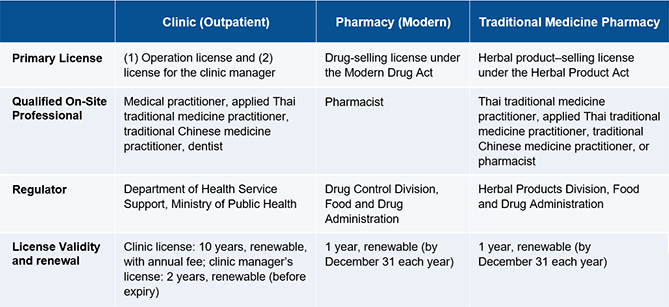
If the government ends dispensaries outright and forces a conversion to clinics or pharmacies, compensation will not be automatic at the outset. As a result, business operators should plan for compliance and repurposing under the Medical Facilities Act, Modern Drug Act, and Herbal Product Act, which regulate medical clinics, modern pharmacies, and traditional medicine pharmacies, respectively. The table below summarizes the required licenses for clinics, pharmacies, and traditional medicine pharmacies selling cannabis flowers in Thailand. Aside from the specific listed licenses, all three types of establishments must also obtain a license to sell a controlled herb (cannabis flowers) from the Department of Thai Traditional and Alternative Medicine. This license is valid for three years and is renewable.
Investors will also need to review contractual allocations of regulatory risk with landlords, lenders, and operators. For investors and operators, value will be concentrated in healthcare‑led platforms. Foreign participants should also account for persistent constraints under the Foreign Business Act when establishing clinics and retail pharmacies.
Outlook
Thailand’s trajectory on recreational cannabis has become volatile. The rules will now channel cannabis flowers into a medical‑only track, with uniform licensing and quality prerequisites. The immediate question for legacy dispensaries is not how long their paper license will remain valid but how quickly they can pivot to a clinic or pharmacy model with on‑site prescribers. Those who execute the pivot successfully will remain in the market, while those who do not adapt quickly enough will likely face suspension or be forced to exit the business.