You are using an outdated browser and your browsing experience will not be optimal. Please update to the latest version of Microsoft Edge, Google Chrome or Mozilla Firefox. Install Microsoft Edge

December 29, 2022

Thailand Unveils New Land and Building Tax Rate Reductions and Deadline Extensions

On December 20, 2022, Thailand’s cabinet approved draft legislation providing further Land and Building Tax reductions of 15% in 2023, on top of current reductions in tax rates, on some types of taxable property. When enacted, the legislation will provide further tax reductions only for the property types in the table below.
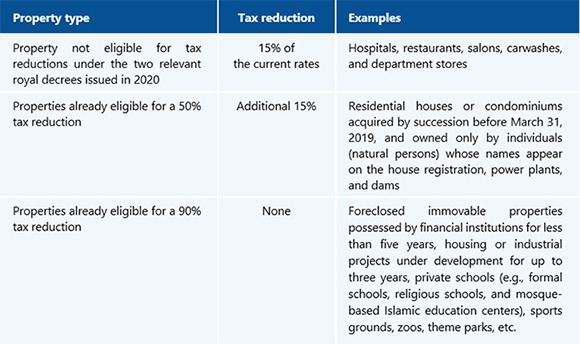
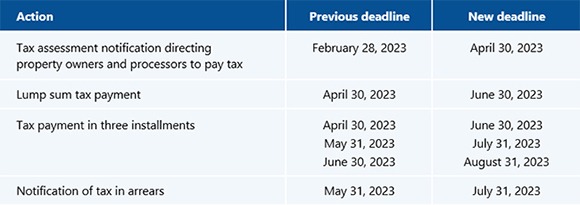
Moreover, in early December, Thailand’s Ministry of Interior promulgated an announcement extending the deadline for tax assessment notification and tax payment (including by scheduled installments) by another two months from the previous statutory deadline of December 20, 2022. The key deadline extensions are shown in the table below.
The Land and Building Tax is a property tax collected annually, with rates varying based on the purpose of use—agricultural, commercial, industrial, or residential. Owners or possessors of land or buildings are liable for Land and Building Tax, which is computed based on the officially appraised value of the property.

For more information on Thailand’s Land and Building Tax, please contact Auaychai Sukawong at [email protected] or Chaiwat Keratisuthisathorn at [email protected].

RELATED INSIGHTS​ 

November 13, 2023
On November 6, 2023, Thailand’s Department of Lands issued a circular letter clarifying that the use of units in condominium buildings for hotel business operations is not allowed. Circular Letter No. Mor Tor 0517.3/Wor 23302, which was sent to all provincial governors in Thailand, explains this by emphasizing that although the Condominium Act (No. 4) B.E. 2551 (2008) rules that some condominium units can be used for commercial operations purposes, the term “commercial operations” does not include hotel business operations. This is in accordance with the Condominium Act’s primary aim of safeguarding the rights of condominium unit owners for residential purposes rather than for the purpose of commercial or hotel business operations. The circular letter also references Opinion of the Council of State No. 710/2550, which specifies that the commercial operations allowed under the Condominium Act are those providing services to the co-owners of a condominium building (e.g., convenience stores and restaurants) and further specifies that these commercial condominium unit areas must have separate exits and entrances that do not disturb the residents of the condominium building. In light of these considerations, using a condominium building for hotel business operations is not permissible, regardless of whether consent is obtained from the co-owners of the condominium building or whether the condominium building’s purpose is changed from residential to hotel purposes (whether in whole or in part). To use a condominium building for hotel business operations, the building owner would have to first cancel the condominium building’s registration under the Condominium Act so that it is no longer regarded as a condominium building. Then it can be used for hotel business operations, provided that the building and business operator comply with the requirements under the hotel law and other relevant laws and regulations (e.g., Building Control Act, Town and Country Planning
November 1, 2023
The commercial real estate sector in Southeast Asia is a dynamic and innovative space, but businesses also face an array of complex legal challenges. With real estate investments transcending borders and regulations, businesses in the region confront a legal environment that demands a clear understanding of the rules and procedures in each jurisdiction. Authored by legal experts at Tilleke & Gibbins, Commercial Real Estate Law in Southeast Asia is a comprehensive resource that addresses the legal issues relevant to enterprises involved in the commercial real estate sector. The guide explores the nuances of commercial real estate law in Cambodia, Laos, Myanmar, Thailand, and Vietnam, providing an overview of the regulatory framework and legal environment governing property transactions in these countries. Within the guide, readers will find detailed sections dedicated to each country, offering in-depth insights into the legal instruments, regulatory authorities, and procedural requirements that shape the commercial real estate landscape. Each section outlines the real estate activities that are permissible, those that are restricted, and the associated liabilities and penalties for noncompliance. The full Commercial Real Estate Law in Southeast Asia guide is available through the button below.
October 30, 2023
On October 9, 2023, Laos issued Presidential Decree No. 003, which raised excise tax rates for certain goods, effective immediately. The move to increase excise tax rates comes amid the marked depreciation of the Lao kip (LAK). The Lao government is trying to monitor and discourage imports of non-essential products in order to reduce the outflow of foreign currency from the country. Increasing the tax rate for some of these products is part of these efforts. The specific products and excise tax rates are listed in the table below.   This new rate policy is also in line with recent government efforts to encourage avoiding payment in foreign currency to prevent the depletion of foreign currency reserves in Laos. In this regard, commercial banks have already taken action to ration the supply of foreign currency by prioritizing imports of essential goods, such as fuel. The products listed above formalize this impetus to prioritize certain imports and discourage others deemed not essential. In addition, the increased excise tax rates on fuel-powered vehicles show the commitment of the Lao government to move toward electric vehicles, which would also lessen the country’s dependence on fuel imports. For more information on these excise tax changes, or on any aspect of Laos’ international trade regulations, please contact Tilleke & Gibbins at [email protected].
October 16, 2023
On September 15, Revenue Departmental Order No. Por. 161/2566 was published, fundamentally changing how Thailand tax residents’ offshore-sourced income will be taxed. Under the order, starting from January 1, 2024, the offshore-sourced income of tax residents will be subject to Thai personal income tax (PIT) in any year that it is brought into Thailand. The purpose of this new rule is to ensure consistent tax collection practices among tax officers and to tackle tax avoidance strategies commonly used by individual taxpayers. PIT on Offshore-Sourced Income According to the resident rule in Thailand’s Revenue Code, Thailand tax residents (i.e., persons who reside in Thailand for at least 180 days in a calendar year) are subject to PIT on their domestic-sourced and offshore-sourced income. “Offshore-sourced income” is broadly defined to include income from work, business, or assets outside Thailand. Existing Practice Currently, Thailand tax residents’ offshore-sourced income is exempted from PIT if it is brought into Thailand after the calendar year in which it was earned. This exemption was adopted 28 years ago in the Revenue Department’s interpretation stated in a resolution from February 1985. This exemption by interpretation has led some Thailand tax residents to avoid PIT by simply holding their newly earned offshore-sourced income abroad temporarily and then bringing it into Thailand at a later time. Through the years, a number of tax rulings have affirmed this practice. New PIT Collection Rules for Offshore-Sourced Income Revenue Departmental Order No. Por. 161/2566 simply revokes the favorable exemption adopted under the February 1985 resolution so that the delay tactic is no longer able to succeed in avoiding tax. Starting from January 1, 2024, the offshore-sourced income of Thailand tax residents will be subject to PIT whenever it is brought into Thailand, at which time the offshore-sourced income must be declared to