You are using an outdated browser and your browsing experience will not be optimal. Please update to the latest version of Microsoft Edge, Google Chrome or Mozilla Firefox. Install Microsoft Edge

December 29, 2022

Thailand Unveils New Land and Building Tax Rate Reductions and Deadline Extensions

On December 20, 2022, Thailand’s cabinet approved draft legislation providing further Land and Building Tax reductions of 15% in 2023, on top of current reductions in tax rates, on some types of taxable property. When enacted, the legislation will provide further tax reductions only for the property types in the table below.
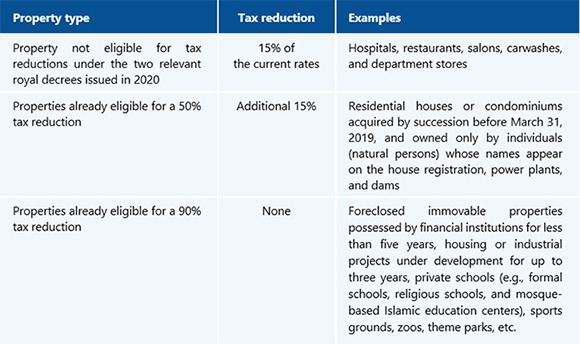
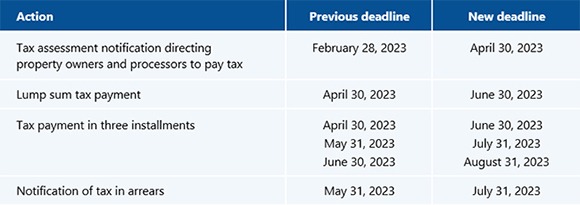
Moreover, in early December, Thailand’s Ministry of Interior promulgated an announcement extending the deadline for tax assessment notification and tax payment (including by scheduled installments) by another two months from the previous statutory deadline of December 20, 2022. The key deadline extensions are shown in the table below.
The Land and Building Tax is a property tax collected annually, with rates varying based on the purpose of use—agricultural, commercial, industrial, or residential. Owners or possessors of land or buildings are liable for Land and Building Tax, which is computed based on the officially appraised value of the property.

For more information on Thailand’s Land and Building Tax, please contact Auaychai Sukawong at [email protected] or Chaiwat Keratisuthisathorn at [email protected].

RELATED INSIGHTS​ 

November 21, 2025
On November 17, 2025, Thailand’s Ministry of Interior introduced significant regulatory changes to make rooftop solar adoption easier and more cost-effective for property owners. Ministerial Regulation No. 72 B.E. 2568 (2025), issued under the Building Control Act B.E. 2522 (1979), was published in the Government Gazette on November 19, 2025, with immediate effect. Background Under the Building Control Act (BCA), any alteration made to a building requires either notification of the relevant authority or application for a building alteration permit—unless the alteration falls under a separate list of exceptions specified in the ministerial regulations issued under the BCA. In 2015, installation of solar rooftops on any residential building under 160 square meters was added to this list of exceptions, subject to inspection and notification requirements. The newly enacted regulation now eliminates many of these requirements and introduces a broader and more permissive framework to promote solar adoption nationwide. Key Changes Specifically, the regulation introduces three major changes: Expanded exemption from the definition of “building alteration”: The installation of solar panels on any building roof—regardless of the type of building or the total area of the installation—is no longer considered a building alteration under the BCA, provided that the total weight of the installation does not exceed 20 kg/m2. Removal of structural integrity certification requirement: The new regulation eliminates the obligation to obtain a structural stability certificate from a licensed civil engineer. Removal of notification requirement: Property owners or possessors are no longer required to notify the local authority before installation of a solar rooftop. Impact This significant streamlining of requirements for solar rooftop installation is expected to accelerate the adoption of renewable energy in the country, particularly for residential and commercial properties—similar to the way Thailand’s December 2024 removal of licensing requirements for factory solar rooftop installations encouraged such
November 14, 2025
Interest in data center land acquisition has increased significantly over the past year, with a notable rise in inquiries from investors seeking to establish digital infrastructure in Thailand. Although the sector is still in its early stages, this emerging wave of development represents a significant shift in Thailand’s technology infrastructure landscape, driven primarily by multinational technology companies and operators looking to expand their regional presence. Project Development The data center sector in Thailand is attracting a diverse range of international investors, though with clear geographic patterns. Most investors are from China, Singapore, and Japan, with some additional interest from countries outside Asia, including the United States and Europe. This investor base consists primarily of multinational tech companies and operators seeking to establish new facilities rather than acquire existing assets. Data center business activities are also a sector promoted by Thailand’s Board of Investment (BOI), which offers investors both tax and nontax privileges as well as exemptions to foreign investment and land-ownership restrictions. Projects currently underway are still largely in the land acquisition and construction phase. Unlike more mature markets where many facilities are operational and generating revenue, the predominant focus in Thailand remains on securing suitable land and beginning the building process. This means that while interest is high and land assembly is accelerating, the sector as a whole has not yet reached the operational phase that will ultimately drive licensing applications and full regulatory compliance. The licensing process itself remains at an early stage, as most projects must first complete their facilities before applying for the specific licenses required from the telecommunications authority. Once the facilities are built, the next critical step will be obtaining these telecommunications licenses, which are mandatory for data center operations. Legal and Regulatory Considerations The complexity of data center development in Thailand requires
November 13, 2025
The Land Department in Thailand’s Ministry of the Interior (MOI) plays a central role in ensuring the stability and legality of real estate transactions in the country. Its core responsibilities include issuing land title deeds, registering transactions (e.g., sales, mortgages, leases), conducting surveys for subdivision or consolidation of land, and providing information and guidance on land and property development laws. These administrative functions secure investor confidence and support transparency in the Thai property market, so any delay can have a significant impact. This is especially true for investors who depend on timely registration to secure or transfer property rights. Delays can create liquidity risks, postpone project timelines, and even reduce Thailand’s attractiveness as a real estate investment destination. This article explores the nature of these challenges, the legal framework governing the timelines for administrative actions, and remedies available under Thai law. Sources of Delay Procedural delays at land offices can arise for a variety of structural and operational reasons. These include approval processes that require several levels of internal review, heavy staff workloads, and occasional communication gaps within the bureaucratic chain. Many processes still rely upon manual documentation, which can prolong administrative steps and increase the likelihood of bottlenecks. Some delays stem from ongoing investigations into the legality of land titles. For example, a land title deed may have an annotation indicating that the title deed is under investigation to verify its legality. Even though this annotation does not legally prohibit the sale or transfer of the land, in practice, most prospective purchasers are reluctant to proceed with a transaction until the annotation is removed. As a result, the land can become effectively illiquid during the investigation period, leading to significant investment delays. While such investigations are essential to maintaining the integrity of Thailand’s land registration system, prolonged inquiries
October 30, 2025
Thailand has introduced a comprehensive overhaul of its tax litigation procedures that will significantly impact how tax disputes are handled. The Regulations for Tax Cases B.E. 2568 (2025) take effect on November 24, 2025, and repeal the prior B.E. 2544 (2001) regulations in full. These regulations support the implementation of the Act on the Establishment of the Tax Court and Tax Case Procedure (No. 3) B.E. 2568 (2025), which expands the Tax Court’s jurisdiction to certain criminal tax matters. Published in the Government Gazette on October 14, 2025, the regulations have been reorganized into three parts covering civil cases, criminal cases, and forms, and are designed to accelerate proceedings, tighten evidentiary discipline, and modernize court operations. Structural Reform and Scope The prior regime governed only civil tax disputes. Under the new framework, the regulations introduce a dedicated chapter for criminal cases alongside updated civil procedures, as the Tax Court now has express authority to adjudicate specified criminal tax offenses. Select mechanisms applied in civil case proceedings, such as electronic communication, recording testimony, and appointing experts, also apply to criminal proceedings mutatis mutandis where they do not conflict with criminal procedure. Civil Cases: Evidence Submission, Deadlines, and Scheduling Parties must submit, together with the witness list, originals of all documentary evidence, media, or electronic data (such as files, USB drives, or CDs), and all physical evidence in the party’s possession. Failure to submit any original within the deadline (see below) results in a loss of the right to adduce that item at trial, subject only to narrow exceptions where submission is impossible due to force majeure or where receipt of the evidence is indispensable to the interests of justice. The practical impact is that parties are now obligated to assemble and verify all original documents and data at the very