You are using an outdated browser and your browsing experience will not be optimal. Please update to the latest version of Microsoft Edge, Google Chrome or Mozilla Firefox. Install Microsoft Edge

December 29, 2022

Thailand Unveils New Land and Building Tax Rate Reductions and Deadline Extensions

On December 20, 2022, Thailand’s cabinet approved draft legislation providing further Land and Building Tax reductions of 15% in 2023, on top of current reductions in tax rates, on some types of taxable property. When enacted, the legislation will provide further tax reductions only for the property types in the table below.
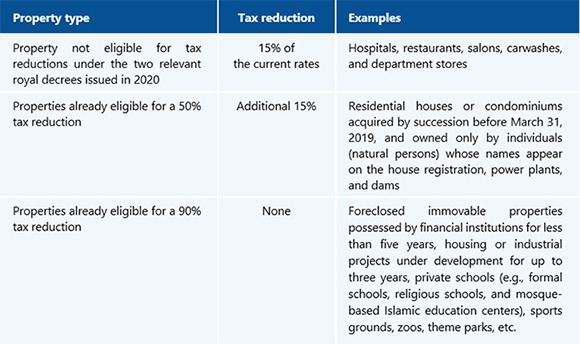
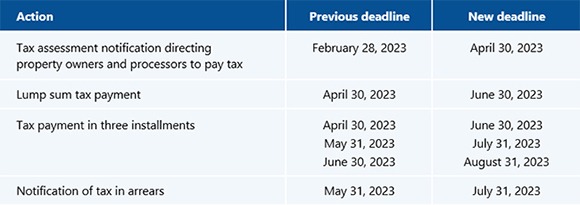
Moreover, in early December, Thailand’s Ministry of Interior promulgated an announcement extending the deadline for tax assessment notification and tax payment (including by scheduled installments) by another two months from the previous statutory deadline of December 20, 2022. The key deadline extensions are shown in the table below.
The Land and Building Tax is a property tax collected annually, with rates varying based on the purpose of use—agricultural, commercial, industrial, or residential. Owners or possessors of land or buildings are liable for Land and Building Tax, which is computed based on the officially appraised value of the property.

For more information on Thailand’s Land and Building Tax, please contact Auaychai Sukawong at [email protected] or Chaiwat Keratisuthisathorn at [email protected].

RELATED INSIGHTS​ 

September 19, 2025
Over the past two years—particularly since Thailand announced incentives for EVs, including tax exemptions and reductions—there has been a clear trend of manufacturers relocating their facilities to Thailand. This shift is reshaping the country’s industrial landscape and creating significant opportunities in the real estate sector for companies looking to establish or expand EV manufacturing operations in Southeast Asia. Incentive-Driven Market Transformation The government’s tax exemptions and reductions have proven effective in attracting foreign investment, with Chinese manufacturers currently dominating the market. Most EV parts and car manufacturers operating in Thailand are from China, reflecting the prominence of Chinese EV brands that have already established a presence in the country. The sector encompasses manufacturers of electrical equipment as well as companies seeking to establish facilities for producing electric vehicle components, parts, and accessories. The surge in activity is evident across Thailand’s EV manufacturing sector, with legal practices handling these transactions experiencing unprecedented demand. Industrial Real Estate Framework and Market Dynamics Thailand’s industrial real estate framework provides compelling advantages for foreign manufacturers, who typically face restrictions on foreign land ownership under the Land Code. However, foreign investors can benefit from exemptions to these restrictions if the land is located within industrial real estate zones designated by the Industrial Estate Authority of Thailand (IEAT) or they obtain investment promotion from the Board of Investment (BOI) if the land is located outside an industrial estate area governed by the IEAT. Both the IEAT and BOI provide special tax and nontax incentives, including foreign land ownership, with even greater incentives available for land situated within the country’s Eastern Economic Corridor (EEC). This regulatory advantage has sparked a parallel trend in land development. Industrial real estate developers in the EEC are actively consolidating land into large plots to develop new industrial estate projects, recognizing that
September 17, 2025
Thailand’s Ministry of Finance has introduced a five-year personal income tax exemption on capital gains from the disposal of cryptocurrency or digital tokens. The Ministerial Regulation No. 399, published in the Government Gazette on September 5, 2025, offers the personal income tax exemption for transfers occurring between January 1, 2025, and December 31, 2029. The ministerial regulation was enacted to promote Thailand as a global financial center and digital asset business hub while encouraging increased domestic investment in digital assets. Key Conditions The exemption, which covers capital gains from cryptocurrency and digital token disposals during the specified five-year period, applies only to individuals. Companies that trade in digital assets are not eligible for this tax exemption. With the tax holiday set to expire in 2029 (unless extended), individual traders should plan ahead for postexemption taxation to ensure full compliance with Thailand’s personal income tax requirements. Proper documentation of digital asset transactions during the exemption period will be essential for future tax compliance. For more details on this tax exemption, or on any aspect of Thailand’s tax law and regulations, please contact Saravut Krailadsiri at [email protected] or Papavarin Sarawongsuth at [email protected].
August 26, 2025
Thailand’s consumer protection authorities have strengthened oversight of residential leasing businesses following numerous complaints about unfair lease terms, including unjustified deposit forfeitures and excessive utility charges. The Contract Committee of Thailand’s Office of the Consumer Protection Board issued the Notification of the Contract Committee Re: The Stipulation of Residential Property Leasing as a Contract-Controlled Business B.E. 2568 (2025), published in the Government Gazette on June 6, 2025. The notification becomes effective on September 4, 2025, and repeals the prior notification issued in 2019. The notification prescribes two types of standard residential lease contracts: short-term residential lease contracts (for leases of not more than three years) and long-term residential lease contracts (for leases of more than three years up to 30 years or for the lessee’s lifetime). However, use of these standard contract forms is not compulsory, and parties may use any form as long as the terms do not contradict the notification’s requirements. Expanded Scope The notification expands the scope of enforcement to include any lessor with at least three residential units, while the 2019 notification applies only to businesses leasing five or more residential units. Hotels and dormitory operators are excluded, as they are regulated under other specific laws. Residential lease contracts entered into under the 2019 notification will remain valid and enforceable until the expiration of the contract. Any residential lease contract executed from September 4, 2025, onward must comply with the new notification. The notification also expressly extends its applicability to lease contracts made through online platforms. Electronically executed lease contracts must comply with the required and prohibited terms specified in the notification as well as applicable laws governing electronic transactions in Thailand. Mandatory Terms and Conditions Residential lease contracts must contain clearly legible Thai text no smaller than two millimeters in size and no more
August 22, 2025
On August 12, 2025, Vietnam’s Ministry of Agriculture and Environment submitted a draft law amending several provisions of the Land Law 2024 (“Draft Amended Land Law” or “Draft”) for government consultation and public comment. The Draft primarily aims to address three controversial issues in Vietnam’s land regime concerning (i) land pricing, (ii) land clearance, and (iii) the allocation of land outside auctions, following policy set out by Resolution 18-NQ/TW and the newly adopted Resolution 69-NQ/TW on land governance modernization. Land pricing is potentially one of the most important areas among the proposed reforms. The Draft, however, has notably not addressed a major concern recently raised by the public: When a project has been allocated or leased land, but the relevant authority has not yet issued the land-price decision, a “supplemental charge” continues to accrue for the entire waiting period. Under current rules, this charge is calculated at 5.4% per year on the ultimately determined land-use fee or land rent, materially shifting project economics and pricing risks to developers or end-buyers. Core Reforms on Land Pricing The Draft Amended Land Law sets out a number of reforms on land pricing, including the following: Land price tables: The Draft maintains provincial land price tables but clarifies the scope of application: They are used to determine land-related financial obligations of land users and compensation when the state recovers land; the government will detail the adjustment coefficient regime, ratios for land-use fee calculation by land type/user/form, and deductible infrastructure costs. Provincial people’s committees will continue to issue land price tables every five years, effective from January 1 of the first year in the cycle, with authority to supplement within the cycle as necessary. In provinces with cadastral maps and digital land price databases, the tables may be established down to the land-parcel level,