You are using an outdated browser and your browsing experience will not be optimal. Please update to the latest version of Microsoft Edge, Google Chrome or Mozilla Firefox. Install Microsoft Edge

December 29, 2022

Thailand Unveils New Land and Building Tax Rate Reductions and Deadline Extensions

On December 20, 2022, Thailand’s cabinet approved draft legislation providing further Land and Building Tax reductions of 15% in 2023, on top of current reductions in tax rates, on some types of taxable property. When enacted, the legislation will provide further tax reductions only for the property types in the table below.
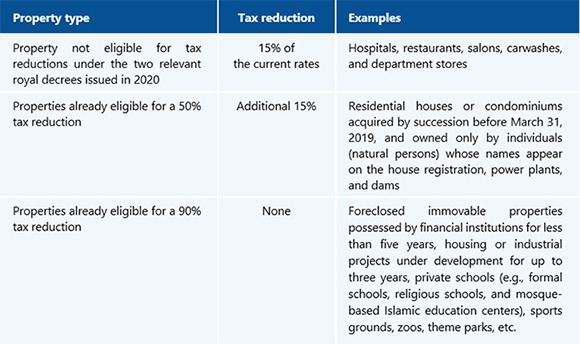
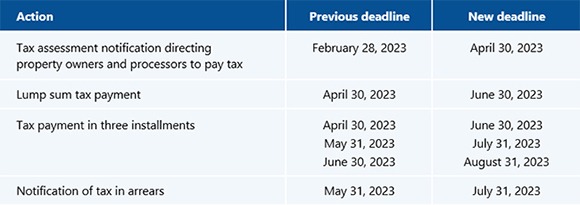
Moreover, in early December, Thailand’s Ministry of Interior promulgated an announcement extending the deadline for tax assessment notification and tax payment (including by scheduled installments) by another two months from the previous statutory deadline of December 20, 2022. The key deadline extensions are shown in the table below.
The Land and Building Tax is a property tax collected annually, with rates varying based on the purpose of use—agricultural, commercial, industrial, or residential. Owners or possessors of land or buildings are liable for Land and Building Tax, which is computed based on the officially appraised value of the property.

For more information on Thailand’s Land and Building Tax, please contact Auaychai Sukawong at [email protected] or Chaiwat Keratisuthisathorn at [email protected].

RELATED INSIGHTS​ 

February 25, 2026
In December 2025, the National Assembly of Vietnam enacted a new Law on Construction, replacing the 2014 Law on Construction as amended in 2020. The 2025 Law on Construction will, in principle, take effect on July 1, 2026, subject to certain exceptions. Among its notable reforms, one development has attracted particular attention from both legal practitioners and market participants: the introduction of a statutory framework governing predetermined damages, commonly referred to as “liquidated damages.” This marks the first time liquidated damages have been expressly recognized at the level of primary legislation in Vietnam. While liquidated damages clauses have long been a common feature of construction contracts in practice, their legal enforceability has historically been subject to uncertainty. Although the new provision appears to represent a positive step toward greater legal clarity, it remains an open question whether it is sufficient, on its own, to provide a solid legal basis for the enforceability of liquidated damages clauses in construction disputes in Vietnam. What’s New? Article 86.2 of the 2025 Law on Construction provides (emphasis added): “Compensation for damages shall be determined on the basis of actual damages [or] predetermined damages corresponding to obligations under the construction contracts that are breached [and] the extent of such breaches.” This provision is significant in that it expressly recognizes predetermined damages, or liquidated damages, as a lawful basis for determining compensation for damage. However, the new law does not define “predetermined damages.” The absence of a statutory definition creates potential ambiguity as to the scope and nature of this concept and may give rise to disputes over how—and whether—a particular contractual clause qualifies as predetermined damages for the purposes of Article 86.2. Further, Article 86.2 qualifies the application of predetermined damages by requiring that such damages correspond to the obligations not fulfilled and the
January 20, 2026
Thailand’s Board of Investment (BOI) has imposed new restrictions on foreign-majority shareholding and land ownership for companies in certain promoted activities. The changes took effect on September 1, 2025, but were not published in the Government Gazette until December 30, 2025, under Notification of the Board of Investment No. Sor. 7/2568 on the Amendment to List of Activities Eligible for Investment Promotion under Notification of the Board of Investment No. 9/2565, dated July 22, 2025. Foreign Land Ownership Restrictions Generally, foreign land ownership is one of the privileges granted to BOI-promoted companies, allowing them to own land to engage in the promoted activities. However, with these new restrictions, the BOI will no longer grant land-ownership privileges to foreign-majority-owned companies that conduct business activities in the following categories: Rolling, drawing, casting, or forging of nonferrous metals (category 5.4.9) Manufacturing of ferrous metal products or ferrous metal parts (category 5.4.11.2) Manufacturing of nonferrous metal products and/or nonferrous metal parts for industrial use (category 5.4.11.4) Manufacturing of other metal products, including other metal parts for industrial use (category 5.4.11.5) Manufacture of chemical products for industry (category 6.2) Manufacture of plastic products for industrial goods and parts (category 6.4.1) These restrictions do not apply to existing BOI-promoted companies that have at least three projects granted promotion under the same juristic person during the past 15 years (2011–2025) with total investment of at least THB 5 billion, excluding the cost of land and working capital. Foreign Shareholding Restrictions For companies to be eligible for BOI promotion in three other categories of business activities, at least 51% of the company’s registered capital must be held by Thai individual shareholders, unless the BOI-promoted activity is located within a special border economic zone as designated by the BOI. These three categories are: Manufacture of bags made of
January 8, 2026
Thailand’s Board of Investment (BOI) has tightened criteria for BOI-promoted companies to own land for residential use and introduced new procedures for land ownership applications under a new notification. Officially titled Notification of the Office of the Board of Investment No. Por. 9/2568 Re: Amended Criteria and Conditions for Permitting Foreign Juristic Persons Receiving Investment Promotion to Own Land for Office and Residence for Operational-Level Workers to Operate Business Granted Investment Promotion, dated July 18, 2025, the new notification was published in the Government Gazette on January 6, 2026, and is applicable to all applications submitted since the date of the notification (July 18, 2025). The new notification introduces an online application process for BOI-promoted companies seeking to own land for office use or residential purposes via the e-Land system, the BOI’s electronic system for land rights and benefits. Applications are reviewed virtually, and any requested amendments or additional documents must be submitted within seven business days. Failure to amend the application or submit any additional requested documents within this period will result in automatic rejection and removal of the application from the system. The new notification builds on the requirements specified in the previous notification on land ownership allowances for foreign companies, issued in 2024, by introducing additional qualification requirements for residences for operational-level workers (i.e., unskilled laborers). In this regard, such a residence must not be: Part of a land development project (housing estate), A condominium unit, or Classified as a house or commercial building.
December 25, 2025
On December 11, 2025, Vietnam’s National Assembly issued Resolution No. 254/2025/QH15 (Resolution No. 254) to address practical difficulties encountered in implementing the Law on Land 2024. The resolution provides specific mechanisms and policies to resolve issues related to land allocation, land leasing, and conversion of land-use purposes, while also addressing land valuation principles, timing of information collection, and land valuation methods. The resolution takes effect on January 1, 2026. Key provisions affecting investors are discussed below. Land Use Terms for Transferred Investment Projects The National Assembly has addressed situations where the remaining term of a transferred investment project is insufficient for the transferee’s business or financial plans. Resolution No. 254, along with the Law on Investment 2025, introduces aligned regulatory solutions. Under the Law on Investment 2025 (4th version submitted to the National Assembly for promulgation), if an investment project implemented prior to March 1, 2026, has been transferred and the transferor holds a Land Use Rights Certificate, has fulfilled all land-related financial obligations, and is not subject to termination, the competent authority may determine a new operating term if the remaining operating term does not meet the transferee investor’s financial or business plan. This adjustment occurs when approving or adjusting the investment policy or issuing or amending the investment registration certificate. The revised operating term is calculated from the date of the approval or issuance and must not exceed the statutory maximum of 70 years for projects in economic zones and 50 years for projects outside economic zones. Resolution No. 254 also permits adjustment of the land use term for transferred investment projects involving land, provided that the transferee investor pays additional land rent in accordance with applicable law, thereby ensuring consistency with the Law on Investment 2025. Land Rent Payment Options Resolution No. 254 generally expands the