
You are using an outdated browser and your browsing experience will not be optimal. Please update to the latest version of Microsoft Edge, Google Chrome or Mozilla Firefox. Install Microsoft Edge

November 4, 2021

Thailand Streamlines Renewal of Licenses for Hazardous Substances and Cosmetics

A new royal decree in Thailand (Royal Decree Re: Licensee to Pay the License Renewal Fee in Lieu of a Grace Period When Submitting a License Renewal Application B.E. 2564) does away with the current red tape associated with renewing certain marketing authorization and business licenses. Under the new royal decree, there is no longer any need to submit renewal applications for eligible licenses or to wait for approval from the relevant authority. Instead, the licenses will be automatically renewed upon payment of renewal fees. There are 31 eligible licenses listed in the royal decree, with a focus on licenses for hazardous substances and cosmetics.

The royal decree on license renewal was published in the Government Gazette in May 2021 and will come into force on November 22, 2021. Although the new royal decree has not yet come into force, Thailand’s Food and Drug Administration (FDA) has already begun renewing licenses for hazardous substance licenses and cosmetics notification receipts via the new procedure. These licenses and notification receipts are detailed below:
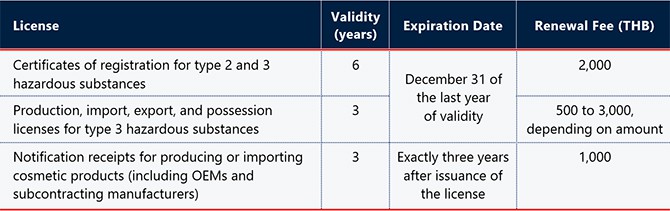
(Note: Hazardous substances for household use and public health are classified into four types according to their risk. Products containing type 2 and 3 substances are a higher risk than type 1 and must be registered with the FDA. Type 4 substances are prohibited.)

Procedural Guidance

The licenses for hazardous substances in the table above should be renewed in the two months preceding their expiry date, while the notification receipts for cosmetics should be renewed in the six months before their expiry date. Renewed licenses are valid for another six or three years (i.e., matching the original validity period).

Under the new royal decree on license renewal, eligible licenses for hazardous substances and cosmetics can be renewed by notifying the FDA via its e-submission system. The license holder will then receive a payment order for the renewal fees, which can be paid through various channels (e.g., payment service points, banks, offices of the relevant authorities, and electronic banking). Upon payment, the license will be renewed automatically and the license holder can download a new license for the cosmetic product or a license attachment for the hazardous substance. It can be used instead of or attached to the old license, and there is no need to change the FDA number.

Other Considerations

The new renewal procedure under this royal decree will greatly reduce the time and effort businesses spend seeking license renewal. Nonetheless, this simpler renewal procedure could also be cause for concern due to the lack of verification or approval in the process. The relevant authority may find it difficult to verify and ensure that businesses are operating properly under relevant laws, which could lead to safety issues for consumers and the general public.

For instance, this streamlining of the license renewal process bears some similarity to circumstances surrounding the recent hazardous substance factory explosion in Samut Prakan Province. In the days after the explosion, the latest amendment of the Factory Act B.E. 2562 (2019) was criticized by the public because it removed license renewal requirements, instead stipulating that factory operation permits no longer had an expiry date—a change from the previous requirement to renew the permit every five years. This change meant that factories no longer had to be verified every five years when it was time to renew the permit. Without verification and monitoring from the relevant authority, it is difficult to confirm factory safety and compliance with the relevant laws and regulations.

Similarly, this latest royal decree on license renewal outlines an easy renewal procedure (automatic approval) without verification or approval from the relevant authority. This lack of regulatory verification and approval could lead to heightened safety concerns for employees, consumers, and the general public. It seems that it is now up to businesses themselves to verify their own regulatory compliance and to be aware of any changes that require a license amendment before renewal. It is the responsibility of the business to ensure that its products are safe and in full compliance with laws and regulations. Therefore, this license renewal procedure under the new royal decree eases bureaucratic burdens on businesses but also serves as a reminder of their essential role in protecting consumers and the public interest.


RELATED INSIGHTS​ 

May 29, 2026
Indonesia’s Food and Drug Authority (BPOM) has issued Regulation No. 7 of 2026 on Drug Promotion and Advertising, establishing an updated framework for promotional activities involving medicinal products in Indonesia. The regulation took effect on April 16, 2026, and supersedes BPOM Regulation No. 2 of 2021 on Drug Advertising Supervision. The new regulation maintains general principles for advertising content, including requirements that advertisements be objective, complete, and not misleading, as further detailed in its annex. It also confirms that advertisements for nonprescription drugs directed to the public must obtain prior approval from BPOM before publication and must be in Bahasa Indonesia. The regulation provides a more comprehensive framework governing how drug promotion is conducted, introducing several notable additions and changes, as described below. Procedure and Requirements for Drug Advertisement Approval To apply for a drug advertisement approval, applicants must create an online account through the dedicated portal SIAPIK. Advertisement approval is available only for registered drugs; unregistered drugs are not eligible for advertisement approval with BPOM. The application must include the advertisement design, along with a translation if the design contains any wording in a foreign language. The submission format varies by media type, requiring, for example, copies in the form of print advertisements for visual media, scripts for audio media, and storyboards for audiovisual media. For online media—including social media—submissions should include any captions, descriptions, and hashtags that form an integral part of the advertising material. The approval timeline takes approximately 3–4 months, as BPOM will generally request additional information or revisions during the verification and evaluation process. Applicants have 20 days to submit any such requested documents. BPOM may also conduct a reevaluation of advertisements that have already received approval, based on monitoring results or new information regarding the safety and quality of the advertised drug. This
May 11, 2026
Vietnam’s legal framework governing chemicals has undergone significant reform, with the Law on Chemicals No. 69/2025/QH15 (Law on Chemicals 2025) taking effect on January 1, 2026. Together with a comprehensive set of implementing instruments issued in January 2026, including three decrees (No. 24/2026/ND‑CP, No. 25/2026/ND‑CP, and No. 26/2026/ND‑CP) and two circulars (No. 01/2026/TT‑BCT and No. 02/2026/TT‑BCT), the Law on Chemicals 2025 has significantly reshaped chemical registration and management requirements. Determining What Constitutes a “New Chemical” Among the most notable changes introduced under the Law on Chemicals 2025 are the rules governing the registration and management of new chemicals, which must be registered with the authority before being placed on the Vietnam market. Although the concept of new chemical registration was first introduced under the Law on Chemicals 2007, the corresponding registration mechanism has remained largely dormant in practice. Under the Law on Chemicals 2025, a “new chemical” is defined as a substance that is not yet included in Vietnam’s National Chemical Inventory and the list of foreign chemical inventories recognized by the competent Vietnamese authority (List of Foreign Chemicals). On a literal reading, the definition in the new law may suggest that a substance qualifies as a new chemical only if it is absent from both lists. Accordingly, a chemical present in either list should be treated as an existing chemical without the registration burden. However, a different interpretation emerges from Decree 26, which specifically requires registration of “new chemicals” even where such substances already appear in the List of Foreign Chemicals. This implies that inclusion in a recognized foreign inventory does not automatically exempt a substance from new chemical registration in Vietnam. This inconsistency between the statutory definition in the Law on Chemicals 2025 and the implementing provisions of Decree 26 creates significant interpretative and compliance challenges. At
April 29, 2026
Effective June 22, 2026, Thai Industrial Standards (TIS) for food contact paper and cooking paper will be enforced as mandatory for sale in the Thai market. This move has important implications for product licensing and tightens hygiene, labeling, and chemical-safety requirements for food-contact and cooking paper products. Thailand is strengthening its regulatory framework for paper-based culinary materials against a backdrop of accelerating global commitments to ESG and sustainability, as such materials—particularly those derived from natural or recycled fibers—have emerged as key alternatives to plastics in food preparation, cooking, and packaging applications. As a result, regulators worldwide are tightening controls to ensure that sustainability initiatives do not compromise consumer safety, particularly regarding the potential migration of chemical substances into food. Regulatory Framework: Voluntary vs. Mandatory Standards Standards under the TIS regime are generally classified into two categories. Voluntary standards allow manufacturers or importers to apply for a product license and affix the TIS mark to demonstrate product quality and build consumer confidence, but compliance is not legally required. Mandatory standards, by contrast, require manufacturers and importers to obtain a product license and affix the TIS mark before placing products on the Thai market, and noncompliant products cannot be legally sold. Previously, the TIS standards for food contact paper (TIS 2948-2562) and cooking paper (TIS 3438-2022) fell under the voluntary standard regime, meaning that obtaining a TIS license and displaying the TIS mark was optional. However, due to the increasing use of paper in food preparation and cooking, the Thai Industrial Standards Institute has determined that upgrading these standards to mandatory status is necessary to enhance consumer safety. As a result, all paper intended for food contact or cooking purposes must now obtain a TIS product license prior to sale in Thailand. Scope of the Standards The primary distinction between the
April 22, 2026
A new decree in Vietnam brings significant implementation clarity to the country’s existing extended producer responsibility (EPR) legal framework. An EPR mechanism was first codified in Vietnam in the 2020 Law on Environmental Protection amid ongoing challenges surrounding the collection and treatment of product and packaging waste. The mechanism was progressively detailed through Decree No. 08/2022/ND‑CP and its successive amendments, but the regulatory framework remained insufficiently developed, notably in terms of support mechanisms for waste collection, recycling, and treatment. The newly launched regulations in Decree No. 110/2026/ND-CP (Decree 110), issued on April 1, 2026, and taking effect on May 25, 2026, stipulate fully and clearly the responsibility of manufacturers and importers to recycle products and packaging and to treat waste. Some key provisions of Decree 110 for manufacturers, importers, and related stakeholders are presented below. Subjects of EPR The Law on Environmental Protection assigns responsibility to manufacturers and importers for product and packaging recycling (under Article 54) or waste collection and treatment (under Article 55), depending on the type of products and packaging they produce or import. Decree 110 elaborates on these EPR provisions by specifying the responsible entities and listing out the types of products and packaging subject to recycling and waste treatment responsibilities. Decree 110 clarifies the responsible entities in special cases, such as when products under the same brand are made by multiple manufacturers, when there is a contract manufacturing or entrusted import relationship, and when the manufacturer or importer is part of a corporate group. Notably, exemptions may be applied in some scenarios, such as for manufacturers and importers of products and packaging exclusively for export, temporary import and re-export, or research and testing purposes, as well as for entities with annual revenue from related products not exceeding VND 30 billion. Recycling Responsibilities Decree 110