You are using an outdated browser and your browsing experience will not be optimal. Please update to the latest version of Microsoft Edge, Google Chrome or Mozilla Firefox. Install Microsoft Edge

February 27, 2024

Thailand Lays Out New Cybersecurity Standards

Thailand’s National Cyber Security Committee (NCSC) released three notifications under the Cybersecurity Act on January 18, 2024, setting cybersecurity-related requirements for key organizations and assets. While one of these notifications already took effect, the two most notable will take effect on January 18, 2025 (i.e., one year from their publication in the Government Gazette).

These two are the NCSC Notification Re: Standards for Defining the Security Category for Data or Information Systems B.E. 2566 (2023) (“Notification on Security Category”) and the NCSC Notification Re: Minimum Standards for Data and Information Systems B.E. 2566 (2023) (“Notification on Minimum Standards”).

These notifications apply to:

  • State agencies;
  • Supervising or regulating organizations (i.e., state organizations, private organizations, or persons designated by law to regulate or supervise the affairs of state organizations or critical information infrastructure organizations); and
  • Critical information infrastructure organizations (i.e., organizations related to or providing national security, significant public services, banking and finance, information technologies and telecommunications, transportation and logistics, energy and public utilities, and public health).

Collectively these are defined as “Organizations” under the notifications.

Notification on Security Category

The Notification on Security Category sets forth risk-based security classifications—or “security categories”—for Organizations’ data or information systems.

For security category assessment purposes, Organizations are required to perform a self-assessment of their data or information systems based on three key security objectives: confidentiality, integrity, and availability. Each of these objectives is further categorized into three risk levels (low, medium, and high), taking into account the assessment of potential impact in the following areas:

  • Organizations’ financial value or reputation;
  • Organizations’ number of service users;
  • Organizations’ ability to perform their duties;
  • State stability or public order.

The risk levels for the three objectives are determined by considering whether there are “minimal,” “severe,” or “serious severe” effects, as described below:

  • Confidentiality (not including data classified as “secret,” which follows different criteria): The effects of unauthorized disclosure of data on Organizations’ reputation and financial value;
  • Integrity: The effects of unauthorized alteration or destruction of data on Organizations’ performance; and
  • Availability: The effects of inability to access or use the data or information system on Organizations’ performance.

If their systems handle different types of data, Organizations must assess each type and set the security category based on the highest risk level identified.

The security category should be reviewed at least once every three years, with the results properly recorded.

Notification on Minimum Standards

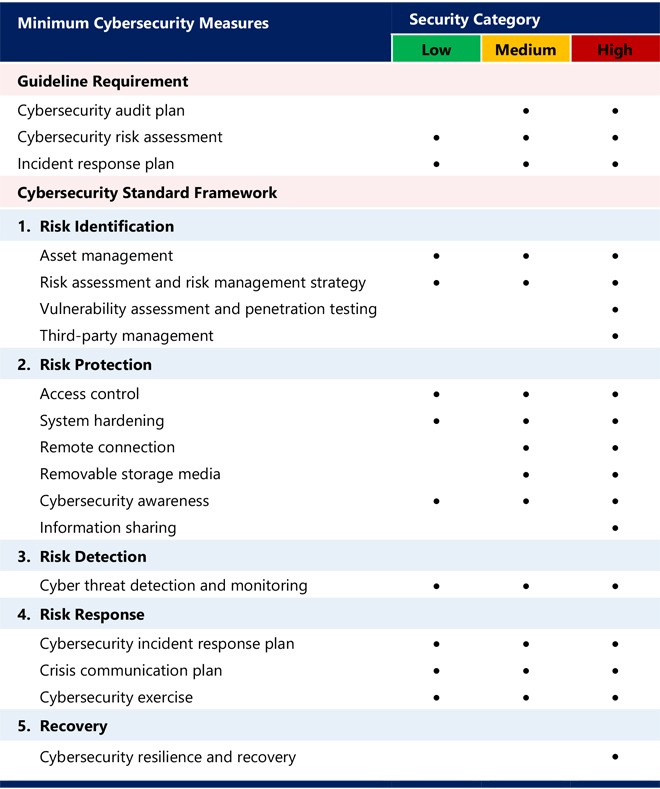
Once the security category is determined, Organizations are responsible for applying the minimum cybersecurity measures stipulated in the Notification on Minimum Standards. These measures are outlined in the table below, which indicates the items that are required for minimum cybersecurity measures under each security category.
For more information on compliance with these notifications under the Cybersecurity Act, or on any aspect of cybersecurity in Thailand, please contact Athistha (Nop) Chitranukroh at [email protected], Nopparat Lalitkomon at [email protected], Napassorn Lertussavavivat at [email protected], or Rada Lamsam at [email protected].

RELATED INSIGHTS​ 

July 25, 2022
Vietnam’s current Law on E-Transactions was passed in 2005 and has been effective since March 1, 2006. This law is considered a framework law, developed based on the Model Law on E-Commerce of the United Nations Commission on International Trade Law (UNCITRAL). According to the Ministry of Information and Communications (MIC), over the past 17 years, the implementation and application of e-transactions has shown significant evolution in certain areas demanding high levels of international integration, such as banking and e-commerce, but has faced difficulties in other areas due to a lack of detailed guidance. In addition, with the strong growth and breakthrough development of digital technologies such as artificial intelligence, big data, biometrics, and blockchain, and in the context of the ongoing Industrial Revolution 4.0 and the development of digital government, digital economy, and digital society, the 2005 Law on E-Transactions has revealed its shortcomings. Therefore, the government of Vietnam has entrusted the MIC to take the lead in drafting a new Law on E-Transactions, which will replace the old 2005 law in order to meet the country’s development needs. Accordingly, the MIC published a Draft Law on E-Transactions (“Draft Law”) for public consultation from May 4 to July 4, 2022. The latest accessible version of the Draft Law at the time of writing is Version 4. The effective date of the Draft Law is still not yet determined, though this law is expected to be submitted to the National Assembly for its review and comments in October 2022 and approval in May 2023. The following are some key contents of the Draft Law: 1. Scope of Application Unlike the current law, which explicitly excludes certain areas such as the issuance of certificates of land use rights and marriage certificates from the scope of application, the Draft Law attempts
July 19, 2022
On June 23, 2022, Thailand’s Securities and Exchange Commission (SEC) opened a public hearing period on regulatory controls for initial coin offering (ICO) portals that serve as financial advisors to digital token issuers. The proposed measures aim to prevent conflicts of interest; allow ICO portals to outsource certain functions; and establish additional notification obligations for ICO portals. The public hearing is open for general comments until July 23, 2022, and the new legislation is expected to be issued soon after that. During the public hearing period, any interested parties can comment on the SEC’s proposed principles. The key proposed points are outlined below. Conflicts of Interest Similar to SEC-approved financial advisors for securities offerings, ICO portals must be clear of conflicts of interest when representing issuers in a coin offering. According to the draft regulation, the following conflicts of interest are prohibited: The ICO portal (and certain individuals as specified by the SEC) directly or indirectly holds a prohibited amount of shares in the issuer, its affiliates, or its subsidiaries. If the issuer is not a listed company, any shareholding or portion thereof is prohibited. If the issuer is a listed company on the Stock Exchange of Thailand (SET), the shares held by the ICO platform may not total more than five percent of the total voting rights. The issuer (and certain individuals as specified by the SEC) directly or indirectly holds shares in the ICO portal in any amount if the ICO portal is not a listed company, or totaling more than five percent of the voting rights if the ICO portal is listed on the SET. Any of the ICO portal’s directors or executives, or the head of the department responsible for screening the ICO project, is also a director in the issuer. The ICO portal has
June 30, 2022
On May 30, 2022, Thailand’s Securities and Exchange Commission (SEC) announced that it would start regulating ready-to-use utility tokens, a type of digital token that had previously been exempted from the SEC’s approval and regulatory control. A public forum was open for comments from various stakeholders until June 29, 2022, and the draft regulation is expected to be issued soon. So far, the SEC has only supervised the issuance of not-ready-to-use utility tokens—digital tokens with the underlying right to acquire specific goods or services, which cannot be utilized upon issuance but at a later date. Due to the growing digital asset industry and lack of regulatory control, ready-to-use utility tokens have become more popular and many are listed for trading in digital asset exchanges. The SEC claimed that it is now necessary to regulate ready-to-use utility tokens as some issuers appeared to be exploiting the regulatory loophole to manipulate the price and supply of these tokens in both the primary and secondary markets, while providing insufficient data disclosure to investors. The SEC’s proposed principles include the following key points: Pre-Approval Requirements The same pre-approval requirement applicable to not-ready-to-use utility tokens will apply to ready-to-use utility tokens which an issuer intends to list on a digital asset exchange. This means that the issuer must proceed with the standard formalities, i.e., obtaining prior approval from the SEC, filing a draft prospectus, and offering the approved tokens via a SEC-approved ICO portal operator only. The SEC offers a fast-track (15 days) approval for qualifying ready-to-use utility tokens, which are those with plain-vanilla characteristics; with an offering price corresponding to the value of the underlying goods/services; for which the supply of goods and services does not vary with the price of the tokens (i.e., fixed coins); and which are not intended to be
June 30, 2022
Thailand’s Personal Data Protection Act B.E. 2562 (2019) (PDPA) became fully effective and enforceable on June 1, 2022. To ensure that the PDPA will be smoothly and efficiently enforced, the Personal Data Protection Commission (PDPC) is issuing various subordinate regulations. On June 20, 2022, the first set of these regulations was issued and published in the Government Gazette, and according to the Ministry of Digital Economy and Society (MDES), another set of subordinate regulations is expected to be issued by the end of June 2022. The first set consists of the following four subordinate regulations:   1) Notification of the PDPC Re: Exemption to the Record of Processing Activities Requirement for Data Controllers that Are Small Businesses B.E. 2565 (2022) (“ROPA Exemption Notification”) Under the PDPA, data controllers are obligated to prepare and maintain a record of processing activities (ROPA) containing information specified in Section 39 of the PDPA, including the personal data collected, the purposes of the processing of the personal data, the retention period, etc. However, under this ROPA Exemption Notification, a data controller will be exempted from the obligation to prepare and maintain a record of such required information (except information related to the rejection of a request from a data subject to exercise (i) right of access; (ii) right to data portability; (iii) right to object; and (iv) right to rectification), if its business falls within the scope of any of the following: Small or medium-sized business according to the law on small and medium-sized enterprise promotion, defined as follows: Community enterprise or social enterprise, as referred to under the law on community enterprise promotion. Social enterprise, as referred to under the under the law on social enterprise promotion. Cooperative, cooperative union, or agriculturist’s group under the law on cooperatives. Foundation, association, religious body, or