
You are using an outdated browser and your browsing experience will not be optimal. Please update to the latest version of Microsoft Edge, Google Chrome or Mozilla Firefox. Install Microsoft Edge

May 15, 2024

Thailand Issues Draft Cybersecurity Standards for Cloud Services

On May 1, 2024, Thailand’s National Cyber Security Committee (NCSC) published the draft NCSC Notification Re: Cloud Cybersecurity Standards for a public hearing period, which was open until May 14, 2024. These standards have been drafted to drive the country’s cloud-first policy with the aim of minimizing risks from cyber threats to cloud services utilized by government agencies, supervising or regulating organizations, and critical information infrastructure (CII) organizations.

The key points of the draft Cloud Cybersecurity Standards are below.

Scope

  • The standards apply to government agencies, supervising or regulating organizations, and CII organizations under the Cybersecurity Act B.E. 2562 (2019), as well as cloud service providers (defined below).
  • The standards prescribe cloud system cybersecurity measures for cloud service customers (defined below) and providers only to the extent that the service is provided to the in-scope organizations outlined above.

Definitions

  • Cloud service customers (CSCs): In-scope organizations that have a formal contractual agreement to use cloud services provided by a cloud service provider.
  • Cloud service providers (CSPs): Persons who enable cloud services to be used by a cloud service customer, responsible for maintaining infrastructure, platforms, and software that enable provision of the cloud services and for managing these resources to ensure their accessibility, security, and scalability for their cloud service customers.

Application

  • In-scope organizations that will use or have been using cloud services must comply with the Cloud Cybersecurity Standards by taking into account their data or technology information systems’ level of impact, as specified in the previously issued Notification of the NCSC Re: Standards for Defining the Security Category for Data and Information Systems B.E. 2566 (2023).
  • The impact level related to personal data is to be rated as being at least at the medium level, and the minimum standards for that level specified in the draft Cloud Cybersecurity Standards must be adopted.
  • In-scope organizations must report their implementation of the Cloud Cybersecurity Standards to the National Cyber Security Agency (NCSA) within 30 days of completing the implementation.
  • The draft Cloud Cybersecurity Standards will come into force one year from their publication in the Government Gazette.

Structure

The requirements in the Cloud Cybersecurity Standards are divided into two areas, (1) cloud security governance and (2) cloud infrastructure and operations:

Requirement Area 1: Cloud Security Governance

  • Information security policies
  • Organization of information security
  • External supplier relationships
  • Compliance

Requirement Area 2: Cloud Infrastructure Security and Operations  

  • Human resource security
  • Asset management
  • Access control
  • Cryptography
  • Physical and environmental security
  • Operational security
  • Communication security
  • System acquisition, development, and maintenance
  • External supplier relationships
  • Information security incident management

Impact Levels and Requirements

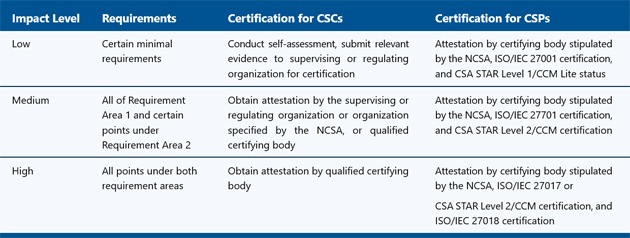
The stipulations of the Cloud Cybersecurity Standards vary depending on the data or information systems’ level of impact. The requirements for each level are summarized in the table below.
For more information on the draft Cloud Cybersecurity Standards, or on any aspect of cybersecurity and cloud-related laws in Thailand, please contact Athistha (Nop) Chitranukroh at [email protected] and Thammapas Chanpanich at [email protected].

RELATED INSIGHTS​ 

March 27, 2024
Last year, the government of Vietnam issued the Personal Data Protection Decree (PDPD), which took effect on July 1, 2023. The Department of Cybersecurity and High-Tech Crime Prevention and Control (referred to as “A05”) under the Ministry of Public Security (MPS) is tasked with implementing and enforcing the requirements under the PDPD. While a decree on sanctioning provisions for noncompliance with the PDPD is still pending issuance, further movements from the MPS/A05 indicate that it aims to start conducting its first inspections into PDPD compliance. This is the first time that companies and government agencies have been officially questioned by the MPS about their compliance with the PDPD. The purposes of this inspection program are (1) to evaluate the compliance status of a group of selected companies and government agencies and to understand challenges in complying with the PDPD requirements; (2) to propose sanctions for noncompliance; and (3) to collect information and comments for the development of the upcoming Personal Data Protection Law—not to spot noncompliance with the PDPD specifically. This round of inspection includes a number of companies in 14 sectors (including e-commerce, aviation, telecom, banking and finance, intermediary payment, insurance, gaming, education, healthcare, real estate, data processing services, ride hailing, etc.). The companies targeted by this inspection program must: (1) submit a report on compliance to the MPS/A05 by May 30, 2024 (this report is different from the data protection impact assessment (DPIA)/transfer impact assessment (TIA) submission requirements); and (2) coordinate with the MPS/A05 on any further investigation actions from June to August 2024. The inspection results will be available by September 2024. Key information to be reported includes, among others: (1) a description of the activities and measures carried out to implement the PDPD (such as protecting data subjects’ rights, performing administrative procedures, preventing violations, etc.)
March 18, 2024
Vietnam’s new Telecom Law 2023 was promulgated on November 24, 2023, and will take effect on July 1, 2024, for most telecom services. For three newly introduced telecom services—OTT telecom services, internet data center services, and cloud computing services—implementation and compliance will be delayed until January 1, 2025. These new services will be explored briefly below. The Ministry of Information Communication (MIC) is currently in the process of developing a number of decrees and circulars that will detail the implementation of the Telecom Law 2023, including one main decree that guides the new law in general. This decree is scheduled for prompt promulgation to coincide with the law’s effective date of July 1, 2024. The draft version of this decree, dated February 22, 2024 (“Draft Decree”), was shared for consultation with international organizations, associations, and enterprises by the Vietnam Telecom Agency (VNTA) in early March 2024 to gather feedback. The Draft Decree is expected to undergo further revisions before being sent to relevant state agencies for input and submission to the Ministry of Justice for assessment by the end of March 2024. The MIC anticipates submitting the subsequent version to the government by April 15, 2024.   New Telecom Services: OTT Telecom Services, IDC Services, and Cloud Computing Services In comparison to the Telecom Law 2009, the Telecom Law 2023 has three new telecom services: Basic telecommunications services on the internet (OTT telecom services) are defined as services whose primary functions including the sending, transmission, and receipt of information between two persons or a group of people using telecommunications services on the internet (Article 3.8 of the Telecom Law 2023). By incorporating the term “primary functions” into the definition, the Telecom Law 2023 aims to exclude services such as ride-hailing platforms where the primary function is transportation, not telecom
March 15, 2024
Vietnam’s fintech industry is booming, and the rapid emergence of tech startups and non-bank institutions offering innovative financial services has been outpacing existing regulations. This regulatory gap not only creates uncertainty for both innovators and consumers, but also poses a number of imminent risks in areas such as consumer protection, data privacy, cybersecurity, and anti-money laundering, among others. The State Bank of Vietnam (SBV) is stepping up to tackle these challenges by accelerating the promulgation of a long-awaited Fintech Sandbox Decree with the issuance of an updated draft (“Draft Fintech Sandbox Decree”) on March 4, 2024. The Draft Fintech Sandbox Decree establishes a controlled environment where fintech companies and financial institutions can test solutions that do not fall squarely within the parameters of existing regulations. The pilot activities will be limited in scope, scale, and duration, with a number of precautionary measures in place. The SBV will supervise this “sandbox” closely, effectively mitigating risks and gathering valuable data to inform future regulations. Who Can Participate in the Sandbox? Traditional financial institutions (credit institutions): Banks and other institutions licensed to provide financial services can participate in the sandbox to test new offerings or refine existing ones. Independent fintech companies: Startups and established companies specializing in fintech solutions can leverage the sandbox to pilot innovative ideas before seeking wider market adoption. Other relevant organizations involved in the pilot: Depending on the specific solution being tested, other entities may also be involved in the sandbox. Geographical scope: Limited to Vietnamese territory; cross-border testing is not allowed. Focusing on Three Solution Categories Earlier versions of the Draft Fintech Sandbox Decree included categories like blockchain technology and other innovative business models, but these were removed in the latest version. To allow the SBV to assess the associated risks and work on the solutions more
March 12, 2024
Thailand’s Ministry of Finance has issued the Notification re: Criteria, Methods and Conditions for Applying for and Issuing Licenses to Operate Virtual Bank Business, which was published in the Government Gazette on March 4, 2024. This notification opens an opportunity for qualified experts in technology, digital services, and diverse data usage fields to apply for virtual bank licenses to provide financial services through new digital channels. The main goal is to serve the financial needs of target groups that may not have received sufficient or tailored financial services from the traditional banking system. Licensing Timeline Application submission period: 6 months (March 20–September 19, 2024). Announcement of successful applicants: Mid-2025 (approx. 9 months–1 year from the end of the submission period) After the announcement, successful licensees must demonstrate their readiness to commence virtual bank operations within 1 year (extendable for up to 1 additional year) via the following: Having paid-up registered capital of THB 5 billion and plans to increase the paid-up registered capital to at least THB 10 billion after the initial business period; Establishment or adjustment of a financial business group; Procurement of human resources, IT systems, and relevant risk management tools. Number of Licenses to be Issued No written or specified limit, subject to the discretion of the Bank of Thailand (BOT). Key Qualifications Applicants must have the following: Experience and resources to support virtual banking operations according to the business model and plan. Expertise and experience in conducting business that utilizes technology and provides services through digital channels. Experience demonstrating the ability to obtain, access, manage, and utilize data, including development of systems or data connections to facilitate user activities, allowing them to use their data to conduct transactions with other providers. Criteria In assessing applicants’ qualifications for a virtual bank license, the BOT will consider
