
You are using an outdated browser and your browsing experience will not be optimal. Please update to the latest version of Microsoft Edge, Google Chrome or Mozilla Firefox. Install Microsoft Edge

May 15, 2024

Thailand Issues Draft Cybersecurity Standards for Cloud Services

On May 1, 2024, Thailand’s National Cyber Security Committee (NCSC) published the draft NCSC Notification Re: Cloud Cybersecurity Standards for a public hearing period, which was open until May 14, 2024. These standards have been drafted to drive the country’s cloud-first policy with the aim of minimizing risks from cyber threats to cloud services utilized by government agencies, supervising or regulating organizations, and critical information infrastructure (CII) organizations.

The key points of the draft Cloud Cybersecurity Standards are below.

Scope

  • The standards apply to government agencies, supervising or regulating organizations, and CII organizations under the Cybersecurity Act B.E. 2562 (2019), as well as cloud service providers (defined below).
  • The standards prescribe cloud system cybersecurity measures for cloud service customers (defined below) and providers only to the extent that the service is provided to the in-scope organizations outlined above.

Definitions

  • Cloud service customers (CSCs): In-scope organizations that have a formal contractual agreement to use cloud services provided by a cloud service provider.
  • Cloud service providers (CSPs): Persons who enable cloud services to be used by a cloud service customer, responsible for maintaining infrastructure, platforms, and software that enable provision of the cloud services and for managing these resources to ensure their accessibility, security, and scalability for their cloud service customers.

Application

  • In-scope organizations that will use or have been using cloud services must comply with the Cloud Cybersecurity Standards by taking into account their data or technology information systems’ level of impact, as specified in the previously issued Notification of the NCSC Re: Standards for Defining the Security Category for Data and Information Systems B.E. 2566 (2023).
  • The impact level related to personal data is to be rated as being at least at the medium level, and the minimum standards for that level specified in the draft Cloud Cybersecurity Standards must be adopted.
  • In-scope organizations must report their implementation of the Cloud Cybersecurity Standards to the National Cyber Security Agency (NCSA) within 30 days of completing the implementation.
  • The draft Cloud Cybersecurity Standards will come into force one year from their publication in the Government Gazette.

Structure

The requirements in the Cloud Cybersecurity Standards are divided into two areas, (1) cloud security governance and (2) cloud infrastructure and operations:

Requirement Area 1: Cloud Security Governance

  • Information security policies
  • Organization of information security
  • External supplier relationships
  • Compliance

Requirement Area 2: Cloud Infrastructure Security and Operations  

  • Human resource security
  • Asset management
  • Access control
  • Cryptography
  • Physical and environmental security
  • Operational security
  • Communication security
  • System acquisition, development, and maintenance
  • External supplier relationships
  • Information security incident management

Impact Levels and Requirements

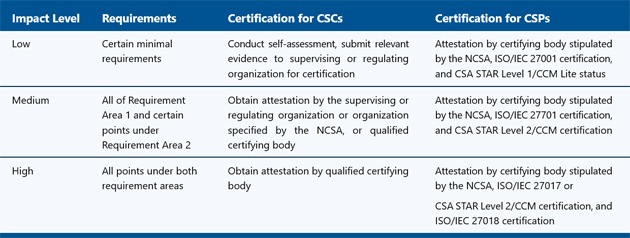
The stipulations of the Cloud Cybersecurity Standards vary depending on the data or information systems’ level of impact. The requirements for each level are summarized in the table below.
For more information on the draft Cloud Cybersecurity Standards, or on any aspect of cybersecurity and cloud-related laws in Thailand, please contact Athistha (Nop) Chitranukroh at [email protected] and Thammapas Chanpanich at [email protected].

RELATED INSIGHTS​ 

February 27, 2024
Thailand’s National Cyber Security Committee (NCSC) released three notifications under the Cybersecurity Act on January 18, 2024, setting cybersecurity-related requirements for key organizations and assets. While one of these notifications already took effect, the two most notable will take effect on January 18, 2025 (i.e., one year from their publication in the Government Gazette). These two are the NCSC Notification Re: Standards for Defining the Security Category for Data or Information Systems B.E. 2566 (2023) (“Notification on Security Category”) and the NCSC Notification Re: Minimum Standards for Data and Information Systems B.E. 2566 (2023) (“Notification on Minimum Standards”). These notifications apply to: State agencies; Supervising or regulating organizations (i.e., state organizations, private organizations, or persons designated by law to regulate or supervise the affairs of state organizations or critical information infrastructure organizations); and Critical information infrastructure organizations (i.e., organizations related to or providing national security, significant public services, banking and finance, information technologies and telecommunications, transportation and logistics, energy and public utilities, and public health). Collectively these are defined as “Organizations” under the notifications. Notification on Security Category The Notification on Security Category sets forth risk-based security classifications—or “security categories”—for Organizations’ data or information systems. For security category assessment purposes, Organizations are required to perform a self-assessment of their data or information systems based on three key security objectives: confidentiality, integrity, and availability. Each of these objectives is further categorized into three risk levels (low, medium, and high), taking into account the assessment of potential impact in the following areas: Organizations’ financial value or reputation; Organizations’ number of service users; Organizations’ ability to perform their duties; State stability or public order. The risk levels for the three objectives are determined by considering whether there are “minimal,” “severe,” or “serious severe” effects, as described below: Confidentiality (not including data classified
February 2, 2024
The pervasive global issue of illicit personal data trading has extended its reach into Vietnam, where such sensitive information is being sold at minimal costs. A 2023 report from the Ministry of Public Security revealed that over two-thirds of the Vietnamese population has fallen victim to unlawful data collection and distribution. In the past two years, authorities have pressed charges on five criminal cases involving the buying and selling of billions of items of personal data, encompassing a wide range of sensitive information such as names, phone numbers, email addresses, and more. Notably, a person’s profile can be acquired for just USD 1, while profiles of millions of business customers can be obtained for a mere USD 100. Recognizing the severity of the problem, Vietnam has made serious efforts to combat illicit personal data trading by criminal means, encompassing both the legal framework and practical implementation.   Understanding the Criminal Legal Framework Vietnam’s 2015 Criminal Code, as amended in 2017, functions as a pivotal legal instrument delineating offenses and their corresponding punishments. Under Section 2 of Chapter XXI of the Criminal Code (“Offenses Against Regulations on Information Technology and Telecommunications Networks”), individuals engaging in the illicit trading of personal data, depending on the nature of the data (e.g., information about phone number, address, or—more dangerously—bank account) and the nature of the infringing acts, may be charged under different crimes. The sanctions can include monetary fines; non-custodial reform; imprisonment; and/or prohibition from holding certain positions, practicing certain professions, or doing certain jobs. For example, for the illicit trade of private information of an individual on a computer or telecommunications network, Article 288 of the Criminal Code specifies penalties including a monetary fine of up to VND 1 billion (equivalent to around USD 41,000); non-custodial reform of up to three years;
January 30, 2024
Thailand has made its draft Platform Economy Act (the “Draft PEA”) available to relevant entities in certain industries. The Draft PEA aims to regulate and standardize digital platform service business operations and protect consumers and other stakeholders. Once the Draft PEA becomes law, the Royal Decree on the Operation of Digital Platform Service Businesses that are subject to Prior Notification B.E. 2565 (2022) and the relevant provisions under the Electronic Transactions Act B.E. 2544 (2001), as amended, will cease to have effect. The key provisions of the Draft PEA are summarized below. Definitions The definitions of the key terms under the Draft PEA are substantially similar to the definitions of the key terms under the royal decree mentioned above. According to the Draft PEA, “digital platform services” refers to the provision of electronic intermediary services that manage data to facilitate connection, through computer networks, between business users, consumers, or users, regardless of whether remuneration is charged. Exemption The Draft PEA does not apply to digital platform services (DPSs) that are regulated by specific laws and have rules guaranteeing transparency and fairness, or that follow operational standards no less stringent than those required in the Draft PEA. Nonetheless, the Electronic Transactions Development Agency (ETDA) can request or link data relating to exempted DPSs from the relevant supervisory authorities. Extraterritorial Effect Offshore DPSs with certain characteristics are also subject to the obligations under the Draft PEA and will have to appoint a coordinating person in Thailand. However, offshore DPSs will not have to establish a business in Thailand. General Responsibilities and Obligations The Draft PEA sets out the following requirements: DPSs with (1) at least THB 100 million (approx. USD 2.8 million) in annual revenue from providing the DPSs in Thailand before deducting expenses, or (2) more than 10,000 monthly users
January 24, 2024
On 17 April 2023, the Vietnamese government issued the Personal Data Protection Decree, which is set to take effect 1 July 2023 without any transitional period. The PDPD is considered to be the first comprehensive document on data protection in Vietnam. Accordingly, it provides detailed regulations on the rights of data subjects, consent requirements and requirements for data processing impact assessments and outbound transfer impact assessments. In 2024, the adoption of the Law on the Protection of Consumer Rights and the Law on Electronic Transactions will play a vital role regarding data protection. The LPCR will require traders to obtain consent to collect consumer data and establish a mechanism enabling consumers to select the information they consent to traders collecting. Consumers must also be allowed to express consent in a suitable form. For special processing purposes — such as sharing, disclosure, or transfer of personal data to third parties, and use of personal data to send advertisements and to introduce products — the LPCR requires a mechanism which enables data subjects to clearly opt in to give, or not give, their consent. This requirement is similar to procedures currently required for regulated stakeholders under the PDPD. In the same vein, the LET strictly forbids the acts of trading data to protect Vietnamese personal data. The government is anticipated to provide more details relating to data privacy guidelines after the issuance of the Draft Law on Telecommunications. Accordingly, the draft requires enterprises to provide the requisite information — such as service user’s name and address, number and location of transmitting or receiving servers, call times, IP address and other personal information supplied by the service user when entering a contract — to the relevant authority, as per a request which is made in accordance with the law. Amendments to Decree
