
You are using an outdated browser and your browsing experience will not be optimal. Please update to the latest version of Microsoft Edge, Google Chrome or Mozilla Firefox. Install Microsoft Edge

May 15, 2024

Thailand Issues Draft Cybersecurity Standards for Cloud Services

On May 1, 2024, Thailand’s National Cyber Security Committee (NCSC) published the draft NCSC Notification Re: Cloud Cybersecurity Standards for a public hearing period, which was open until May 14, 2024. These standards have been drafted to drive the country’s cloud-first policy with the aim of minimizing risks from cyber threats to cloud services utilized by government agencies, supervising or regulating organizations, and critical information infrastructure (CII) organizations.

The key points of the draft Cloud Cybersecurity Standards are below.

Scope

  • The standards apply to government agencies, supervising or regulating organizations, and CII organizations under the Cybersecurity Act B.E. 2562 (2019), as well as cloud service providers (defined below).
  • The standards prescribe cloud system cybersecurity measures for cloud service customers (defined below) and providers only to the extent that the service is provided to the in-scope organizations outlined above.

Definitions

  • Cloud service customers (CSCs): In-scope organizations that have a formal contractual agreement to use cloud services provided by a cloud service provider.
  • Cloud service providers (CSPs): Persons who enable cloud services to be used by a cloud service customer, responsible for maintaining infrastructure, platforms, and software that enable provision of the cloud services and for managing these resources to ensure their accessibility, security, and scalability for their cloud service customers.

Application

  • In-scope organizations that will use or have been using cloud services must comply with the Cloud Cybersecurity Standards by taking into account their data or technology information systems’ level of impact, as specified in the previously issued Notification of the NCSC Re: Standards for Defining the Security Category for Data and Information Systems B.E. 2566 (2023).
  • The impact level related to personal data is to be rated as being at least at the medium level, and the minimum standards for that level specified in the draft Cloud Cybersecurity Standards must be adopted.
  • In-scope organizations must report their implementation of the Cloud Cybersecurity Standards to the National Cyber Security Agency (NCSA) within 30 days of completing the implementation.
  • The draft Cloud Cybersecurity Standards will come into force one year from their publication in the Government Gazette.

Structure

The requirements in the Cloud Cybersecurity Standards are divided into two areas, (1) cloud security governance and (2) cloud infrastructure and operations:

Requirement Area 1: Cloud Security Governance

  • Information security policies
  • Organization of information security
  • External supplier relationships
  • Compliance

Requirement Area 2: Cloud Infrastructure Security and Operations  

  • Human resource security
  • Asset management
  • Access control
  • Cryptography
  • Physical and environmental security
  • Operational security
  • Communication security
  • System acquisition, development, and maintenance
  • External supplier relationships
  • Information security incident management

Impact Levels and Requirements

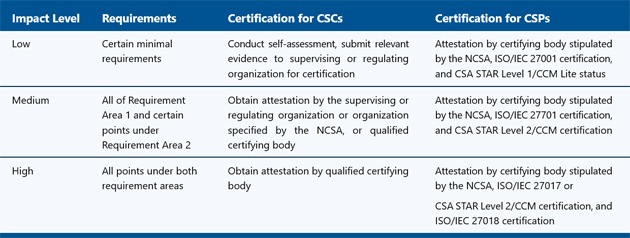
The stipulations of the Cloud Cybersecurity Standards vary depending on the data or information systems’ level of impact. The requirements for each level are summarized in the table below.
For more information on the draft Cloud Cybersecurity Standards, or on any aspect of cybersecurity and cloud-related laws in Thailand, please contact Athistha (Nop) Chitranukroh at [email protected] and Thammapas Chanpanich at [email protected].

RELATED INSIGHTS​ 

January 4, 2024
On December 25, 2023, Thailand’s Personal Data Protection Committee (PDPC) issued two notifications under sections 28 and 29 of the Personal Data Protection Act 2019 (PDPA) that address essential aspects and criteria for the cross-border transfer of personal data. These notifications are scheduled to come into effect on March 24, 2024. Key points in the notifications are outlined below. Adequate Data Protection Standards (Section 28) Unless otherwise provided by the PDPA, the destination country or international organization that receives the transferred personal data must have “adequate data protection standards,” as determined by the following factors: Legal measures and mechanisms. The destination country or international organization must have legal measures or mechanisms aligned with the personal data protection laws in Thailand. Specifically, the obligations of data controllers need to include providing appropriate security measures, implementing personal data protection measures that are suitable and that enable the exercise of data subjects’ rights, and establishing effective legal remedial measures. Regulatory authority. The presence of an agency or organization entrusted with the duties and authority to enforce laws and regulations related to personal data protection is also a critical factor. In addition, this notification empowers the Office of the PDPC to refer cases, either independently identified or proposed by a data controller, to the PDPC for adjudication. The PDPC retains the discretion to make decisions on a case-by-case basis or to establish a list of destination countries or international organizations that it considers to have adequate data protection standards. Binding Corporate Rules and Appropriate Safeguards (Section 29): In the realm of global data exchange, two prominent mechanisms have emerged as key enablers of secure and compliant transfer of personal data: Binding corporate rules (BCRs). Implementation of BCRs involves enforcing an approved policy for safeguarding personal data transferred among affiliated businesses or within the
January 2, 2024
Myanmar’s Ministry of Commerce (MOC) has released updated information regarding the registration fees for online retail businesses. The fees and criteria, which are included in the MOC’s Export/Import Newsletter No. 17/2023 dated December 28, 2023, are laid out below. Registration Fees The official registration fees vary depending on the applicant type: Companies or other commercial organizations: MMK 70,000 (approx. USD 33.5) for registration and renewal; MMK 3,000 (approx. USD 1.5) for each amendment. Small and medium enterprises (SMEs): MMK 50,000 (approx. USD 24) for registration and renewal; MMK 3,000 (approx. USD 1.5) for each amendment. Individual applicants: 30,000 MMK (approx. USD 14.5) for registration and renewal; MMK 3,000 (approx. USD 1.5) for each amendment. Validity Period Registrations approved from January 1, 2024, will be valid for two years from the date of grant. The requirement for online retail businesses to register their operations was announced in July 2023. Based on statements from the MOC, online retail businesses need to complete their registration by late January 2024 to avoid potential enforcement actions. Regarding SMEs, the MOC will also evaluate their SME registration certificate issued by the Agency Office under the Small and Medium Enterprises Development Law 2015. For assistance completing the registration process, or for more details on any aspect of online retail operations in Myanmar, contact Tilleke & Gibbins at [email protected].
December 15, 2023
As part of its membership in Lex Mundi, Tilleke & Gibbins has published an updated edition of its Guide to Doing Business in Thailand for 2023. This guide outlines the key factors for starting and operating a business in the Thai market. Issues covered include: Investment incentives Financial facilities Exchange controls Import and export regulations Structures for doing business Requirements for the Establishment of a Business Operation of the Business Cessation or Termination of the Business Labor legislation, relations, and supply Tax Immigration requirements This publication is part of Lex Mundi’s Country Guides series prepared by member firms in more than 100 jurisdictions worldwide. The guides serve as a useful resource for planning international business strategy and researching new markets. The full Guide to Doing Business in Thailand is available through the button below.
December 15, 2023
Vietnam’s new Law on Electronic Transactions No. 20/2023/QH15 (LOET 2023) was promulgated by the National Assembly on June 22, 2023, and will replace the existing Law on Electronic Transactions No. 51/2005/QH11 (LOET 2005) when it enters into effect on July 1, 2024. The LOET 2023 is aimed at facilitating transactions carried out in an electronic environment in all sectors. Derived from the fundamental principles of the LOET 2005, the LOET 2023 is similarly considered a framework law, developed based on the Model Law on E-Commerce of the United Nations Commission on International Trade Law (UNCITRAL). The main points of interest of the LOET 2023 are summarized below. 1. Scope of Application Unlike the LOET 2005, which explicitly excludes certain areas such as the issuance of certificates of land use rights and birth certificates from the scope of application, the LOET 2023 covers all areas without exception. However, the LOET 2023 will still not interfere with the regulations of substantive laws that stipulate the content, conditions, and forms of transactions in their respective areas (Article 1.2). The LOET 2023 also provides that it will only be applicable if other laws either allow or remain silent on the electronic execution of transactions; otherwise, if another law specifically does not permit a transaction to be carried out electronically, such law shall apply (Article 1.3). This emphasizes that the applicability of the LOET 2023 depends on the electronic readiness of specific sectors. 2. Enabling E-Transactions in All Sectors For traditional transactions or contracts to be legally valid, they typically require written documentation, the signatures of the involved parties, and the seals of organizations or companies, if required by substantive laws or common practice. Additionally, certain sectors mandate further steps like notarization or certification, such as in property transactions like house sales or inheritance
