You are using an outdated browser and your browsing experience will not be optimal. Please update to the latest version of Microsoft Edge, Google Chrome or Mozilla Firefox. Install Microsoft Edge

January 4, 2024

Thailand Unveils Regulations for Cross-Border Personal Data Transfer

On December 25, 2023, Thailand’s Personal Data Protection Committee (PDPC) issued two notifications under sections 28 and 29 of the Personal Data Protection Act 2019 (PDPA) that address essential aspects and criteria for the cross-border transfer of personal data. These notifications are scheduled to come into effect on March 24, 2024.

Key points in the notifications are outlined below.

Adequate Data Protection Standards (Section 28)

Unless otherwise provided by the PDPA, the destination country or international organization that receives the transferred personal data must have “adequate data protection standards,” as determined by the following factors:

  • Legal measures and mechanisms. The destination country or international organization must have legal measures or mechanisms aligned with the personal data protection laws in Thailand. Specifically, the obligations of data controllers need to include providing appropriate security measures, implementing personal data protection measures that are suitable and that enable the exercise of data subjects’ rights, and establishing effective legal remedial measures.
  • Regulatory authority. The presence of an agency or organization entrusted with the duties and authority to enforce laws and regulations related to personal data protection is also a critical factor.

In addition, this notification empowers the Office of the PDPC to refer cases, either independently identified or proposed by a data controller, to the PDPC for adjudication. The PDPC retains the discretion to make decisions on a case-by-case basis or to establish a list of destination countries or international organizations that it considers to have adequate data protection standards.

Binding Corporate Rules and Appropriate Safeguards (Section 29):

In the realm of global data exchange, two prominent mechanisms have emerged as key enablers of secure and compliant transfer of personal data:

  • Binding corporate rules (BCRs). Implementation of BCRs involves enforcing an approved policy for safeguarding personal data transferred among affiliated businesses or within the same group of undertakings in order to jointly operate the business.
  • Appropriate safeguards. Appropriate safeguards not only protect personal data but can also enforce the rights of data subjects and include effective legal remedial measures. These safeguards can take various forms, such as standard contractual clauses.

To be deemed effective mechanisms for cross-border data transfer, both BCRs and appropriate safeguards must do the following:

  • Maintain legal effectiveness and enforceability across all parties involved, including juristic and natural persons, data processors, senders/transferors, and recipients of personal data while complying with personal data protection laws and being binding upon the personnel, employees, staff, any other persons related to the senders/transferors, and recipients of the personal data;
  • Recognize personal data protection, the rights of the data subject, and lodging of complaints in relation to the personal data that has been sent or transferred to a foreign country; and
  • Provide personal data protection measures and security measures that comply with personal data protection laws and with the minimum standards prescribed by law, such as those described in the initial set of subordinate regulations enacted under the PDPA.

In the absence of a decision on adequate data protection standards or where there are no BCRs in place, cross-border transfer of personal data is permissible if appropriate safeguards are implemented. This implementation can take the form of any of the following:

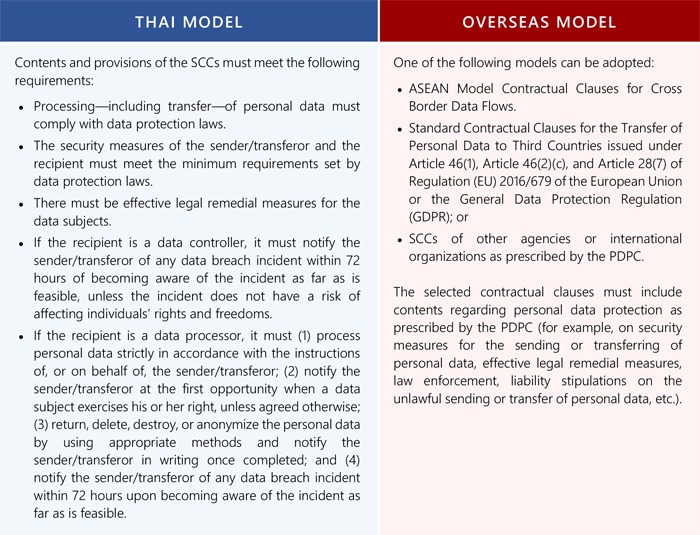
  • Standard contractual clauses (SCCs) that serve as foundational frameworks for establishing legal agreements, especially in the context of cross-border data transfers. In this regard, Thailand currently accepts two distinct SCC models, the Thai Model and the Overseas Model. The specific provisions and applications of each model—either of which can be adopted, as appropriate—are summarized in the table below.
  • Certification of the implementation of the appropriate safeguards in accordance with recognized standards to be determined by the PDPC. These must include the personal data protection contents as prescribed in the notification.
  • Statutes or agreements that are legally binding and enforceable between state agencies in Thailand and foreign state agencies that transfer personal data between each other.

For more details on Thailand’s requirements for the cross-border transfer of personal data, or on any aspect of compliance with the PDPA, please contact Athistha (Nop) Chitranukroh at [email protected], Nopparat Lalitkomon at [email protected], Gvavalin Mahakunkitchareon at [email protected], Thammapas Chanpanich at [email protected], or Punyavee Koaysomboon at [email protected].

RELATED INSIGHTS​ 

September 7, 2026
On September 4, 2026, Thailand’s prime minister convened the first meeting of the Data Center Business Policy Committee. The committee endorsed a draft policy framework for the data center industry and tasked four subcommittees with developing the standards that would sit beneath it, shifting away from fragmented, agency-by-agency approvals toward a unified national strategy aiming to maximize economic value while managing environmental and infrastructure concerns. Proposed Scope and Pillars of the National Data Center Policy Framework The proposed framework would cover all types of data centers, including internal or captive facilities operated within a company or its affiliates, rather than only commercial third-party providers. If adopted in this form, companies running private data centers purely for internal purposes would also become subject to regulatory oversight. Minimum safety and operational standards would be established, with uniform enforcement across all categories. The committee endorsed a draft policy framework with four key pillars: Industrial classification: Data centers exceeding 2 MW would be classified as industrial operations, which may require factory licenses and environmental impact assessments under the Factory Act. Resource pricing: Utility rates would be structured to reflect both direct and indirect costs, supporting green energy and green data center standards. Centralized screening: A centralized review would evaluate project suitability and resource allocation. Operators may be required to submit proposals through periodic “pitching” rounds, where projects are competitively assessed on their potential economic and strategic benefits to Thailand. Digital ecosystem: The framework would prioritize data sovereignty, tax incentives, and conditions promoting domestic digital businesses, AI, and cloud infrastructure. Multidimensional Evaluation Criteria and Subcommittees Four subcommittees will be established to develop standards responsible for the following dimensions: Economic: Criteria for assessing the economic viability of data center projects, for use in prioritizing data centers based on infrastructure readiness, demand type (including AI factories),
September 4, 2026
Foreign business restrictions on telecommunications, treasury center businesses, and intragroup support services were eased when Thailand published the Ministerial Regulation Prescribing Service Businesses Not Requiring Permission for Foreign Business Operations (No. 5) B.E. 2569 (2026) in the Government Gazette on August 28, 2026. The ministerial regulation expands the categories of service businesses that foreign investors may operate without a foreign business license (FBL) under the Foreign Business Act B.E. 2542 (1999) (FBA). Of particular relevance to the telecommunications, fintech, and technology sectors, the ministerial regulation exempts: Type 1 telecommunications licensees, which do not have their own networks; Treasury center businesses operated in accordance with Thailand’s exchange control regulations; and Certain intragroup administrative, human resources, and information technology management services. Telecommunications Services Foreign-owned businesses providing telecommunications services under a type 1 telecommunications license may now operate without obtaining an FBL. This may streamline market entry for qualifying telecommunications and digital infrastructure businesses. The exemption applies only to the FBA licensing requirement. Operators must continue to comply with applicable requirements under the Telecommunications Business Act and the regulations of the National Broadcasting and Telecommunications Commission, and the change does not affect foreign ownership restrictions applicable to type 2 or type 3 telecommunications businesses. Treasury Center Businesses The ministerial regulation also exempts qualifying treasury center businesses from the FBL requirement. This may facilitate centralized treasury functions in Thailand, including liquidity management, foreign exchange management, and intragroup funding arrangements. Treasury center operations remain subject to applicable requirements of the Bank of Thailand and other competent authorities. Intragroup Administrative, HR, and IT Services Certain administrative, human resources, and information technology management services provided between affiliated entities are also exempt, provided the relevant entities satisfy prescribed ownership or management criteria. The exemption is available where the service provider and recipient are related through specified ownership
September 2, 2026
Thailand and China have a longstanding and significant trade relationship, which increasingly extends to e-commerce and digitally enabled supply chains. While these channels create new opportunities for businesses to reach consumers across borders, their growth also brings greater exposure to intellectual property (IP) infringement across jurisdictions and online platforms. Effective cooperation between the two countries’ enforcement authorities has therefore become increasingly important. To strengthen cooperation in this area, Thailand and China signed a memorandum of understanding (MOU) on IP enforcement in Beijing on July 20, 2026, during the Thai prime minister’s official visit to China. Officially titled “Memorandum of Understanding Between the State Administration for Market Regulation of the People’s Republic of China and the Ministry of Commerce of the Kingdom of Thailand on Cooperation in the Field of Intellectual Property Enforcement,” the MOU forms part of a broader bilateral agenda covering industrial and supply chains, participation by micro, small, and medium-sized enterprises (MSMEs), cooperation associated with the ASEAN–China Free Trade Area 3.0, and progress on the registration of Thai geographical indications in China. The MOU establishes a bilateral framework for cooperation and coordination in five broad areas: Strengthening dialogue in IP enforcement; Enhancing information sharing; Facilitating the enforcement of IP rights in cases arising in the parties’ domestic markets and on online platforms, in accordance with their respective domestic laws; Promoting cooperation in IP enforcement training and human resource development; and Undertaking other cooperation activities agreed upon by both sides. The Department of Intellectual Property (DIP) will serve as the principal coordinating agency for Thailand, while the Bureau of Law Enforcement and Inspection in China’s State Administration for Market Regulation (SAMR) will serve in that role for China. The framework is particularly relevant to the growth of e-commerce, as it covers infringement in the domestic markets and on
August 25, 2026
Vietnam has enacted a new decree establishing administrative penalties for violations in the fields of cybersecurity and personal data protection. Decree No. 330/2026/NĐ-CP (Decree 330), issued and effective from August 19, 2026, provides a detailed sanctions framework for noncompliance with the Law on Personal Data Protection (including its implementing regulations under Decree 356/2025/ND-CP) and the Law on Cybersecurity, together with their guiding decrees. The issuance of Decree 330 signals that the practical grace period previously perceived by many businesses may be drawing to a close, with active regulatory enforcement in these areas expected to commence in earnest. Scope and Key Provisions Decree 330 has extraterritorial effect and applies to both onshore and offshore companies. For offshore companies, it applies to those that (1) provide telecommunications, internet, online-content, information-technology, cybersecurity, or cross-border services and (2) are involved in or related to the processing of personal data of Vietnamese citizens and certain other people of Vietnamese origin. Decree 330’s key provisions cover the following areas: Administrative penalties for violations relating to the protection of national security and public order in cyberspace, including the dissemination of unlawful, false, or unverified information. Sanctions for cyberattacks, unauthorized access, introduction of harmful code or programs, and failure to cooperate with specialized cybersecurity forces. Sanctions for personal data protection violations, such as consent, cross-border data transfers, impact assessments, breach notification, and data-subject rights, among others—with maximum fines of up to 5% of an organization’s preceding-year revenue for cross-border transfer violations, or up to VND 3 billion for other data-protection breaches. Personal Data Protection Penalties The key sanctions for personal data protection violations are as follows: Consent violations: Fines of up to VND 70 million (approx. USD 2,642), plus potential additional sanctions and remedial measures including irreversible deletion of personal data collected without consent and confiscation of