
You are using an outdated browser and your browsing experience will not be optimal. Please update to the latest version of Microsoft Edge, Google Chrome or Mozilla Firefox. Install Microsoft Edge

May 15, 2024

Thailand Issues Draft Cybersecurity Standards for Cloud Services

On May 1, 2024, Thailand’s National Cyber Security Committee (NCSC) published the draft NCSC Notification Re: Cloud Cybersecurity Standards for a public hearing period, which was open until May 14, 2024. These standards have been drafted to drive the country’s cloud-first policy with the aim of minimizing risks from cyber threats to cloud services utilized by government agencies, supervising or regulating organizations, and critical information infrastructure (CII) organizations.

The key points of the draft Cloud Cybersecurity Standards are below.

Scope

  • The standards apply to government agencies, supervising or regulating organizations, and CII organizations under the Cybersecurity Act B.E. 2562 (2019), as well as cloud service providers (defined below).
  • The standards prescribe cloud system cybersecurity measures for cloud service customers (defined below) and providers only to the extent that the service is provided to the in-scope organizations outlined above.

Definitions

  • Cloud service customers (CSCs): In-scope organizations that have a formal contractual agreement to use cloud services provided by a cloud service provider.
  • Cloud service providers (CSPs): Persons who enable cloud services to be used by a cloud service customer, responsible for maintaining infrastructure, platforms, and software that enable provision of the cloud services and for managing these resources to ensure their accessibility, security, and scalability for their cloud service customers.

Application

  • In-scope organizations that will use or have been using cloud services must comply with the Cloud Cybersecurity Standards by taking into account their data or technology information systems’ level of impact, as specified in the previously issued Notification of the NCSC Re: Standards for Defining the Security Category for Data and Information Systems B.E. 2566 (2023).
  • The impact level related to personal data is to be rated as being at least at the medium level, and the minimum standards for that level specified in the draft Cloud Cybersecurity Standards must be adopted.
  • In-scope organizations must report their implementation of the Cloud Cybersecurity Standards to the National Cyber Security Agency (NCSA) within 30 days of completing the implementation.
  • The draft Cloud Cybersecurity Standards will come into force one year from their publication in the Government Gazette.

Structure

The requirements in the Cloud Cybersecurity Standards are divided into two areas, (1) cloud security governance and (2) cloud infrastructure and operations:

Requirement Area 1: Cloud Security Governance

  • Information security policies
  • Organization of information security
  • External supplier relationships
  • Compliance

Requirement Area 2: Cloud Infrastructure Security and Operations  

  • Human resource security
  • Asset management
  • Access control
  • Cryptography
  • Physical and environmental security
  • Operational security
  • Communication security
  • System acquisition, development, and maintenance
  • External supplier relationships
  • Information security incident management

Impact Levels and Requirements

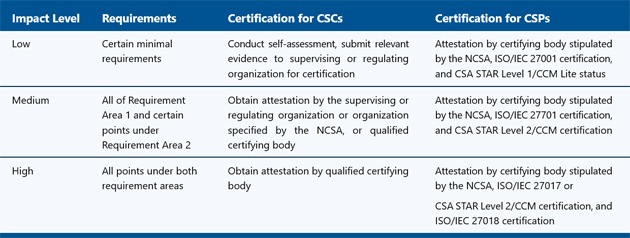
The stipulations of the Cloud Cybersecurity Standards vary depending on the data or information systems’ level of impact. The requirements for each level are summarized in the table below.
For more information on the draft Cloud Cybersecurity Standards, or on any aspect of cybersecurity and cloud-related laws in Thailand, please contact Athistha (Nop) Chitranukroh at [email protected] and Thammapas Chanpanich at [email protected].

RELATED INSIGHTS​ 

March 17, 2025
Tilleke & Gibbins has contributed the Cambodia, Myanmar, Thailand, and Vietnam chapters to Data Protection and Cybersecurity Regulation in Southeast Asia, a wide-ranging guide published by Drew Network Asia (DNA). The resource provides a comprehensive overview of data protection and cybersecurity laws across the region, offering practical insight into compliance requirements and regulatory developments affecting organizations that handle personal data or operate digital services in Southeast Asia. The guide begins with a regional overview, including the broader ASEAN context and cooperation initiatives. Jurisdiction-specific chapters follow a consistent structure—covering data privacy and governance obligations, security requirements and breach notification, outsourcing and cross-border data transfers, and broader accountability and compliance measures. This format allows readers to compare regulatory approaches across markets such as Brunei, Indonesia, Malaysia, the Philippines, Singapore, and others. In addition to the country chapters, the publication addresses cybersecurity and privacy engineering challenges, providing guidance for organizations and outlining obligations applicable to data controllers, processors, and intermediaries. A dedicated section on data breach management across ASEAN examines notification requirements, response considerations, and practical steps for managing incidents in a regional or global context. The guide is intended to serve as a practical reference, and the authors note that specific legal requirements may vary depending on sector, processing activity, or evolving legislation. Readers seeking more detailed advice can contact the practitioners listed in each chapter. The full guide is available for download using the button below or directly from the DNA website.
March 13, 2025
Vietnam’s Ministry of Finance has released a draft Decree on Tax Administration for E-Commerce and Digital Platforms (“Draft Decree”), introducing significant tax compliance obligations that could reshape how digital platforms, and individuals and business households conducting business through the platforms, manage their tax responsibilities. Aimed at strengthening tax enforcement, the Draft Decree requires e-commerce and digital platforms to actively track and withhold taxes from business households and individual sellers, and remit payments to tax authorities. While it has not yet been promulgated, the Draft Decree is expected to take effect on April 1, 2025, leaving platforms with a limited window to prepare for compliance. Who Is Affected by the New Tax Rules? The Draft Decree significantly broadens the tax administration scope beyond traditional e-commerce platforms to cover a wide range of digital economy participants. Specifically, the Draft Decree places direct tax-related responsibilities on two major categories (collectively, “Regulated Operators”): E-commerce and digital platforms with payment functions (e.g., platforms that process buyer payments via e-wallets, bank transfers, cards, or cash-on-delivery); and Other digital-economy players that enable e-commerce transactions, including (i) intermediary service platforms connecting service providers with consumers, (ii) digital content platforms, (iii) online advertising providers, (iv) cloud computing and data storage providers, (v) social media platforms engaged in business activities (e.g., live-stream, in-app transactions), (vi) online education, gaming, and digital entertainment platforms generating revenue from digital transactions, (vii) Vietnam-based partners of foreign digital service providers facilitating local payments for overseas platforms, and (viii) intermediary payment service providers handling financial transactions for e-commerce activities. Under the Draft Decree, Regulated Operators will be required to track, report, and enforce tax compliance for both resident and nonresident individuals and households conducting business through their platforms (“Sellers”). What New Tax Obligations Do Platforms Face? Onshore platforms For the first time, Regulated Operators will
March 10, 2025
Thailand’s Securities and Exchange Commission (SEC) will officially add USD Coin (USDC) and Tether (USDT) to its list of approved cryptocurrencies for use in digital asset transactions on March 16, 2025. The addition is a significant move that expands Thailand’s digital asset market, aiming to enhance market flexibility and provide more payment options for investors and traders in Thailand’s digital asset ecosystem. Under the SEC regulations, digital asset operators, including digital token issuers, ICO portals, and digital asset exchanges, are only permitted to accept, conduct transactions with, and use “approved cryptocurrencies” as trading pairs. After the addition of USDC and USDT, the full list of approved cryptocurrencies will include: Bitcoin (BTC) Ethereum (ETH) Ripple (XRP) Stellar (XLM) Tether (USDT) USD Coin (USDC) Other cryptocurrencies used for testing programmable payments under the enhanced regulatory sandbox in accordance with the Bank of Thailand’s rules and conditions. For more information on these new additions, or on any aspect of digital assets and cryptocurrency in Thailand, please contact Kobkit Thienpreecha at [email protected], Pornpan Wichawut at [email protected], Napassorn Lertussavavivat at [email protected], or Rujaporn Paritsantik at [email protected].
February 28, 2025
Vietnam’s Decree No. 163/2024/ND-CP (Decree 163), which has been in full effect since January 1, 2025, provides crucial guidance on the implementation of Vietnam’s 2023 Telecom Law. Decree 163 replaced Decree No. 25/2011/ND-CP dated April 6, 2011 (Decree 25), which guided the implementation of the previous 2009 Telecom Law, and introduces many notable changes to the regulations on telecom service provision. Some key changes that will impact businesses engaged in the telecom sector in Vietnam are detailed below. 1. Classification of Telecom Services The classification of telecom services into “basic telecom services” and “value-added telecom services” has been retained, in alignment with Vietnam’s WTO commitments in the telecom sector. However, Decree 163 expands the scope of both categories, as follows: Basic telecom services: “Transmission services for machine-to-machine (M2M) communication” and “leasing services of all or part of the telecom network” are added. “Image transmission services” is changed to “transmission services for radio and television.” Value-added telecom services: “Data center services,” “cloud computing services,” and “basic telecom services over the internet” (also known as over-the-top (OTT) telecom services) are added. 2. M2M Communication Services Since M2M communication services are classified as basic telecom services, without exception, they are subject to the same regulatory framework. Specifically: Cross-border provision: M2M communication services provided across borders must be conducted through a commercial agreement with a Vietnamese telecom enterprise licensed to provide telecom services with an international communication scope. Onshore provision: Onshore M2M communication services will require a telecom license. 3. New Telecom Services (Data Center, Cloud, and OTT Telecom Services) The 2023 Telecom Law adopted a light-touch management approach for data center, cloud, and OTT telecom services by not requiring the same licensing as previously regulated value-added telecom services, but instead mandating registration or notification before service provision. Decree 163 offers clearer guidance
