
You are using an outdated browser and your browsing experience will not be optimal. Please update to the latest version of Microsoft Edge, Google Chrome or Mozilla Firefox. Install Microsoft Edge

May 15, 2024

Thailand Issues Draft Cybersecurity Standards for Cloud Services

On May 1, 2024, Thailand’s National Cyber Security Committee (NCSC) published the draft NCSC Notification Re: Cloud Cybersecurity Standards for a public hearing period, which was open until May 14, 2024. These standards have been drafted to drive the country’s cloud-first policy with the aim of minimizing risks from cyber threats to cloud services utilized by government agencies, supervising or regulating organizations, and critical information infrastructure (CII) organizations.

The key points of the draft Cloud Cybersecurity Standards are below.

Scope

  • The standards apply to government agencies, supervising or regulating organizations, and CII organizations under the Cybersecurity Act B.E. 2562 (2019), as well as cloud service providers (defined below).
  • The standards prescribe cloud system cybersecurity measures for cloud service customers (defined below) and providers only to the extent that the service is provided to the in-scope organizations outlined above.

Definitions

  • Cloud service customers (CSCs): In-scope organizations that have a formal contractual agreement to use cloud services provided by a cloud service provider.
  • Cloud service providers (CSPs): Persons who enable cloud services to be used by a cloud service customer, responsible for maintaining infrastructure, platforms, and software that enable provision of the cloud services and for managing these resources to ensure their accessibility, security, and scalability for their cloud service customers.

Application

  • In-scope organizations that will use or have been using cloud services must comply with the Cloud Cybersecurity Standards by taking into account their data or technology information systems’ level of impact, as specified in the previously issued Notification of the NCSC Re: Standards for Defining the Security Category for Data and Information Systems B.E. 2566 (2023).
  • The impact level related to personal data is to be rated as being at least at the medium level, and the minimum standards for that level specified in the draft Cloud Cybersecurity Standards must be adopted.
  • In-scope organizations must report their implementation of the Cloud Cybersecurity Standards to the National Cyber Security Agency (NCSA) within 30 days of completing the implementation.
  • The draft Cloud Cybersecurity Standards will come into force one year from their publication in the Government Gazette.

Structure

The requirements in the Cloud Cybersecurity Standards are divided into two areas, (1) cloud security governance and (2) cloud infrastructure and operations:

Requirement Area 1: Cloud Security Governance

  • Information security policies
  • Organization of information security
  • External supplier relationships
  • Compliance

Requirement Area 2: Cloud Infrastructure Security and Operations  

  • Human resource security
  • Asset management
  • Access control
  • Cryptography
  • Physical and environmental security
  • Operational security
  • Communication security
  • System acquisition, development, and maintenance
  • External supplier relationships
  • Information security incident management

Impact Levels and Requirements

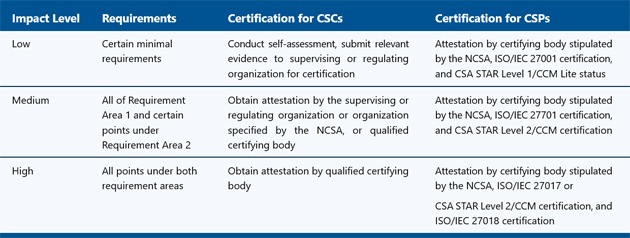
The stipulations of the Cloud Cybersecurity Standards vary depending on the data or information systems’ level of impact. The requirements for each level are summarized in the table below.
For more information on the draft Cloud Cybersecurity Standards, or on any aspect of cybersecurity and cloud-related laws in Thailand, please contact Athistha (Nop) Chitranukroh at [email protected] and Thammapas Chanpanich at [email protected].

RELATED INSIGHTS​ 

April 30, 2025
With a favorable crypto climate from the Trump administration in the United States, Thailand is ready for digital asset platforms and has market appetite. This article highlights the country’s regulatory initiatives supporting the growth of digital assets like crypto, stablecoins, and smart contracts, along with efforts to establish clear oversight. Bank of Thailand Sandbox Stablecoins used as a medium of payment, particularly those pegged to the Thai baht (THB) for public use, are considered as mirroring fiat currency, which violates the Currency Act B.E. 2501 (1958). These can also be classified as e-money under the Payment Systems Act B.E. 2560 (2017). The Bank of Thailand (BOT) urges issuers to engage in preconsultation prior to implementation, due to concerns about stablecoins being used in place of THB currency. Other FX- or asset-backed stablecoins are not recognized as legal tender under Thai law, and users must bear their own risks. The BOT recognizes the potential and benefits of these technologies in reducing operational costs for financial service providers and addressing the needs of financial service users. Consequently, the BOT issued a sandbox framework in June 2024. In particular, the enhanced regulatory sandbox allows nonlicensed entities to test financial innovations in controlled conditions. These tests must have a clearly defined duration (usually under one year) and involve a limited user group with an exit strategy. Several programmable payment projects—automated transactions with predefined conditions for the payment of goods and services—were piloted under this sandbox, which closed for applications in September 2024. Eight participants are planning to launch their test runs this year, some of which include asset tokenization or exchange global stablecoins in their programmable payment projects. Thai Securities and Exchange Commission Sandbox Given that digital asset businesses fall under the Royal Decree on Digital Asset Businesses B.E. 2561 (2018), supervised by
April 30, 2025
The Bank of Thailand (BOT) is accepting public comments until May 2, 2025, on three draft notifications that will institute an enhanced supervision scheme and impose additional requirements for systemically important retail payment system (SIRPS) operators to align with international standards and encourage open infrastructure and competition. The SIRPS operators will be determined by the BOT from the “designated payment system operators” under the Payment Systems Act B.E. 2560 (2017). SIRPS Designation The BOT will announce a list of payment system operators designated as SIRPS operators and thus subject to enhanced supervision. The BOT will evaluate whether the payment system operator should be deemed a SIRPS operator when it meets the criteria in either the BOT’s quantitative or qualitative assessments, which cover the following: Quantitative assessment: The payment system’s transaction values, market share, cross-border payment network scale and value, and settlement with other financial market infrastructure. Qualitative assessment: The payment system’s function as a part of the country’s payment system infrastructure, the significance of the system users’ roles in the payment services, the substitutability of the payment system, and the impact level on the public and users in the event of an emergency or system suspension. Supervision of SIRPS Business Operations SIRPS operators will be subject to heightened supervision in three areas, in addition to various BOT regulations on designated payment system supervision, as follows: Governance: SIRPS operators will be required to have a balanced board composition with an independent director and directors with varied expertise, establish subcommittees to assist the board in supervising the operator’s compliance with its policy and strategy, and have senior executives overseeing risk and technology security separately from the executives overseeing business operations. Risk management and security: SIRPS operators will be required to have comprehensive risk management to ensure system stability and security. This
April 28, 2025
In recent years, Vietnam has positioned itself among the leading countries in the world in terms of digital asset ownership and trading volume. This rapid adoption reflects the country’s growing digital economy and the increasing engagement of individuals and businesses in blockchain-based financial activities. Central to this growth are Resolution No. 57-NQ/TW of the Politburo dated December 22, 2024, on breakthroughs in science, technology, innovation, and national digital transformation with a vision to 2045 (“Resolution 57”) and Resolution No. 03/NQ-CP of the Government dated January 9, 2025, promulgating the Action Plan to Implement Resolution 57 (“Resolution 03”), which outline a flexible and innovative policy framework that embraces pilot programs for emerging technologies to lay the groundwork for Vietnam’s legislative framework concerning cryptocurrency and blockchain technologies. Regulatory clarity in terms of digital assets and blockchain technologies is now more critical than ever for businesses and investors. In light of this, Vietnam is currently in the process of introducing three key legal instruments, with drafts of the Law on Digital Technology Industry (“Draft DTI Law”), Resolution of the National Assembly on the Establishment of Regional and International Financial Centers in Vietnam (“Draft Financial Center Resolution”), and Resolution of the Government on the Pilot Implementation of Crypto Asset Markets in Vietnam (“Draft Crypto Pilot Resolution”) nearing promulgation. Current Regulatory Direction and Schedule Vietnam’s regulatory framework for crypto assets and blockchain has been in a developmental stage since 2017, focusing on directions, plans, and schedules rather than established regulations. In February 2024, under Decision No. 194/QD-TTg of the Prime Minister, the Ministry of Finance (MOF) was assigned to draft a legal framework to either prohibit or regulate virtual assets and service providers by May 2025, signaling a clearer regulatory direction. In March 2025, Directive No. 05/CT-TTg of the Prime Minister directed the MOF
April 18, 2025
On April 12, 2025, Thailand published an amendment to the Emergency Decree on Measures for the Prevention and Suppression of Technological Crimes in the Government Gazette, with the regulation taking effect the following day. Drafts of the amendment had been shared in recent months, and the final amendment of the decree contains some additional key revisions, such as narrowing the business operators subject to the decree’s requirements, reducing operators’ obligations, and establishing collaboration between relevant stakeholders to tackle technology crime. These key revisions to the amendment are detailed below. Business operators subject to the decree: The business operators covered under the decree now include only payment service providers under the Payment System Act and digital asset operators under the Royal Decree on Digital Asset Businesses. Digital platform services under the Royal Decree on Digital Platform Service Businesses That Are Subject to Prior Notification are no longer within the scope of the decree. Definition of technology crime: The final version of the amendment removed the expanded definition of technology crime that had been included in a previous draft, leaving the decree’s existing definition unchanged. Telecommunications provider obligations: Mobile and telecommunications service providers now have an obligation to monitor and screen for content that may be related to technology crime and suspend SIM cards when instructed to do so by the National Broadcasting and Telecommunications Commission (NBTC). Transaction and account suspension: The amendment removes the decree’s complex transaction suspension procedures and leaves room for business-specific regulators (e.g., Bank of Thailand, Securities and Exchange Commission, NBTC) to impose various technology crime suspension requirements on business operators under their supervision. The newly established Center for Prevention and Suppression of Technology Crimes can also notify financial institutions and business operators of names or digital asset wallet addresses that may be related to technology crime,
