
You are using an outdated browser and your browsing experience will not be optimal. Please update to the latest version of Microsoft Edge, Google Chrome or Mozilla Firefox. Install Microsoft Edge

May 15, 2024

Thailand Issues Draft Cybersecurity Standards for Cloud Services

On May 1, 2024, Thailand’s National Cyber Security Committee (NCSC) published the draft NCSC Notification Re: Cloud Cybersecurity Standards for a public hearing period, which was open until May 14, 2024. These standards have been drafted to drive the country’s cloud-first policy with the aim of minimizing risks from cyber threats to cloud services utilized by government agencies, supervising or regulating organizations, and critical information infrastructure (CII) organizations.

The key points of the draft Cloud Cybersecurity Standards are below.

Scope

  • The standards apply to government agencies, supervising or regulating organizations, and CII organizations under the Cybersecurity Act B.E. 2562 (2019), as well as cloud service providers (defined below).
  • The standards prescribe cloud system cybersecurity measures for cloud service customers (defined below) and providers only to the extent that the service is provided to the in-scope organizations outlined above.

Definitions

  • Cloud service customers (CSCs): In-scope organizations that have a formal contractual agreement to use cloud services provided by a cloud service provider.
  • Cloud service providers (CSPs): Persons who enable cloud services to be used by a cloud service customer, responsible for maintaining infrastructure, platforms, and software that enable provision of the cloud services and for managing these resources to ensure their accessibility, security, and scalability for their cloud service customers.

Application

  • In-scope organizations that will use or have been using cloud services must comply with the Cloud Cybersecurity Standards by taking into account their data or technology information systems’ level of impact, as specified in the previously issued Notification of the NCSC Re: Standards for Defining the Security Category for Data and Information Systems B.E. 2566 (2023).
  • The impact level related to personal data is to be rated as being at least at the medium level, and the minimum standards for that level specified in the draft Cloud Cybersecurity Standards must be adopted.
  • In-scope organizations must report their implementation of the Cloud Cybersecurity Standards to the National Cyber Security Agency (NCSA) within 30 days of completing the implementation.
  • The draft Cloud Cybersecurity Standards will come into force one year from their publication in the Government Gazette.

Structure

The requirements in the Cloud Cybersecurity Standards are divided into two areas, (1) cloud security governance and (2) cloud infrastructure and operations:

Requirement Area 1: Cloud Security Governance

  • Information security policies
  • Organization of information security
  • External supplier relationships
  • Compliance

Requirement Area 2: Cloud Infrastructure Security and Operations  

  • Human resource security
  • Asset management
  • Access control
  • Cryptography
  • Physical and environmental security
  • Operational security
  • Communication security
  • System acquisition, development, and maintenance
  • External supplier relationships
  • Information security incident management

Impact Levels and Requirements

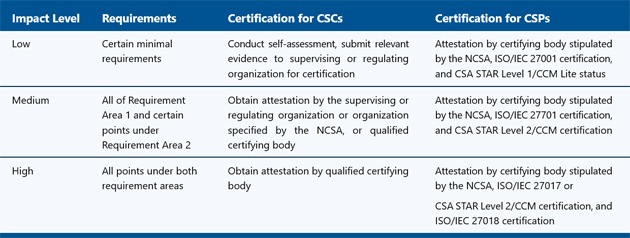
The stipulations of the Cloud Cybersecurity Standards vary depending on the data or information systems’ level of impact. The requirements for each level are summarized in the table below.
For more information on the draft Cloud Cybersecurity Standards, or on any aspect of cybersecurity and cloud-related laws in Thailand, please contact Athistha (Nop) Chitranukroh at [email protected] and Thammapas Chanpanich at [email protected].

RELATED INSIGHTS​ 

April 18, 2025
On April 12, 2025, Thailand issued an amended digital asset regulation that covers offshore digital asset businesses providing services on a cross-border basis to Thai users. These businesses will now be subject to the licensing requirements of the Royal Decree on Digital Asset Business Operations B.E. 2561 (2018), which is supervised by Thailand’s Securities and Exchange Commission (SEC). A digital asset business will be deemed as providing services in Thailand—and therefore subject to requirements under the Royal Decree on Digital Asset Business Operations—if the business does any of the following: Displays content in Thai, either fully or partially; Is registered under a “.th,” or “.ไทย” domain, contains any name relating to Thailand, or uses a domain written in Thai characters; Allows or requires payments in Thai baht (THB) or receives payments through Thai bank accounts or e-wallets; Chooses Thai law to govern transactions or Thai courts to litigate any dispute; Pays online search engines to attract users in Thailand to its services; Has an office, establishment, or personnel in Thailand to support or assist users within the country; or Meets any other criteria specified by the SEC. To operate legally in Thailand, offshore operators meeting any of the above criteria will be required to incorporate a local company in Thailand in order to apply for a digital asset business license with the SEC.
April 11, 2025
Vietnam’s draft Personal Data Protection Law (PDPL) continues to evolve, with significant implications for businesses operating in the region. The latest draft, released to the public in March 2025, contains several noteworthy changes from the previous draft that businesses with operations in Vietnam should be aware of when developing their data protection strategies and compliance frameworks. The draft PDPL will be submitted to the vote of the National Assembly in May 2025 with a tentative entry into force on January 1, 2026. Key Changes in the Latest Draft PDPL 1. Redefined Categories of Personal Data The draft PDPL has made important revisions to personal data classifications: Basic personal data: An individual’s image is no longer classified as basic personal data. Sensitive personal data: Bank account information has been removed from this classification (and is now considered basic personal data), but two new categories have been added: (i) salary, allowances, and other income sources, and (ii) information on land users and information on land containing such information. Organizations should review their data classification schemes and update protection measures accordingly, particularly for salary and compensation information. 2. Data Encryption Requirements The draft PDPL explicitly states that encrypted data remains classified as personal data. Additionally, it mandates that sensitive personal data must be encrypted when stored, transmitted, received, or shared in cyberspace. Organizations and individuals can freely opt for one or more encryption solutions and encryption/decryption processes suitable for their personal data management and administration activities. 3. Biometric Data Processing The latest draft PDPL adds new protection requirements for biometric data. Organizations processing biometric data (such as fingerprints) must: Implement physical security measures for devices storing and transmitting biometric data. Use strong encryption methods during transmission and storage. Restrict access to biometric data. Have early-detection monitoring systems to detect violations of biometric
April 10, 2025
After making revisions to the initial draft notification released in November 2024, Thailand’s Electronic Transactions Development Agency (ETDA) has released an updated draft Notification on Additional Obligations for Digital Platform Service Operators of Online Marketplaces for Goods with Specific Characteristics under Section 18(2) of the Royal Decree on the Operation of Digital Platform Service Businesses Subject to Prior Notification B.E. 2565 (2022) B.E. … . A focus group session was also held to gather feedback from business operators. Below is a summary of key provisions in the new draft. Unchanged Items Some key concerns that remain unchanged from the previous version of the draft notification include the following: Offshore business operators running online marketplaces that act as intermediaries for the sale or exchange of goods and provide facility services for the sale of goods (referred to as “specific marketplace operators” in the draft) are required to establish a local entity in Thailand. However, the criteria for determining which operators are specific marketplace operators are still under discussion due to feedback from business operators. Specific marketplace operators must submit a compliance report to the ETDA along with their annual report each year. Specific marketplace operators must verify that “business users” (e.g., merchants) provide complete details about goods in accordance with product standardization requirements. Removed Obligations The updated draft notification has removed specific marketplace operators’ obligations to: Conduct Identity Assurance Level 2 (IAL2) verification of business users before onboarding them on their platforms. Submit a registry of business users’ information to the ETDA. Retain business users’ information for a specified retention period. Implement measures to filter reviews of products subject to specific standards. Revisions Key revisions made to the draft notification include the following: The effective date has been extended to 120 days after the notification’s publication in the Government Gazette,
March 18, 2025
On February 6, 2025, the prime minister of Vietnam, Pham Minh Chinh, chaired an online meeting to review the progress of Vietnam’s digital transformation agenda. The meeting assessed achievements under the National Digital Transformation Program and Project 06 on the development and application of population data, electronic identification, and authentication for national digital transformation for the period 2022-2025, with a vision to 2030, approved by the prime minister in 2022. The meeting also outlined key legislative and regulatory priorities for 2025, as set forth in Notice No. 56/TB-BPCP issued by the Government Office on February 23, 2025 (Notice 56). One of the central focuses of the 2025 digital transformation agenda is the development and issuance of laws and regulations governing digital technology, data management, and cybersecurity. Below are the key legal developments provided in Notice 56 that stakeholders should anticipate in the coming months. 1. Law on Digital Technology Industry The Ministry of Information and Communications (MIC) has been tasked with finalizing the draft Law on Digital Technology Industry (DTI Law) for submission to the National Assembly at its 9th session in May 2025. This law is expected to establish a comprehensive legal framework for the digital technology sector, addressing regulatory gaps in emerging fields such as artificial intelligence (AI), Internet of Things (IoT), cloud computing, big data and platform services to promote innovation, ensure data security, and support the growth of the digital economy in Vietnam. Concurrently, the MIC will expedite the issuance of guiding decrees to ensure the swift implementation of the DTI Law once enacted. 2. Law on Personal Data Protection and regulations guiding implementation of Data Law The Ministry of Public Security (MPS) is making efforts to finalize the long-anticipated Law on Personal Data Protection (PDPL)—data protection is currently governed by Decree No. 13/2023/ND-CP on
