You are using an outdated browser and your browsing experience will not be optimal. Please update to the latest version of Microsoft Edge, Google Chrome or Mozilla Firefox. Install Microsoft Edge

July 7, 2021

Thailand Introduces Online Ride-Hailing Services Regulations

Thailand’s Transport Ministry has issued new rules for ride-hailing services, aiming to strictly regulate the types of vehicle that can be registered, the number of registered vehicles per user, and the fees that are levied and collected. These rules are laid out in the Ministerial Regulation Re: Ride-Hailing Service Vehicle via an Electronic System B.E. 2564 (2021), which was published in the Royal Gazette on June 23, 2021.

Under the regulation, a personal vehicle transporting no more than seven passengers can be subsequently registered as a “ride-hailing service vehicle via an electronic system.” An individual is only allowed to register one private vehicle under the regulation. The vehicle registrations are classified as follows:

  • Small vehicles with a maximum engine power of 50–90 kilowatts;
  • Medium vehicles with a maximum engine power of 91–120 kilowatts; or
  • Large vehicles with a maximum engine power of more than 120 kilowatts.

In the case of an electric vehicle, it must be able to travel at a speed of at least 90 km/h.

Each ride-hailing vehicle must be covered by a service-providing communication system operated by an electronic service provider (e.g., a ride-hailing app) that has been endorsed and approved by the Department of Land Transport (DLT). This system must communicate the following details:

  • Car and driver information;
  • Driver’s identity system;
  • Pre-calculated fare;
  • Car tracking system;
  • Time and location validation system; and
  • Complaint and emergency system.

All data records must be retained for at least one month for examination purposes.

The regulation further prescribes that the vehicle must display a sign indicating that it is a ride-hailing service vehicle operating via an electronic system, and the vehicle must be the same color as appears in the personal vehicle registration certificate prior to its registration as a ride-hailing vehicle.

Registration under the regulation is valid for nine years. The ride-hailing vehicle registration plate’s size, specifications, and color are identical to the criteria for registering personal vehicles carrying no more than seven people, meaning that the same vehicle registration plate can be used for the ride-hailing vehicle. The condition of the ride-hailing vehicle must also be examined annually, as prescribed by ministerial regulations under the Vehicle Act B.E. 2522 (1979), and both the interior and exterior must be kept clean and tidy.

Service Fees

The regulation empowers the minister of transport to prescribe the fees for ride-hailing vehicles; the current fees are outlined in the table below.
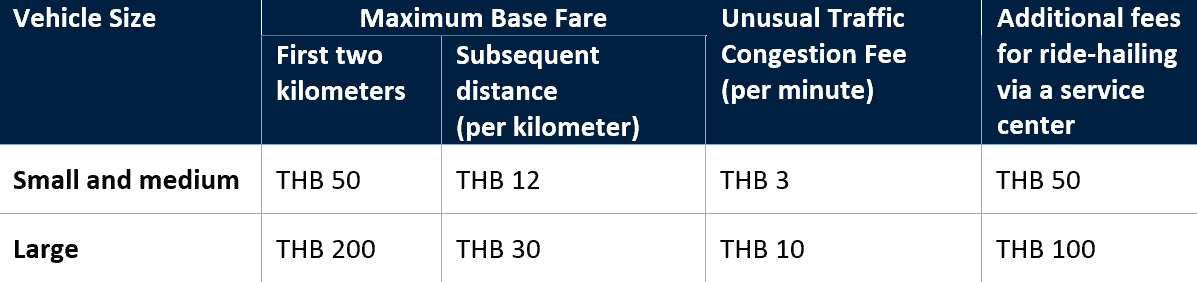
All fees must be shown to the passenger before the provision of any service, and only this same amount can be charged and collected.

For more details about this regulation, or about any aspect of transportation and technology laws in Thailand, please contact Charuwan Charoonchitsathian at [email protected] or +66 2056 5657, or Panchanit Trakarnvanich at [email protected] or +66 2056 5531.

RELATED INSIGHTS​ 

June 12, 2025
Thailand’s Ministry of Finance has issued a royal decree placing the business of hire purchase and leasing of cars and motorcycles under the scope of the Financial Institution Business Act B.E. 2551 (2008), effective December 2, 2025. This is to ensure appropriate regulatory oversight of these business activities, as they function similarly to credit granting and serve as a source of funding for the public with a broad impact on the overall economic system and consumers at large. The business operators that this royal decree applies to include corporate entities engaging regularly in the business of hire purchase or leasing of cars or motorcycles, currently excluding: Financial institutions and specialized financial institutions. Individuals operating such businesses (noncorporate entities). Cooperatives. Key regulatory obligations of this royal decree include the following: Business operators must disclose interest rates, service fees, and other relevant business information to the public and report to the Bank of Thailand (BOT). Business operators must display how the annual percentage rate (APR), including all annual charges covering interest and service fees, is calculated. Business operators must maintain accurate accounting records in accordance with recognized accounting standards. The BOT may issue warnings or suspend operations if business operators fail to comply with this royal decree or act unfairly in a way that may result in serious harm to customers. Directors, managers, and responsible persons of any business operator that violates this royal decree may also be subject to the prescribed penalties. Before the royal decree takes effect, business operators should conduct internal assessments and engage with counsel to prepare for regulatory implementation. The BOT is expected to issue further subordinate regulations and guidance regarding: Interest, service fees, deposits, collateral, benefits, and penalties that may be charged by business operators. Contract content, methods of benefit calculation, and format in conducting
June 11, 2025
Myanmar’s Ministry of Commerce has established new regulatory measures for importing electric vehicles (EVs) as part of a pilot project running from January 2025 to March 31, 2026, while the Ministry of Planning and Finance has reduced customs duty rates for fuel-powered vehicles manufactured domestically under semi-knocked down (SKD) and completely knocked down (CKD) systems, effective June 1, 2025, to May 31, 2026. Importation of EVs On May 29, 2025, Myanmar’s Ministry of Commerce (MOC) issued an announcement regarding the importation of EVs from abroad as part of its pilot project, detailed in MOC Notification No. 40/2025. The MOC notification establishes the following regulatory measures to support the development of EVs and related businesses: Approval must be obtained from the National-Level Steering Committee for the Development of Electric Vehicles and Related Enterprises. A registration certificate for an EV sales showroom must be secured. Vehicles must be imported in accordance with the permitted number and standards defined by the National-Level Steering Committee for the Development of Electric Vehicles and Related Enterprises. The importing company must provide necessary arrangements for warranties on imported EVs, spare parts, and after-sales services. For companies wishing to open a sales showroom, the following requirements apply: The company must be a registered national or joint venture entity with the Directorate of Investment and Company Administration. The company must be officially appointed as a distributorship or dealership by the original company or regional office for each brand. A permit from the respective state or regional government and a business license from the respective Municipal Committee must be obtained. The company must provide evidence of tax clearance issued by the Internal Revenue Department. Standards for the showroom, building, and warehouse, as issued periodically by the MOC, must be adhered to, including: Compound area: 10,000 square feet (the total
May 28, 2025
Tilleke & Gibbins attorneys in Vietnam have contributed the 2025 edition of Doing Business in Vietnam, a comprehensive Q&A-style resource from Thomson Reuters Practical Law that provides essential insights for companies navigating business operations in Vietnam. The guide presents a detailed overview of the country’s legal framework and regulatory environment, reflecting recent updates in Vietnamese legislation and practice. This annually updated guide offers key information on the following areas: Legal system: Structure of the Vietnamese judiciary and the role of codified law. Foreign investment: Conditions for market access, licensing requirements, foreign ownership restrictions, and investment incentives. Business vehicles: Formation and operation of legal entities, including limited liability companies, joint-stock companies, and representative offices. Employment: Employment contracts, social insurance, labor rights, and procedures for hiring foreign nationals. Tax: Overview of corporate income tax, personal income tax, value-added tax, and other tax obligations. Intellectual property: Procedures for protecting and enforcing patents, trademarks, copyrights, and other IP rights. Data protection: Compliance requirements under Vietnam’s data privacy laws, including the Personal Data Protection Decree. Competition law: Antitrust rules and regulatory oversight under the Law on Competition. Anti-bribery and corruption: Legal framework and enforcement practices aimed at curbing corrupt activities. E-commerce and digital business: Regulations governing online platforms, digital content, and cross-border services. Marketing and advertising: Laws and guidelines on advertising standards and consumer protection. Product regulation and liability: Safety requirements, product liability issues, and roles of relevant authorities. Doing Business in Vietnam is part of Practical Law’s global series of legal guides designed to support international practitioners and businesses. To access the most recent edition of the Vietnam guide, visit the Practical Law website and sign up for a free trial.
May 28, 2025
Thailand’s Food and Drug Administration (FDA) has launched a strategic collaboration with leading e-commerce platforms Lazada and Shopee to strengthen regulatory oversight of health-related products sold online. This partnership is part of a broader initiative to enhance consumer protection, enforce compliance with Thai health regulations, and foster a safer digital marketplace for health products. As part of this initiative, the Thai FDA is urging all sellers—particularly cross-border vendors—to secure proper FDA registration for their products before market entry. The objective is to ensure that only legally authorized, safe, and quality-assured healthcare products are available to Thai consumers. In pursuit of this goal, the FDA has been working closely with Lazada and Shopee to implement proactive surveillance mechanisms aimed at identifying and removing noncompliant, substandard, or unregistered products. This collaboration has already yielded measurable results. Between September 2023 and 2024, Lazada supported regulatory enforcement by removing 9,454 noncompliant listings and delisting 30 vendors. In addition, 134 sellers were subjected to legal proceedings for regulatory violations. Shopee has taken a similarly rigorous stance, committing to the immediate removal of products found to be in breach of FDA regulations. The platform has also provided educational materials for merchants and implemented consumer complaint mechanisms to enhance accountability. Looking ahead, the Thai FDA plans to roll out a data integration system utilizing API technology, enabling seamless and secure exchange of regulatory data between the agency and e-commerce platforms. This system will be supported by comprehensive training for both Thai FDA officials and e-commerce staff, with a particular focus on the use of the Thai government’s Law Enforcement Request Portal, a secure communication channel for coordinating enforcement actions between government agencies and platform operators. Additionally, a joint product inspection framework is currently under development in partnership with Lazada and Shopee. This framework will incorporate strict