You are using an outdated browser and your browsing experience will not be optimal. Please update to the latest version of Microsoft Edge, Google Chrome or Mozilla Firefox. Install Microsoft Edge

July 7, 2021

Thailand Introduces Online Ride-Hailing Services Regulations

Thailand’s Transport Ministry has issued new rules for ride-hailing services, aiming to strictly regulate the types of vehicle that can be registered, the number of registered vehicles per user, and the fees that are levied and collected. These rules are laid out in the Ministerial Regulation Re: Ride-Hailing Service Vehicle via an Electronic System B.E. 2564 (2021), which was published in the Royal Gazette on June 23, 2021.

Under the regulation, a personal vehicle transporting no more than seven passengers can be subsequently registered as a “ride-hailing service vehicle via an electronic system.” An individual is only allowed to register one private vehicle under the regulation. The vehicle registrations are classified as follows:

  • Small vehicles with a maximum engine power of 50–90 kilowatts;
  • Medium vehicles with a maximum engine power of 91–120 kilowatts; or
  • Large vehicles with a maximum engine power of more than 120 kilowatts.

In the case of an electric vehicle, it must be able to travel at a speed of at least 90 km/h.

Each ride-hailing vehicle must be covered by a service-providing communication system operated by an electronic service provider (e.g., a ride-hailing app) that has been endorsed and approved by the Department of Land Transport (DLT). This system must communicate the following details:

  • Car and driver information;
  • Driver’s identity system;
  • Pre-calculated fare;
  • Car tracking system;
  • Time and location validation system; and
  • Complaint and emergency system.

All data records must be retained for at least one month for examination purposes.

The regulation further prescribes that the vehicle must display a sign indicating that it is a ride-hailing service vehicle operating via an electronic system, and the vehicle must be the same color as appears in the personal vehicle registration certificate prior to its registration as a ride-hailing vehicle.

Registration under the regulation is valid for nine years. The ride-hailing vehicle registration plate’s size, specifications, and color are identical to the criteria for registering personal vehicles carrying no more than seven people, meaning that the same vehicle registration plate can be used for the ride-hailing vehicle. The condition of the ride-hailing vehicle must also be examined annually, as prescribed by ministerial regulations under the Vehicle Act B.E. 2522 (1979), and both the interior and exterior must be kept clean and tidy.

Service Fees

The regulation empowers the minister of transport to prescribe the fees for ride-hailing vehicles; the current fees are outlined in the table below.
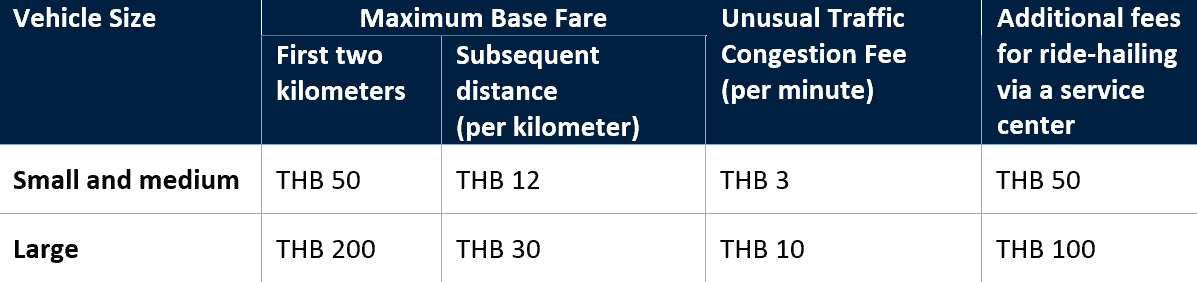
All fees must be shown to the passenger before the provision of any service, and only this same amount can be charged and collected.

For more details about this regulation, or about any aspect of transportation and technology laws in Thailand, please contact Charuwan Charoonchitsathian at [email protected] or +66 2056 5657, or Panchanit Trakarnvanich at [email protected] or +66 2056 5531.

RELATED INSIGHTS​ 

May 26, 2025
On May 21, 2025, the Trade Competition Commission of Thailand (TCCT) published a press release signaling heightened regulation of digital platforms in response to the influx of products from foreign countries being sold in Thailand via e-commerce platforms. In recent years, the rapid expansion of cross-border multi-sided e-commerce platforms has unlocked unprecedented growth, but it has also flooded Thailand’s digital marketplaces with low-cost imports sold by unregulated foreign vendors via these platforms, unfairly undercutting local merchants’ market share and exposing consumers to uneven product quality. According to the press release, the TCCT announced progress on drafting new guidelines on unfair trade practices, monopolistic conduct, and competition restraint by multi-sided e-commerce platforms at a recent meeting of the Management Committee for Addressing Issues of Foreign Goods and Businesses Violating Laws. This regulatory push is part of a broader governmental effort to tackle issues stemming from the foregoing that create uneven playing fields and undermine consumer welfare. The draft guidelines are designed to regulate platform operators and their complex and multidimensional trade relations that cause network effects and distort competition. The forthcoming guidelines, to be issued under the Trade Competition Act B.E. 2560 (2017), will undergo public consultation to ensure platform operators, the public, and other stakeholders will have an opportunity to provide input before they are finalized and enforced. The guidelines are seen as an important priority, with the minister of commerce urging swift implementation of the measures to achieve the government’s objectives. In addition to the legislative advancement, one of the TCCT commissioners has been appointed to advise a subcommittee on preventing nominee arrangements by foreign investors and a subcommittee dedicated to promoting Thai SMEs and eliminating poor-quality imports. The appointee will also support the nationwide task force against illegal foreign products in overseeing proactive field operations and comprehensive
May 22, 2025
While digital technologies have significantly enhanced communication and information sharing, they have also created new opportunities for misuse, particularly for children, who are especially vulnerable to online abuse and exploitation. These risks are often difficult for parents and guardians to detect or prevent in a timely manner. To address these concerns, Thailand has drafted an amendment to the Criminal Code to introduce new provisions targeting offenses against children committed via online platforms. The objective is to close existing legal gaps and to provide more robust protections for children in the digital environment. The draft amendment focuses primarily on addressing online offenses against children and enhancing legal protections for children. The draft amendment proposed changes regarding the following issues: Jurisdiction and media misuse Expanding Thailand’s jurisdiction to cover sexual and liberty-related offenses committed against children outside the country. Adding offenses for misuse of media, including recording, publishing, or transmitting text, images, or sounds for unlawful or exploitative purposes. Offenses involving child exploitation Adding penalties for persuading, luring, or enticing children to engage in sexual or indecent conduct. Imposing harsher penalties for aggravated cases relating to child exploitation that result in serious harm or death. Adding penalties for sending or forwarding inappropriate sexual content to children with exploitative intent. Adding penalties for using threats involving sexual conduct to pressure or coerce victims. Removing ignorance of a child’s age as a possible defense for certain offenses (e.g., luring children or sending inappropriate content) when the child is under 13 years old. Special protections for vulnerable individuals Imposing harsher penalties for offenses committed against parents, persons under legal guardianship or parental authority, or individuals unable to protect themselves. Adding penalties to offenses such as luring children, sending inappropriate content, and cases involving serious harm or death. Child pornography Increasing liability for possession and
May 15, 2025
Thailand’s Electronic Transactions Development Agency (ETDA) held an explanatory session on the draft principles and regulatory approaches of the country’s planned artificial intelligence (AI) law on May 2, 2025. This came after a lull of two years following the initial release of draft legislation on AI. In the session, the ETDA explained that the earlier drafts were modeled after the EU’s legal framework for AI, but given the evolving Thai legal and technological landscape, it is now necessary to revisit and refine the drafts to ensure they remain relevant and effective in the local context. To aid in this process, the ETDA will accept public comments on the draft principles of the AI law until June 9, 2025. Based on gap analysis and a comparative study of how different countries have addressed AI issues, the ETDA’s draft AI law principles are structured into five key areas. These are described below. 1. Risk-Based Requirements The draft principles outline a set of approaches that the legislation will take toward mitigating risk: Delegation of powers to enforcement agency or sectoral regulators The primary legislation will not directly specify a list of prohibited risks or high-risk types of AI. Instead, it will empower an enforcement agency or relevant sectoral regulators to determine and issue such lists. This approach allows regulators in each specific industry to assess the necessity of risk classifications within their respective sectors, based on the principle that sectoral regulators are best positioned to understand the specific risks in their domains. These regulators are expected to issue subordinate legislation in alignment with the overall framework. Meanwhile, the central enforcement agency will coordinate oversight across sectors and cover areas not under the jurisdiction of any specific regulator. Duties of high-risk AI providers Providers of AI deemed by the enforcement agency or sectoral
May 14, 2025
Following the amendment to the Emergency Decree on Measures for the Prevention and Suppression of Technological Crimes in mid-April 2025, new measures were introduced by the Electronic Transactions Development Agency (ETDA) in a hearing session held on May 13, 2025, to establish shared liability between online social media platform operators and other in-scope operators for damages arising from technological crimes. Stakeholders are being invited to submit their comments on the proposed new provisions directly to the ETDA by May 20, 2025. The concept of the new measures for social media platform operators is that to be released from liability for damages arising from technological crimes, social media platform operators must demonstrate compliance with the relevant technological crime prevention standards and measures prescribed by their respective regulators (“safe harbor rules”). Safe Harbor Rules Under the principles of the proposed safe harbor rules, social media platform operators and the relevant service providers would be required to comply with the following obligations: Immediate takedown and suspension of dissemination: Disable access, remove the content from the system, or suspend the relevant service within 24 hours of receiving an official notification from the Cyber Crime Investigation Bureau’s Anti-Online Scam Operation Center (AOC) that a service or social media platform is disseminating content that is or may be used to commit or support technological crimes. Establishment of notification channels: Establish a system or channel to receive notifications from the AOC. User registration and identity verification: Require user registration (including identity verification and authentication) before allowing content to be posted, with sufficient information to identify the user. Suspending dissemination of suspect advertisements: Disable access to advertisements reasonably suspected of involving or potentially involving the commission of technology-related crimes. Reporting: Report on actions taken, including details like account owner information, IP address, email, or phone number used for account