You are using an outdated browser and your browsing experience will not be optimal. Please update to the latest version of Microsoft Edge, Google Chrome or Mozilla Firefox. Install Microsoft Edge

July 7, 2021

Thailand Introduces Online Ride-Hailing Services Regulations

Thailand’s Transport Ministry has issued new rules for ride-hailing services, aiming to strictly regulate the types of vehicle that can be registered, the number of registered vehicles per user, and the fees that are levied and collected. These rules are laid out in the Ministerial Regulation Re: Ride-Hailing Service Vehicle via an Electronic System B.E. 2564 (2021), which was published in the Royal Gazette on June 23, 2021.

Under the regulation, a personal vehicle transporting no more than seven passengers can be subsequently registered as a “ride-hailing service vehicle via an electronic system.” An individual is only allowed to register one private vehicle under the regulation. The vehicle registrations are classified as follows:

  • Small vehicles with a maximum engine power of 50–90 kilowatts;
  • Medium vehicles with a maximum engine power of 91–120 kilowatts; or
  • Large vehicles with a maximum engine power of more than 120 kilowatts.

In the case of an electric vehicle, it must be able to travel at a speed of at least 90 km/h.

Each ride-hailing vehicle must be covered by a service-providing communication system operated by an electronic service provider (e.g., a ride-hailing app) that has been endorsed and approved by the Department of Land Transport (DLT). This system must communicate the following details:

  • Car and driver information;
  • Driver’s identity system;
  • Pre-calculated fare;
  • Car tracking system;
  • Time and location validation system; and
  • Complaint and emergency system.

All data records must be retained for at least one month for examination purposes.

The regulation further prescribes that the vehicle must display a sign indicating that it is a ride-hailing service vehicle operating via an electronic system, and the vehicle must be the same color as appears in the personal vehicle registration certificate prior to its registration as a ride-hailing vehicle.

Registration under the regulation is valid for nine years. The ride-hailing vehicle registration plate’s size, specifications, and color are identical to the criteria for registering personal vehicles carrying no more than seven people, meaning that the same vehicle registration plate can be used for the ride-hailing vehicle. The condition of the ride-hailing vehicle must also be examined annually, as prescribed by ministerial regulations under the Vehicle Act B.E. 2522 (1979), and both the interior and exterior must be kept clean and tidy.

Service Fees

The regulation empowers the minister of transport to prescribe the fees for ride-hailing vehicles; the current fees are outlined in the table below.
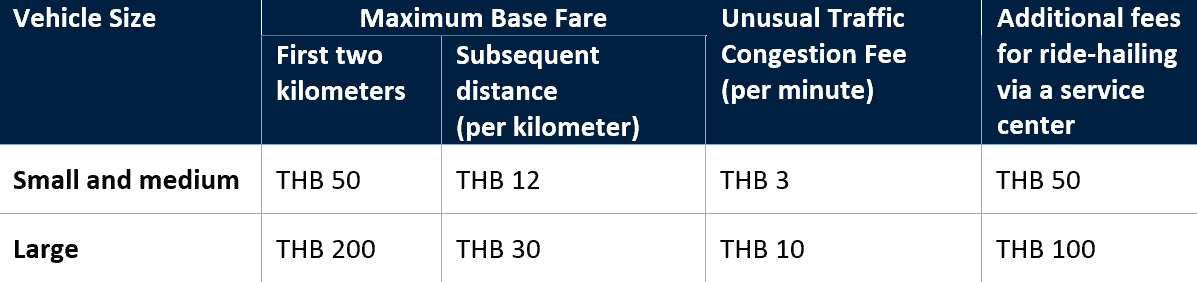
All fees must be shown to the passenger before the provision of any service, and only this same amount can be charged and collected.

For more details about this regulation, or about any aspect of transportation and technology laws in Thailand, please contact Charuwan Charoonchitsathian at [email protected] or +66 2056 5657, or Panchanit Trakarnvanich at [email protected] or +66 2056 5531.

RELATED INSIGHTS​ 

May 6, 2026
Thailand has introduced new requirements for online social media platforms to verify the identity of paying advertisers before publishing their advertisements. On May 5, 2026, the Electronic Transactions Commission published the Notification on Measures for Prevention of Technology Crime for Online Social Media (No. 2) in the Government Gazette. The notification, which aims to prevent technology crimes such as fraud and scams, takes effect 180 days after publication (i.e., on November 1, 2026). Mandatory Advertiser Identity Verification Online social media service providers must verify the identity of every advertiser before publishing an advertisement. Verification remains valid for up to one year from the most recent verification date. The notification requires social media providers to use either of the following methods when verifying advertisers: Document-based verification: Examine government-issued identity documents (e.g., national ID, passport, or juristic person registration certificate), cross-check the connection between the advertiser and the identity documents (e.g., facial comparison with photo ID), and ensure that the identity documents are verifiable against reliable sources. Digital identity verification: Use an identity verification system with a level of assurance no lower than that prescribed by the Electronic Transactions Commission. Advertiser Data Collection and Retention Service providers must collect and retain certain data—including name, identification number, and contact details—from the start of the advertising service and for a minimum of 90 days after the end of the advertising service relationship. The same requirements apply where there is a third-party payer, such as an ad agency. Implications for Affected Businesses The notification raises two key areas of concern for affected businesses: Social media platforms must implement know-your-advertiser (KYA) onboarding as described above, including document upload and identity matching processes. The 180-day implementation window requires immediate technical and operational planning. The collection and retention of national ID cards, passport copies, and other personal
April 30, 2026
Vietnam’s Decree No. 134/2026/ND‑CP, which took effect on 9 April 2026, plays an important role in detailing and implementing Vietnam’s Intellectual Property (IP) Law in the context of rapid digital transformation and the growing application of artificial intelligence (AI). The new decree provides comprehensive guidance on the application of copyright and related‑rights regulations, addressing key issues such as authorship, ownership, statutory exceptions and limitations, registration procedures, and enforcement mechanisms. Through these measures, Decree 134 seeks to achieve an appropriate balance between safeguarding the legitimate interests of rightsholders and fostering innovation, research, and technological advancement, thereby strengthening the state’s framework for the effective management, protection, and exploitation of intellectual property in the digital and AI‑driven environment. Some notable aspects of Decree 134 are discussed below. Copyright for AI-Created Works Decree 134 provides important guidance on the determination of copyright and related rights in works created with the assistance of AI. Article 5a reaffirms the principle that human creativity remains central to copyright protection, clarifying that copyright or related rights arise only where a human makes a substantial and decisive intellectual contribution, exercises effective control over the creative outcome, and assumes responsibility for the content and its legality. At the same time, the provision confirms that AI is regarded solely as a technological tool rather than a rights‑holding subject, thus ensuring consistency with the fundamental concepts of authorship and ownership under the IP Law. By introducing requirements on transparency, proof of human contribution, and compliance with AI‑specific labelling and technical marking obligations, Decree 134 establishes a clear and enforceable legal framework for the responsible use of AI in creative activities. Lawful Use of Copyrighted Texts and Data Article 37a of Decree 134 sets out the specific conditions under which copyrighted texts and data may be lawfully used for scientific research, experimentation,
April 23, 2026
Vietnam has progressively positioned blockchain as a strategic technology within its broader digital transformation agenda over the past decade. From early policy orientations to more recent legislative developments, the regulatory approach has gradually shifted from high-level recognition to more concrete legal integration. Against this backdrop, a new draft decree regulating activities relating to product and goods identification, authentication, and traceability (the “Draft Decree”) marks a notable turning point. Rather than merely referencing blockchain as a policy priority, the Draft Decree incorporates blockchain directly into a nationwide regulatory system, positioning it as part of the underlying infrastructure for data governance and public administration in relation to the management, verification, and traceability of product-related data. Evolution of Vietnam’s Blockchain Legal Framework: The Draft Decree in Context Vietnam’s blockchain legal framework has developed in several distinct phases. The first phase, beginning around 2019, was characterized by high-level policy recognition in several resolutions of the Party Central Committee. Particularly, blockchain was identified as part of the broader category of digital technologies critical to industrial modernization and participation in the Fourth Industrial Revolution. These resolutions did not regulate blockchain directly, but established its strategic importance at the national level. The second phase (2023 to 2025) saw the introduction of national strategies and technology policies that more explicitly recognized blockchain as a priority technology. Those policies collectively signaled a clear policy commitment to developing blockchain infrastructure and applications. However, these instruments remained largely at a policy-level and did not establish binding regulatory frameworks. The third phase (from 2025) involves the gradual integration of blockchain into sectoral legislation. Laws such as the Law on Digital Technology Industry (2025), the Law on Personal Data Protection (2025), and the Law on Science, Technology, and Innovation (2025) have introduced concepts such as digital assets, crypto assets, and even specific
April 23, 2026
Thailand’s Board of Investment (BOI) has introduced a new investment promotion measure to encourage partnerships between Thai and foreign automotive parts manufacturers. The measure, published in the Government Gazette on March 31, 2026, under Notification of the Board of Investment No. 5/2569 Re: Investment Promotion Measures for Joint Ventures between Thai and Foreign Companies in the Auto Parts Manufacturing Industry, aims to enhance local industry participation and create new business opportunities for Thai operators. Corporate Income Tax Exemption Under this measure, the BOI grants an additional corporate income tax (CIT) exemption of three years to both new investment projects and existing operators under the BOI’s business category 3.4 (manufacture of engines, equipment, or parts) or category 3.5 (manufacture of vehicle parts). If the CIT exemption period is added to an existing one, the total exemption period will be capped at a maximum of eight years. To benefit from the exemption, certain conditions must be met, as described below. Conditions for New Investment Projects The joint venture company must be newly established after January 15, 2026. At least 20% of the registered capital must be held by a Thai juristic person throughout the CIT exemption period. The Thai juristic person must have been operating in the automotive or auto parts industry for at least three years prior to the application date and must be at least 60%-owned by Thai individuals. Conditions for Existing BOI-Promoted Projects The company must have been wholly foreign-owned at the time the promotion certificate was issued. The shareholding structure must be amended following the issuance of the notification to establish a joint venture between a foreign juristic person and a Thai juristic person that has been operating in the automotive or auto parts industry for at least three years prior to the application date. This Thai