You are using an outdated browser and your browsing experience will not be optimal. Please update to the latest version of Microsoft Edge, Google Chrome or Mozilla Firefox. Install Microsoft Edge

July 7, 2021

Thailand Introduces Online Ride-Hailing Services Regulations

Thailand’s Transport Ministry has issued new rules for ride-hailing services, aiming to strictly regulate the types of vehicle that can be registered, the number of registered vehicles per user, and the fees that are levied and collected. These rules are laid out in the Ministerial Regulation Re: Ride-Hailing Service Vehicle via an Electronic System B.E. 2564 (2021), which was published in the Royal Gazette on June 23, 2021.

Under the regulation, a personal vehicle transporting no more than seven passengers can be subsequently registered as a “ride-hailing service vehicle via an electronic system.” An individual is only allowed to register one private vehicle under the regulation. The vehicle registrations are classified as follows:

  • Small vehicles with a maximum engine power of 50–90 kilowatts;
  • Medium vehicles with a maximum engine power of 91–120 kilowatts; or
  • Large vehicles with a maximum engine power of more than 120 kilowatts.

In the case of an electric vehicle, it must be able to travel at a speed of at least 90 km/h.

Each ride-hailing vehicle must be covered by a service-providing communication system operated by an electronic service provider (e.g., a ride-hailing app) that has been endorsed and approved by the Department of Land Transport (DLT). This system must communicate the following details:

  • Car and driver information;
  • Driver’s identity system;
  • Pre-calculated fare;
  • Car tracking system;
  • Time and location validation system; and
  • Complaint and emergency system.

All data records must be retained for at least one month for examination purposes.

The regulation further prescribes that the vehicle must display a sign indicating that it is a ride-hailing service vehicle operating via an electronic system, and the vehicle must be the same color as appears in the personal vehicle registration certificate prior to its registration as a ride-hailing vehicle.

Registration under the regulation is valid for nine years. The ride-hailing vehicle registration plate’s size, specifications, and color are identical to the criteria for registering personal vehicles carrying no more than seven people, meaning that the same vehicle registration plate can be used for the ride-hailing vehicle. The condition of the ride-hailing vehicle must also be examined annually, as prescribed by ministerial regulations under the Vehicle Act B.E. 2522 (1979), and both the interior and exterior must be kept clean and tidy.

Service Fees

The regulation empowers the minister of transport to prescribe the fees for ride-hailing vehicles; the current fees are outlined in the table below.
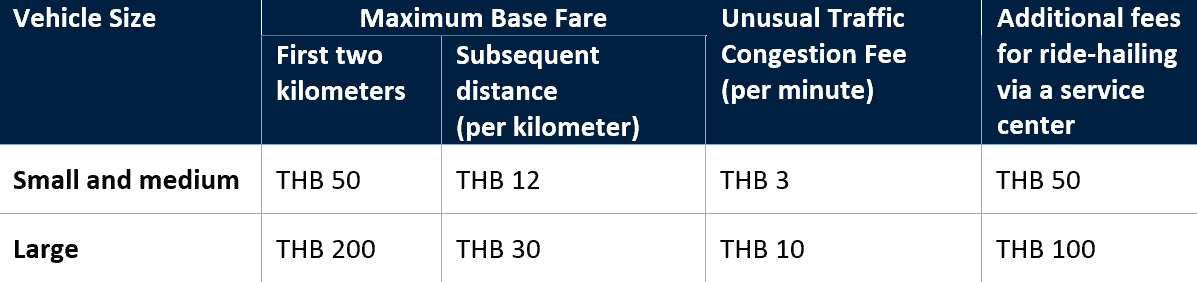
All fees must be shown to the passenger before the provision of any service, and only this same amount can be charged and collected.

For more details about this regulation, or about any aspect of transportation and technology laws in Thailand, please contact Charuwan Charoonchitsathian at [email protected] or +66 2056 5657, or Panchanit Trakarnvanich at [email protected] or +66 2056 5531.

RELATED INSIGHTS​ 

April 21, 2026
Thailand’s Personal Data Protection Committee (PDPC) has launched a public consultation period on a draft notification setting out criteria for data subject access requests (DSARs). The draft notification addresses practical uncertainties in handling DSARs by introducing standardized procedural requirements for data controllers. The consultation period runs from April 16 to May 15, 2026. The notification will enter into force 30 days from the date of its publication in the Government Gazette. Key Features of the Draft Notification The draft notification covers the following key areas: Scope of information subject to access. Data controllers must enable data subjects to access at least the following upon request: (1) personal data collected directly from them; (2) personal data obtained from other sources; and (3) the source of personal data obtained from other sources without consent. Information required under section 23 of the PDPA and information that must be recorded pursuant to section 39 of the PDPA—such as the categories of personal data collected and purposes of processing—must also be made available. Submission channels and formal requirements. Data controllers must provide at least in-person and postal channels for DSARs, while electronic or other channels are optional. Requests may be made either directly by the data subject or through an authorized representative, and must be signed and include sufficient identifying information, a preferred response method, and DSAR details. Identity verification documents (and proof of authority if the request is through a representative) are required, and additional documentation may be requested for verification or communication purposes. Data controllers may use different verification methods for DSARs submitted via electronic or other channels, provided this does not create undue obstacles to the exercise of data subject rights. Verification and response timelines. Data controllers must complete preliminary verification within seven business days of receiving a request. If a
April 21, 2026
Thailand’s Board of Investment (BOI) has introduced special investment promotion measures to accelerate the development of advanced automotive manufacturing technologies and the transitional electric vehicle ecosystem. Published in the Government Gazette on March 31, 2026, BOI Notification No. 4/2569 aims to stimulate the use of automation and robotic systems to improve production efficiency and increase the competitive capacity of Thailand’s automotive industry. Qualifying Project Categories All existing and new investment projects under the following promotional categories are eligible to apply for the new privileges: General automotive manufacturing (category 3.6) Manufacture of plug-in hybrid electric vehicles (PHEVs) and hybrid electric vehicles (HEVs) (category 3.8) Applications will be accepted until the end of 2027. Incentives and Benefits Eligible investment projects will receive exemption from import duties for machinery, and a 50% corporate income tax (CIT) exemption for three years on investment in automation and robotics systems, excluding land costs and working capital. If at least 30% of the total value of the modified or total machinery used is linked to or supports Thailand’s domestic automation machinery manufacturing industry, this CIT exemption will be increased to 100%. Eligible existing investment projects will be exempt from CIT on existing business income, with the exemption period counted from the date on which income is generated following receipt of the investment promotion certificate. Eligibility Conditions Projects must meet the following criteria to qualify for these privileges: The project must not currently benefit from CIT exemption. Those that have already received investment promotion may apply once their existing CIT exemption or reduction benefits have expired. The project must have an investment value of at least THB 1 million, excluding land cost and working capital but including expenditures for machinery, equipment, software, programs, information technology systems, and cloud or data center services, subject to conditions stipulated in
April 10, 2026
Thailand has introduced new regulatory guidance requiring digital platform operators to adopt structured, transparent, and fair fee practices. On March 16, 2026, the Electronic Transactions Development Agency (ETDA) published Announcement No. DPS 2/2569, titled “Guidelines for Transparency and Fairness in Digital Platform Service Fee Determination,” issued under the Royal Decree on Digital Platform Service Business Operations B.E. 2565 (2022). The guidelines establish a framework governing how digital platform operators should set, disclose, and adjust fees charged to users and related service providers such as logistics and payment providers. Although framed as best-practice guidance rather than legally binding rules with explicit penalties, the guidelines carry regulatory weight under the royal decree and represent a significant step toward structured governance of digital platform fee practices in Thailand. The guidelines establish various transparency principles and divide fees into two distinct categories—compulsory and additional—with specific governance principles for each. Transparency Principles The guidelines recommend that digital platform operators adopt several transparency measures to ensure that users can fully understand the costs of using a platform. Fee catalog. All fees should be consolidated into a single, accessible location, which should include the fee name, definition, scope of covered services, calculation methodology, rate, billing period, and calculation examples. Minimum service disclosure. Operators should disclose the minimum service that users can expect, such as baseline visibility, product listing capabilities, access to transaction data, and back-end dashboard access. Price structure disclosure. Operators should disclose the categories of costs underlying their fees, such as system maintenance, cybersecurity, and operational costs. While exact cost figures need not be made public, operators should be able to provide numerical data to regulators upon request. Clear fee formulas. Fee calculations should be simple and easy to understand—for example, percentage of net sales, cost per order, or cost per product listing. Operators should
April 10, 2026
As digital commerce continues to reshape consumer behavior in Thailand, the Office of the Consumer Protection Board (OCPB) has been taking steps to review and update key regulations for online platforms. The OCPB has had a particular focus on addressing the risks posed by e-marketplace businesses—from misleading product information to fraudulent online transactions. Some of the regulator’s current legislative efforts related to Thailand’s labeling regulations as well as potential changes to the country’s law on direct sales and marketing. Proposed Changes to Consumer Protection Labeling Regulations On February 24, 2026, the OCPB convened a public hearing to review the Notification of the Committee on Labels re: Specification of Goods as Controlled Label Goods B.E. 2565 (2022) and its annex issued under the Consumer Protection Act. The closed-door session, which started the OPCD’s process of seeking feedback on the proposed changes, brought together representatives from government agencies, business operators, and consumer groups. The OCPB explained that its review of the labeling regulations aims to address regulatory gaps arising from evolving commercial practices, particularly the expansion of e-commerce and cross-border transactions. Authorities highlighted recurring issues involving product information that is unclear, incomplete, or potentially misleading in digital sales channels. The proposed revisions are intended to improve consumers’ access to accurate and complete product information, ensure that label disclosures remain relevant amid the growth of e-commerce, and strengthen protections against deceptive or misleading digital advertising. The review is being undertaken pursuant to the Consumer Protection Act B.E. 2522 (1979). As part of the initiative, the OCPB signaled a potential update to the categories of “controlled label products” as well as enhanced disclosure obligations for business operators, with the broader aim of promoting greater transparency, reinforcing operator accountability, and aligning Thailand’s labeling framework with current market conditions. The OCPB secretary general emphasized that