You are using an outdated browser and your browsing experience will not be optimal. Please update to the latest version of Microsoft Edge, Google Chrome or Mozilla Firefox. Install Microsoft Edge

July 7, 2021

Thailand Introduces Online Ride-Hailing Services Regulations

Thailand’s Transport Ministry has issued new rules for ride-hailing services, aiming to strictly regulate the types of vehicle that can be registered, the number of registered vehicles per user, and the fees that are levied and collected. These rules are laid out in the Ministerial Regulation Re: Ride-Hailing Service Vehicle via an Electronic System B.E. 2564 (2021), which was published in the Royal Gazette on June 23, 2021.

Under the regulation, a personal vehicle transporting no more than seven passengers can be subsequently registered as a “ride-hailing service vehicle via an electronic system.” An individual is only allowed to register one private vehicle under the regulation. The vehicle registrations are classified as follows:

  • Small vehicles with a maximum engine power of 50–90 kilowatts;
  • Medium vehicles with a maximum engine power of 91–120 kilowatts; or
  • Large vehicles with a maximum engine power of more than 120 kilowatts.

In the case of an electric vehicle, it must be able to travel at a speed of at least 90 km/h.

Each ride-hailing vehicle must be covered by a service-providing communication system operated by an electronic service provider (e.g., a ride-hailing app) that has been endorsed and approved by the Department of Land Transport (DLT). This system must communicate the following details:

  • Car and driver information;
  • Driver’s identity system;
  • Pre-calculated fare;
  • Car tracking system;
  • Time and location validation system; and
  • Complaint and emergency system.

All data records must be retained for at least one month for examination purposes.

The regulation further prescribes that the vehicle must display a sign indicating that it is a ride-hailing service vehicle operating via an electronic system, and the vehicle must be the same color as appears in the personal vehicle registration certificate prior to its registration as a ride-hailing vehicle.

Registration under the regulation is valid for nine years. The ride-hailing vehicle registration plate’s size, specifications, and color are identical to the criteria for registering personal vehicles carrying no more than seven people, meaning that the same vehicle registration plate can be used for the ride-hailing vehicle. The condition of the ride-hailing vehicle must also be examined annually, as prescribed by ministerial regulations under the Vehicle Act B.E. 2522 (1979), and both the interior and exterior must be kept clean and tidy.

Service Fees

The regulation empowers the minister of transport to prescribe the fees for ride-hailing vehicles; the current fees are outlined in the table below.
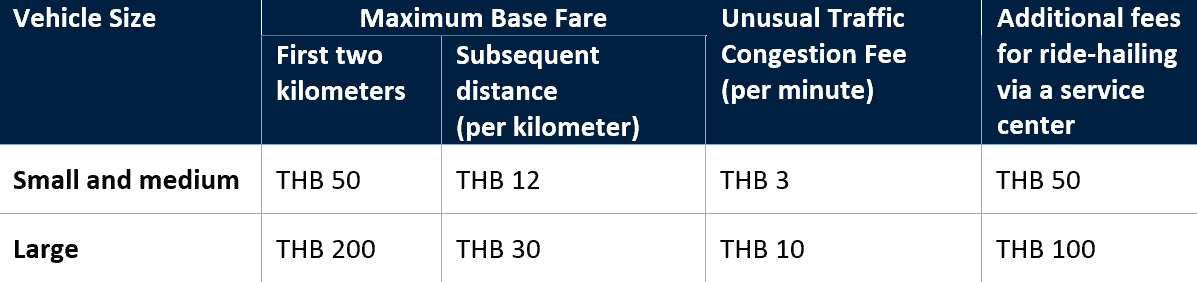
All fees must be shown to the passenger before the provision of any service, and only this same amount can be charged and collected.

For more details about this regulation, or about any aspect of transportation and technology laws in Thailand, please contact Charuwan Charoonchitsathian at [email protected] or +66 2056 5657, or Panchanit Trakarnvanich at [email protected] or +66 2056 5531.

RELATED INSIGHTS​ 

February 4, 2026
On November 18, 2025, Vietnam’s Ministry of Finance released for public consultation a draft decree on administrative sanctions in the field of crypto assets and crypto asset markets (the “Draft Decree”), intended to implement Resolution No. 05/2025/NQ-CP dated September 9, 2025, on the pilot crypto asset market in Vietnam (“Resolution 05”). While Resolution 05 sets out who may participate and under what conditions, the Draft Decree addresses a more practical question for market participants, i.e., what happens if those conditions are not met. In doing so, the Draft Decree offers important insight into how Vietnamese regulators intend to supervise, discipline, and ultimately shape the crypto market during the pilot phase. Regulatory Scope and Overall Sanctions Architecture The Draft Decree applies to both domestic and foreign organizations and individuals engaging in crypto-related activities in Vietnam’s market. Covered entities include: (i) crypto asset issuers; (ii) crypto asset service providers, including trading platforms and market operators; (iii) Vietnamese and foreign investors participating in the pilot market; and (iv) other organizations involved in the offering, issuance, or provision of crypto-related services in Vietnam. The breadth of this scope is deliberate. It appears to reflect a regulatory view that cross-border structures, offshore platforms, and indirect participation may not necessarily insulate market actors from compliance obligations once they operate within the pilot framework. For the crypto industry, this may mark a shift from regulatory ambiguity toward a more explicit articulation of jurisdictional reach. At first glance, the Draft Decree’s monetary penalties appear restrained. The maximum fine per administrative violation is capped at VND 200 million (approx. USD 7,700) for organizations and VND 100 million (approx. USD 3,800) for individuals. However, focusing solely on fine levels risks missing the point. The Draft Decree also places great regulatory weight on supplementary sanctions and corrective measures, including: (i)
January 30, 2026
Thailand’s Data Privacy Day 2026, hosted by the Office of the Personal Data Protection Committee (PDPC), underscored the country’s commitment to strengthening personal data protection, advancing regulatory maturity, and preparing organizations for the next phase of PDPA enforcement. The event marked a clear shift from policy-level compliance toward “Privacy in Action,” signaling that operational readiness and real-world implementation are now priorities. The Office of the PDPC also emphasized that data protection is now a national economic enabler that supports digital trust, competitiveness, and sustainable growth, not just a compliance obligation. The following insights summarize the key takeaways from the Data Privacy Day 2026 event. PDPA in Real Life: What Happens to Your Data Today The Office of the PDPC provided concrete data on enforcement trends and real-world compliance issues facing organizations across Thailand. Complaints and trends. The Office of the PDPC’s Personal Data Protection Act (PDPA) Center recorded 2,672 PDPA-related complaints as of January 2026, with the highest volumes involving failure to comply with the data minimization principle, collection without lawful basis, and use and disclosure without lawful basis. Administrative penalties. Several administrative penalties have been imposed on data controllers and data processors across various sectors, including government, healthcare, retail, SMEs and e-commerce, ranging from tens of thousands to several million baht. Most violations stemmed from weak security measures, failure to notify data breaches within the required timeline, absence of a data protection officer (DPO) when required, and noncompliance with governance requirements such as the Record of Processing Activities (ROPA) and data processing agreements with data processors. Case studies. The Office of the PDPC highlighted specific examples of violations: Hospitals misused personal data for purposes beyond their intended scope (e.g., using personal data collected for providing medical services to send birthday cards) Vendors compromised systems due to inadequate password
January 29, 2026
Following the recent enactment of a comprehensive legal framework addressing sexual harassment, Thailand has launched a fast-track judicial process enabling victims of online sexual harassment to obtain court orders suspending and removing obscene content from the internet. On January 26, 2026, the Office of the Judiciary introduced the “Take It Down” procedure through the Court Integral Online Service (CIOS) platform, providing victims with their first direct, expedited pathway to halt the spread of online content that violates the new legal provisions against sexual harassment. This new remedy stems from section 284/4 of the Penal Code, introduced through the Act Amending the Penal Code (No. 30) B.E. 2568, which took effect on December 30, 2025. Under section 284/4, an injured person or a competent official may petition the court to suspend dissemination of violating data and remove the data from computer systems within a court-specified period. The court may also direct system controllers, service providers, or competent authorities to carry out the order and report back within 15 days. Filing through the CIOS Platform The CIOS platform serves as the primary electronic channel for these petitions. Key features include: Individuals can file online without appearing in person and may submit petitions at any time the system is available. Users must complete digital identity verification via the ThaID application to access the CIOS. Petitions under section 284/4 are limited to requests to suspend or remove violating content. Claims for monetary damages must be pursued separately, including via separate proceedings or prefiling mediation. Streamlined Review Process The submission workflow is end-to-end electronic, and the system provides step-by-step guidance. After submission, court staff review the petition before presenting it to a judge for consideration. The court may conduct an online inquiry to obtain additional information, and in-person attendance is required only if deemed
January 22, 2026
On January 20, 2026, Vietnam’s Ministry of Finance (MOF) issued Decision No. 96/QD-BTC to formally launch pilot administrative procedures for licensing crypto asset trading market services in Vietnam. The decision took immediate effect and implements the government’s pilot crypto asset market program under Resolution No. 05/2025/NQ-CP. Notably, competent authorities have now begun accepting license applications, marking the first time Vietnam has operationalized a licensing pathway for crypto trading market operators. Administrative Procedures and Applications The decision stipulates procedures for (i) granting, (ii) adjusting, and (iii) revoking licenses to provide services for organizing crypto asset trading markets. It provides detailed, step-by-step guidance for each procedure, including dossier composition, internal review stages, coordination mechanisms, and statutory timelines. These procedures apply specifically to entities seeking to organize and operate crypto asset trading markets within Vietnam’s pilot regulatory framework. The MOF is the authority responsible for reviewing and deciding on the above procedures, with the State Securities Commission acting as the receiving, coordinating, and procedural focal point. For licensing applications, the MOF will coordinate with multiple authorities, including the State Bank of Vietnam and the Ministry of Public Security, particularly in relation to anti-money laundering, cybersecurity, system safety, and risk control requirements. Applications may be submitted in person, by post, or electronically via the National Public Service Portal or the administrative procedure information system, in line with applicable regulations. Statutory processing timelines vary depending on the specific procedure and stage involved. For applications to obtain a license to organize a crypto asset trading market, the process is conducted in multiple phases: The MOF will issue an initial written response within 20 working days from receipt of a complete and valid initial dossier, following which, upon submission of the full set of required documents, the MOF will complete substantive review and issue the license