You are using an outdated browser and your browsing experience will not be optimal. Please update to the latest version of Microsoft Edge, Google Chrome or Mozilla Firefox. Install Microsoft Edge

July 7, 2021

Thailand Introduces Online Ride-Hailing Services Regulations

Thailand’s Transport Ministry has issued new rules for ride-hailing services, aiming to strictly regulate the types of vehicle that can be registered, the number of registered vehicles per user, and the fees that are levied and collected. These rules are laid out in the Ministerial Regulation Re: Ride-Hailing Service Vehicle via an Electronic System B.E. 2564 (2021), which was published in the Royal Gazette on June 23, 2021.

Under the regulation, a personal vehicle transporting no more than seven passengers can be subsequently registered as a “ride-hailing service vehicle via an electronic system.” An individual is only allowed to register one private vehicle under the regulation. The vehicle registrations are classified as follows:

  • Small vehicles with a maximum engine power of 50–90 kilowatts;
  • Medium vehicles with a maximum engine power of 91–120 kilowatts; or
  • Large vehicles with a maximum engine power of more than 120 kilowatts.

In the case of an electric vehicle, it must be able to travel at a speed of at least 90 km/h.

Each ride-hailing vehicle must be covered by a service-providing communication system operated by an electronic service provider (e.g., a ride-hailing app) that has been endorsed and approved by the Department of Land Transport (DLT). This system must communicate the following details:

  • Car and driver information;
  • Driver’s identity system;
  • Pre-calculated fare;
  • Car tracking system;
  • Time and location validation system; and
  • Complaint and emergency system.

All data records must be retained for at least one month for examination purposes.

The regulation further prescribes that the vehicle must display a sign indicating that it is a ride-hailing service vehicle operating via an electronic system, and the vehicle must be the same color as appears in the personal vehicle registration certificate prior to its registration as a ride-hailing vehicle.

Registration under the regulation is valid for nine years. The ride-hailing vehicle registration plate’s size, specifications, and color are identical to the criteria for registering personal vehicles carrying no more than seven people, meaning that the same vehicle registration plate can be used for the ride-hailing vehicle. The condition of the ride-hailing vehicle must also be examined annually, as prescribed by ministerial regulations under the Vehicle Act B.E. 2522 (1979), and both the interior and exterior must be kept clean and tidy.

Service Fees

The regulation empowers the minister of transport to prescribe the fees for ride-hailing vehicles; the current fees are outlined in the table below.
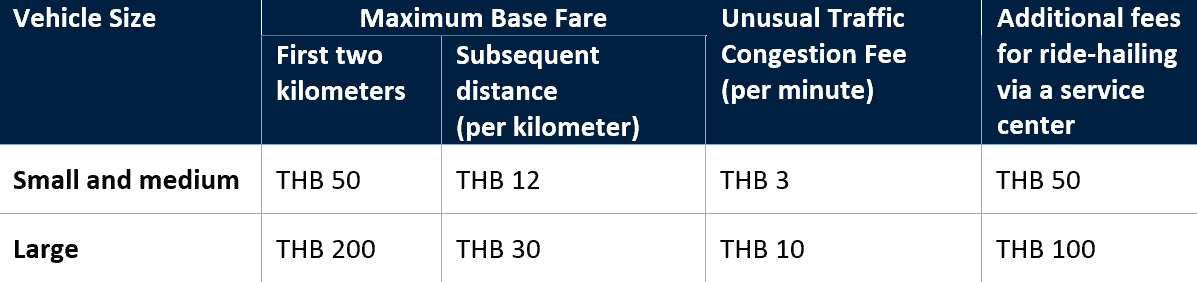
All fees must be shown to the passenger before the provision of any service, and only this same amount can be charged and collected.

For more details about this regulation, or about any aspect of transportation and technology laws in Thailand, please contact Charuwan Charoonchitsathian at [email protected] or +66 2056 5657, or Panchanit Trakarnvanich at [email protected] or +66 2056 5531.

RELATED INSIGHTS​ 

January 21, 2026
On January 16, 2026, Thailand’s Electronic Transactions Committee released for public comment a draft notification that would require social media platforms operating in Thailand to implement identity verification for all user accounts and advertisers, with enhanced scrutiny for high-risk advertising activities. If finalized in its current form, the Notification on Measures to Prevent Technology Crime for Social Media Service Providers would take effect 180 days after publication in the Government Gazette, fundamentally changing how platforms verify users and monetize advertising services. The public comment period is open through February 2, 2026. Mandatory User and Advertiser Identity Verification The draft establishes a universal requirement that all social media service providers implement identity verification measures for every user account. The draft imposes stricter verification obligations for advertisers than for general users. Before publishing any advertisement, platforms must verify the advertiser’s identity at a level sufficient to identify the advertiser, unless the advertiser has previously completed verification. Risk-Based Advertisement Verification The identification requirements for advertisers will be more stringent in the following cases: The advertiser has a history of user complaints or has previously violated the platform’s terms of service. The advertisement involves finance, investment, loans, sensitive personal data, or content flagged as potentially involving cybercrime. The advertisement specifically targets vulnerable groups, such as the elderly or other at-risk demographics. In such cases, platforms must conduct identity verification using government-issued identification documents and must confirm the accuracy, authenticity, and currency of these documents with the issuing government agencies. Alternatively, platforms may verify identity through an eligible digital identity verification and authentication system provider. Information Retention Platforms must retain specific information for each advertiser, including the name of the individual or juristic person and any representatives, government-issued identification documents such as ID cards, passports, or certificates of incorporation, and reachable contact information including
January 21, 2026
Spurred by global geopolitics and Canada’s Indo-Pacific Strategy, which aims to forge deeper ties with ASEAN, Canadian companies have been showing growing interest in Thailand and Southeast Asia in recent years. To understand the opportunities offered by the region, we sat down with Andrew Stoutley, a Toronto native and the chief operating officer of Tilleke & Gibbins, a leading Southeast Asian regional law firm with over 130 years of history in Thailand. Q: Why are Canadian companies looking at Thailand and Southeast Asia right now? A: Two reasons stand out. First, diversification has moved up the agenda. Many Canadian companies want options outside North America due to tariff volatility and policy uncertainty in the United States, as well as questions around the next Canada–United States–Mexico Agreement mandatory joint review. At the same time, the shift of global production from China to Southeast Asia is accelerating, driven by rising costs, geopolitics, and the need to avoid overreliance on a single market. As a result, Canadian companies are looking for a second production base or a regional hub, and Thailand and its neighbors are natural choices given their manufacturing depth, location, and established supply chains. Second, Canada’s own efforts in the region are gaining traction. The Indo-Pacific Strategy has led to more on-the-ground support, including larger trade missions, upgraded diplomatic posts, and new financing options. Export Development Canada (EDC) now has a presence in Bangkok, giving Canadian companies a direct line to financing and insurance in Thailand. There’s also steady progress on trade frameworks like the recently signed Canada–Indonesia Comprehensive Economic Partnership Agreement (which will come into effect pending domestic procedures), ongoing negotiations of a Canada–ASEAN FTA, and the exciting announcement about the launch of negotiations of a Canada–Thailand FTA. Together, these developments have the potential to make it much easier
January 13, 2026
On January 9, 2026, Thailand’s Securities and Exchange Commission (SEC) filed a criminal complaint with the Economic Crime Suppression Division (ECD) against five individuals for unauthorized operation of a digital-asset dealer business under the Emergency Decree on Digital Asset Businesses B.E. 2561 (2018). This precedent-setting case signals that the regulator is willing to pursue crypto enforcement against natural persons even in the absence of a licensed platform entity. Background and Implications The case follows the SEC’s October 2025 public warning about the use of iris-scanning technology in exchange for certain digital tokens. In its warning, the SEC cautioned that exchanging or trading these specific tokens with unlicensed service providers exposes users to heightened fraud, scam, and money laundering risks. Unlike prior regulatory enforcement matters, which involved platform-level administrative fines for operational or compliance failures, this case targets misconduct by individuals who may not be professional traders but openly advertised their willingness to buy these tokens from the public, opened individual over-the-counter (OTC) trade channels for these tokens, and facilitated off-exchange transactions in a manner resembling ordinary commercial dealing. This enforcement action establishes a clear precedent that natural persons engaging in public-facing digital-asset dealing may face criminal liability under Thai law, even without operating through a corporate or licensed platform structure. Outlook The alleged offenders may not settle this crime by payment of fines. Following the SEC’s referral, the ECD will undertake further investigation, after which prosecutors may review the case and proceed to court. The SEC has stated that it will cooperate fully with enforcement agencies throughout the criminal enforcement process.
January 9, 2026
Vietnam has taken a decisive step into the global artificial intelligence regulatory landscape with the promulgation of the Law on Artificial Intelligence No. 134/2025/QH15 (AI Law), adopted on December 10, 2025, and effective from March 1, 2026. As one of the earliest comprehensive, standalone AI statutes in Southeast Asia, the AI Law signals Vietnam’s ambition to position itself as both an innovation-friendly and governance-conscious AI market. In doing so, the legislature has also streamlined Vietnam’s AI regulatory architecture. The AI Law repeals most AI-related provisions previously embedded in the Law on Digital Technology Industry No. 71/2025/QH15, consolidating AI governance under a single, unified legal framework. This structural move underscores an intent to provide greater regulatory clarity and coherence for businesses operating across the AI value chain. Against this backdrop, the key question for AI developers, providers, deployers, and governance teams is how the new risk-based framework will shape compliance expectations, operational decisions, and governance design in practice. This article examines the new AI Law through that practical lens, focusing on what it means for AI businesses operating in or into Vietnam. Scope of Application The AI Law applies broadly to Vietnamese organizations and individuals, as well as foreign entities that participate in AI-related activities within Vietnam. The law expressly excludes AI activities conducted solely for national defense, security, and cryptography purposes. A defining feature of the AI Law is that it regulates by role, not by industry. It distinguishes between: Developers, who design, build, train, test, or fine-tune AI models and have direct control over the technical methods, training data, or model parameters; Providers, who place AI systems on the market or put them into use under their own names; Deployers, who use AI systems under their control in professional, commercial, or service-provision activities; Users, who interact with AI