You are using an outdated browser and your browsing experience will not be optimal. Please update to the latest version of Microsoft Edge, Google Chrome or Mozilla Firefox. Install Microsoft Edge

July 7, 2021

Thailand Introduces Online Ride-Hailing Services Regulations

Thailand’s Transport Ministry has issued new rules for ride-hailing services, aiming to strictly regulate the types of vehicle that can be registered, the number of registered vehicles per user, and the fees that are levied and collected. These rules are laid out in the Ministerial Regulation Re: Ride-Hailing Service Vehicle via an Electronic System B.E. 2564 (2021), which was published in the Royal Gazette on June 23, 2021.

Under the regulation, a personal vehicle transporting no more than seven passengers can be subsequently registered as a “ride-hailing service vehicle via an electronic system.” An individual is only allowed to register one private vehicle under the regulation. The vehicle registrations are classified as follows:

  • Small vehicles with a maximum engine power of 50–90 kilowatts;
  • Medium vehicles with a maximum engine power of 91–120 kilowatts; or
  • Large vehicles with a maximum engine power of more than 120 kilowatts.

In the case of an electric vehicle, it must be able to travel at a speed of at least 90 km/h.

Each ride-hailing vehicle must be covered by a service-providing communication system operated by an electronic service provider (e.g., a ride-hailing app) that has been endorsed and approved by the Department of Land Transport (DLT). This system must communicate the following details:

  • Car and driver information;
  • Driver’s identity system;
  • Pre-calculated fare;
  • Car tracking system;
  • Time and location validation system; and
  • Complaint and emergency system.

All data records must be retained for at least one month for examination purposes.

The regulation further prescribes that the vehicle must display a sign indicating that it is a ride-hailing service vehicle operating via an electronic system, and the vehicle must be the same color as appears in the personal vehicle registration certificate prior to its registration as a ride-hailing vehicle.

Registration under the regulation is valid for nine years. The ride-hailing vehicle registration plate’s size, specifications, and color are identical to the criteria for registering personal vehicles carrying no more than seven people, meaning that the same vehicle registration plate can be used for the ride-hailing vehicle. The condition of the ride-hailing vehicle must also be examined annually, as prescribed by ministerial regulations under the Vehicle Act B.E. 2522 (1979), and both the interior and exterior must be kept clean and tidy.

Service Fees

The regulation empowers the minister of transport to prescribe the fees for ride-hailing vehicles; the current fees are outlined in the table below.
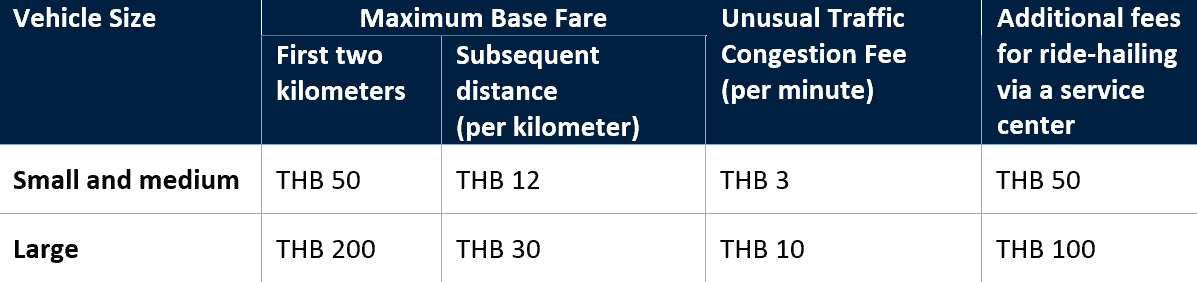
All fees must be shown to the passenger before the provision of any service, and only this same amount can be charged and collected.

For more details about this regulation, or about any aspect of transportation and technology laws in Thailand, please contact Charuwan Charoonchitsathian at [email protected] or +66 2056 5657, or Panchanit Trakarnvanich at [email protected] or +66 2056 5531.

RELATED INSIGHTS​ 

March 9, 2026
Over the past several years, numerous automobile manufacturers have brought electric vehicles (EVs) to the market and received positive feedback from consumers in Thailand and around the world. EVs have gained popularity due to their lower maintenance costs, reduced energy expenses, and environmental benefits. However, reports have emerged of EVs causing problems such as battery fires, autopilot malfunctions leading to accidents, and safety systems such as brakes engaging automatically under inappropriate conditions. Even when these situations do not cause injury to drivers or passengers, they raise significant concerns for EV manufacturers, importers, and sellers operating in Thailand. These problems may seriously impact businesses if the products are identified as unsafe under Thailand’s Product Liability Act (PLA), officially known as the Liability for Damages Arising from Unsafe Products Act. Under this law, authorities or courts can order business operators to recall products from the market or prohibit their export, import, or sale. To manage and mitigate the risk of being found liable for damages due to an unsafe product under the PLA, EV business operators should be aware of the scope of the law. Potentially Liable Parties The PLA identifies several types of entrepreneurs and business operators—both individuals and entities—as “potentially liable parties” (PLPs) who may be held liable under the law. In the EV context, this could include vehicle manufacturers, battery suppliers, software developers whose systems are integrated into the vehicle, and local importers or distributors. Specifically, the PLA covers: Manufacturers or hirers Importers Sellers of goods for which the manufacturer, hirer, or importer cannot be identified Any other party who uses the name, trade name, trademark, or statements associated with the alleged unsafe products, or acts in a manner that causes them to be perceived as a manufacturer, hirer, or importer Definition of “Product” and “Unsafe Product” The
March 6, 2026
Thailand’s Legislation Consideration Committee of the Ministry of Interior has ruled that in-game loot boxes in online games do not constitute gambling under the Gambling Act B.E. 2478 (1935). This first-of-its-kind ruling provides useful guidance for online game operators and digital entertainment companies operating in Thailand. Background The ruling came in response to an inquiry concerning an online role-playing game operator that launched a campaign featuring a loot box mechanism. The mechanism allowed players to purchase a token in exchange for the opportunity to receive a virtual loot box containing randomized in-game items. The key features of this were as follows: The items received were digital, noncash items usable only within the game. The items could not be exchanged, redeemed, or converted into cash with the game operator. Items may differ in rarity but remain purely virtual. The central question was whether paying money to obtain randomized in-game items constituted a risk-based activity involving the chance to receive money or property of monetary value, which would constitute gambling under the Gambling Act. Committee Ruling The committee reached the following conclusions regarding the characteristics of the game’s loot-box mechanism: No cash or monetary equivalent: Players did not receive cash or property that could be exchanged for cash. The in-game items were merely usage rights within the online game ecosystem. No real-world monetary valuation: There was no determination of item value in real currency, and no mechanism for redeeming or converting items into money with the game operator. Any off-platform trading of in-game items between players is irrelevant to online game operators, as any value arising from such transactions is determined by the market rather than by the operators themselves. Service fee characterization: Payments made by players purchasing in-game loot boxes constituted fees for online game services. Accordingly, the committee concluded
March 5, 2026
Thailand’s Securities and Exchange Commission (SEC) has filed a criminal complaint against a licensed digital asset broker, its overseas trading platform, and its executives for allegedly operating an unlicensed digital asset exchange targeting Thai customers. The case marks an escalation in the SEC’s enforcement efforts against unlicensed offshore platforms that attempt to serve Thai users through local licensed entities. Criminal Complaint On February 20, 2026, the SEC filed a criminal complaint with the Economic Crime Suppression Division against a local licensed digital asset broker, its overseas global trading platform, and its executives. The SEC alleges that the parties violated the Digital Asset Business Emergency Decree B.E. 2561 (2018) by cooperatively operating a digital asset exchange business on a cross-border basis since 2023 without the required SEC license. According to the SEC, the local broker promoted the overseas platform’s services to the public through Thai-language posts on social media channels, with services available exclusively to customers residing in Thailand. Access to the global platform was provided through the local broker’s website and mobile application. Customers who registered for the local broker’s services were automatically granted access to the global platform without having to undergo a separate identity verification process. The SEC also found that the local broker provided back-office system support services to the global platform. The SEC considers these activities to constitute joint operation of an unlicensed digital asset exchange. The former executives of the local broker are being held liable as the responsible persons during the relevant period. The SEC emphasized that the complaint initiates the criminal process, and the decision to prosecute or convict the accused parties will ultimately be made by law enforcement authorities and the criminal courts. Platform Blocking The SEC has also coordinated with the Ministry of Digital Economy and Society to block public
February 27, 2026
The Bank of Thailand (BOT) has officially implemented a new regulatory framework supervising systemically important retail payment systems (SIRPS), effective February 21, 2026, with PromptPay being the first payment system designated as a SIRPS. Under this new set of regulations, the BOT may designate payment systems under the Payment Systems Act B.E. 2560 (2017) as SIRPSs based on quantitative and qualitative assessments. Once a system is designated as a SIRPS, the operator becomes subject to expanded supervisory obligations beyond the general requirements of the Payment Systems Act. Enhanced Supervisory Requirements SIRPS operators must comply with a heightened supervisory regime across three key areas, outlined below. 1. Governance SIRPS operators must maintain robust and transparent governance structures, including: Balanced board composition, with at least one-third of the board comprising independent directors who represent stakeholders in the system (such as payment service providers, consumers, and experts). Independent directors may serve for no more than two consecutive terms. Subcommittees to assist the board in overseeing compliance, policy implementation, and operational strategy. Clear separation between executives responsible for risk and information security and those overseeing day-to-day business operations. Risk Management and System SecuritySIRPS operators must implement comprehensive risk management frameworks, including: Clear service agreements between the SIRPS operator and its direct participants (payment service providers who connect directly to the SIRPS), defining roles and responsibilities among stakeholders. These agreements must include obligations for direct SIRPS participants to supervise any indirect participants they onboard to ensure compliance with service agreements and business rules. A business continuity plan covering both IT and non-IT aspects, with annual review. The SIRPS must target service availability comparable to international payment infrastructures, including the ability to recover operations within two hours of a disruption and to maintain scalable operational capacity. Tools and controls to monitor and manage material or