You are using an outdated browser and your browsing experience will not be optimal. Please update to the latest version of Microsoft Edge, Google Chrome or Mozilla Firefox. Install Microsoft Edge

July 7, 2021

Thailand Introduces Online Ride-Hailing Services Regulations

Thailand’s Transport Ministry has issued new rules for ride-hailing services, aiming to strictly regulate the types of vehicle that can be registered, the number of registered vehicles per user, and the fees that are levied and collected. These rules are laid out in the Ministerial Regulation Re: Ride-Hailing Service Vehicle via an Electronic System B.E. 2564 (2021), which was published in the Royal Gazette on June 23, 2021.

Under the regulation, a personal vehicle transporting no more than seven passengers can be subsequently registered as a “ride-hailing service vehicle via an electronic system.” An individual is only allowed to register one private vehicle under the regulation. The vehicle registrations are classified as follows:

  • Small vehicles with a maximum engine power of 50–90 kilowatts;
  • Medium vehicles with a maximum engine power of 91–120 kilowatts; or
  • Large vehicles with a maximum engine power of more than 120 kilowatts.

In the case of an electric vehicle, it must be able to travel at a speed of at least 90 km/h.

Each ride-hailing vehicle must be covered by a service-providing communication system operated by an electronic service provider (e.g., a ride-hailing app) that has been endorsed and approved by the Department of Land Transport (DLT). This system must communicate the following details:

  • Car and driver information;
  • Driver’s identity system;
  • Pre-calculated fare;
  • Car tracking system;
  • Time and location validation system; and
  • Complaint and emergency system.

All data records must be retained for at least one month for examination purposes.

The regulation further prescribes that the vehicle must display a sign indicating that it is a ride-hailing service vehicle operating via an electronic system, and the vehicle must be the same color as appears in the personal vehicle registration certificate prior to its registration as a ride-hailing vehicle.

Registration under the regulation is valid for nine years. The ride-hailing vehicle registration plate’s size, specifications, and color are identical to the criteria for registering personal vehicles carrying no more than seven people, meaning that the same vehicle registration plate can be used for the ride-hailing vehicle. The condition of the ride-hailing vehicle must also be examined annually, as prescribed by ministerial regulations under the Vehicle Act B.E. 2522 (1979), and both the interior and exterior must be kept clean and tidy.

Service Fees

The regulation empowers the minister of transport to prescribe the fees for ride-hailing vehicles; the current fees are outlined in the table below.
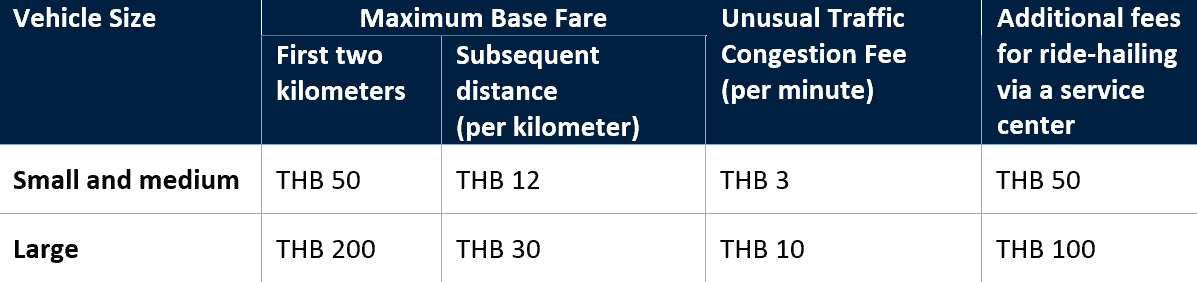
All fees must be shown to the passenger before the provision of any service, and only this same amount can be charged and collected.

For more details about this regulation, or about any aspect of transportation and technology laws in Thailand, please contact Charuwan Charoonchitsathian at [email protected] or +66 2056 5657, or Panchanit Trakarnvanich at [email protected] or +66 2056 5531.

RELATED INSIGHTS​ 

February 26, 2026
Thailand is preparing to offer new tools for intellectual property enforcement as the Electronic Transactions Development Agency (ETDA) recently released for public consultation a draft notification requiring social media platforms to verify user identities and conduct know-your-customer (KYC) checks on advertisers. The draft Notification of the Electronic Transactions Commission on Measures to Prevent Technological Crimes for Social Media Service Providers, which is to be issued under the Emergency Decree on Measures for the Prevention and Suppression of Technological Crimes B.E. 2566 (2023), as amended in 2025, primarily aims to combat online fraud and technology-related crimes. However, its new obligations also provide IP owners with valuable tools to identify anonymous infringers. Key Regulatory Mandates The draft notification imposes several verification requirements on social media platforms operating in Thailand. These requirements also strengthen IP rights holders’ ability to identify anonymous infringers, as platforms must: Verify user identities through registered phone numbers and link all accounts to verifiable identities. Conduct KYC checks on advertisers, including individuals, companies, and any third-party payers. Perform heightened identity checks for high-risk or repeat offenders before publishing advertisements. Promptly remove content flagged by the Anti-Technology Crime Division and prescreen advertisements for prohibited or high-risk content. How IP Owners Can Use This Notification for Enforcement The phone number–based verification requirement enables IP owners to work more effectively with enforcement authorities in tracing individuals or entities responsible for infringing content. The comprehensive advertiser KYC obligations, including mandatory disclosure of third-party payment sources, create a clear audit trail even when bad actors attempt to obscure their identity through intermediaries or shell accounts. This traceability is essential for pursuing damages and dismantling organized counterfeit operations. The ETDA is now considering adjustments to the draft notification after receiving comments during the public consultation period, which ended on February 2, 2026. Following finalization
February 23, 2026
On February 17, 2026, Thailand’s Personal Data Protection Committee (PDPC) released its draft Guidelines on Personal Data Protection in the Development and Use of Artificial Intelligence. The draft guidelines, which translate data controller and data processor compliance obligations under the Personal Data Protection Act (PDPA) into measures tailored to AI development and deployment, are open for public comment until February 25, 2026. At a public hearing session on the draft guidelines held on February 19, the PDPC emphasized that its approach to AI is not to hinder innovation but to develop practical guidance supporting safe deployment while ensuring data protection. Although the guidelines are not legally binding, they indicate the regulator’s expectations and the likely direction of interpretation and enforcement. Scope of Application and Role of Stakeholders The guidelines will apply to all data controllers and data processors in Thailand, and to overseas data controllers and data processors whose data processing falls within the extraterritorial scope of the PDPA. The draft guidelines distinguish the roles of parties involved in AI deployment. Users of AI who determine the purpose of use and designate the input data, and retain outputs generated by the AI, are considered data controllers. In contrast, AI model providers or system integrators that process personal data under the instructions of the data controller are generally regarded as data processors. However, if an AI model provider utilizes user data for its own purposes, such as model fine-tuning or training, it may instead be classified as a data controller. Key Obligations for AI Data Collection and Use The basic principles of data processing under the PDPA must be maintained throughout the AI implementation lifecycle, from design to decommissioning, emphasizing accountability and privacy-by-design principles. The draft guidelines also stipulate the following: Data processing agreements (DPAs) should include model training prohibitions,
February 20, 2026
On February 2, 2026, Myanmar’s Ministry of Finance and Revenue issued Notification No. 19/2026, reducing the customs duty rate to 0% for certain battery‑electric vehicles, machinery, and related spare parts, applicable from February 2, 2026, through March 31, 2026. Under the notification, imports of battery‑electric special‑purpose vehicles, battery‑electric industrial machinery, and associated spare parts listed in the notification’s annex are eligible for a zero‑percent customs duty rate. These items must be supported by technical recommendations from the Ministry of Electric Power and a recommendation from the Ministry of Industry. The notification applies to a broad range of battery electric equipment, including the following categories: Special purpose vehicles, such as crane trucks, mobile drilling trucks, concrete mixers, mobile clinics, broadcast vans, and street‑cleaning vehicles. Heavy machinery, including excavators, bulldozers, loaders, cranes, rollers, forklifts, and port handling equipment. Spare parts, covering 16 specified categories, including key components such as chargers, inverters, and controllers. Importers and businesses using electric‑powered industrial equipment should review the scope of the eligible items and confirm whether their planned imports fall within the lists covered by the notification.
February 10, 2026
Data center and cloud investments are forming a major focus of private-sector investment in Thailand, with tech giants like Amazon, Google, Microsoft, and TikTok, as well as numerous telecom and data center companies, committing significant outlays to data center and cloud development. The country’s Board of Investment (BOI) approved projects worth THB 1.87 trillion in 2025, and THB 746 billion of this was from planned data center investments—by far the largest amount from any single industry. Thailand’s swift rise as a regional data center hub is fueled by surging demand for cloud, AI, and digital services, as well as large-scale investments from global tech firms. The country’s strategic location, competitive power costs, robust fiber infrastructure, expanding IT talent, and supportive government policies—including BOI incentives and streamlined approvals—have made it an attractive destination for scalable and sustainable digital infrastructure investments. The BOI’s proactive approach in updating promoted categories and providing both tax and non-tax incentives further ensures Thailand’s continued growth in this sector. 2025 BOI Changes for Data Centers In the middle of 2025, the BOI responded to the remarkable trend by updating investment‑promotion categories across various sectors (e.g., machinery and electrical equipment, public utilities, digital and innovative industries) to accommodate growing investment in data‑center projects. Before the change, which was detailed in a notification that has applied to investment promotion applications submitted from July 1, 2025, onward, data‑center projects under BOI promotion were granted a single A1 incentive (an eight‑year corporate income‑tax exemption) and subject to one uniform set of conditions. The July 2025 notification restructured promotion for data centers into two categories based on power‑usage efficiency: high‑efficiency data centers and other data centers. Under these rules, qualified high‑efficiency data centers are eligible for an eight‑year corporate income tax (CIT) exemption, while for other data centers this exemption is