You are using an outdated browser and your browsing experience will not be optimal. Please update to the latest version of Microsoft Edge, Google Chrome or Mozilla Firefox. Install Microsoft Edge

August 23, 2021

Thailand Deploys Relief Measures to Help Insured Persons under the Social Security Act

Since July 13, 2021, the Thai government has issued a series of resolutions offering relief measures for persons insured under sections 33 (regular employees), 39 (former employees still paying contributions to the SSO) and 40 (freelancers) of the Social Security Act B.E. 2533 (1990) (the SSA) who have been affected by the COVID-19 prevention measures under the Emergency Decree on Public Administration in Emergency Situations B.E. 2548 (2005), including the business closures required in some provinces.

The latest cabinet resolution extends relief measures to SSA-insured persons in 29 provinces designated as maximum control areas (or “dark red” provinces). The provinces are grouped into three categories based on when they received that designation (which, in turn, impacts the duration of the relief which they receive):
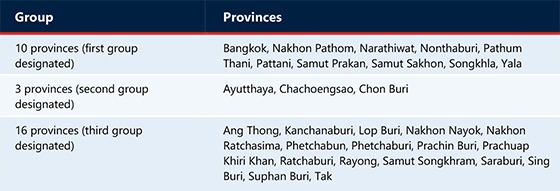
Two types of relief measures have been announced—one for parties under section 33 of the SSA, and one for parties under sections 39 and 40.


Section 33 (Regular Employees)

Monetary assistance is available for Thai nationals insured under section 33 of the SSA (and their employers) engaged in the following business activities:

  • Administrative and support activities
  • Arts, entertainment, and recreation
  • Automotive repair
  • Construction
  • Food and accommodation
  • Information and communication activities
  • Professional activities in science and academia
  • Services
  • Transportation and storage
  • Wholesale/retail

Employers must submit an application to the Social Security Office (SSO) through the online portal (www.sso.go.th/eservices) in order for them and their employees to receive the assistance payments. Each qualifying employee receives THB 2,500 per month if they are registered with the SSO within the deadline, while registered employers receive THB 3,000 per qualifying employee, up to a maximum of 200 employees (i.e., THB 600,000), as summarized in the table below.
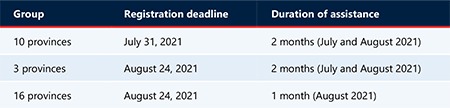
 

Section 39 (Former Employees Still Paying SSO Contributions) and Section 40 (Freelancers)

THB 5,000 assistance payments are available for Thai employees insured under sections 39 and 40 of the SSA. Government officers and those who receive a government pension are not eligible to receive the payments. Although the payments are classified as monthly, the current regulations authorize only one month of payments for qualifying insured persons who register with the SSO by the deadlines below.
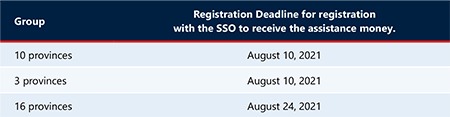
Both of the relief measures described above are likely to be renewed on a monthly basis if the pandemic remains severe. However, as of August 19, no resolution has yet been issued to approve an extension for September.

Tilleke & Gibbins will continue to monitor the situation for developments. Questions on Thailand’s COVID-19 relief measures for employers and employees can be directed to Chusert Supasitthumrong at [email protected] or Piyawat Vitooraporn at [email protected].
RELATED INSIGHTS​ 

October 28, 2022
Tilleke & Gibbins employment specialists in Myanmar have contributed an updated Myanmar chapter to Employment and Employee Benefits Global Guide, a Thomson Reuters Practical Law online publication that provides an overview of employment and employee benefits in jurisdictions worldwide. The Myanmar chapter was written by members of Tilleke & Gibbins’ Yangon office, including Yuwadee Thean-ngarm, director; Nwe Oo, senior associate; Sher Hann Chua, consultant; and Kyaw Min Tun, consultant. The chapter covers a wide range of key employment topics, including employment status, background checks, regulation of the employment relationship, minimum wage, working hours and holidays, illness and injury of employees, discrimination and harassment, termination of employment, resolution of employer-employee disputes, redundancy/layoffs, employee representation and consultation, business transfer and insolvency, employee relocation, health and safety obligations, taxation of employment income, intellectual property issues, and more. Practical Law, produced by Thomson Reuters, is the world’s leading legal resource for business lawyers, publishing a huge range of guides for hundreds of jurisdictions and practice areas. The Employment and Employee Benefits Global Guide covers 46 jurisdiction around the world, with Tilleke & Gibbins also providing the Vietnam chapter of the guide. To view the latest version of the Myanmar chapter, please visit the Practical Law website.
October 10, 2022
Thailand’s recent removal of cannabis from the list of narcotics represents a significant development for the country, and it has some human resources teams wondering whether they should prepare certain measures in order to prevent detrimental incidents from happening in their organizations. For example, some employees could still be under the influence of cannabis because they used it before coming to work. In the past, this was rarely a consideration as cannabis was clearly banned. Using cannabis or possessing cannabis inside the employer’s premises subjected employees to criminal liability including imprisonment and fines. However, now that the government has removed cannabis from the narcotics list under the Narcotics Act, such incidents are more likely to occur. This likelihood has led to concern among many employers about how they can prevent or handle these incidents. An employer does have the right to prohibit any employee from bringing cannabis inside its premises, as it is the property of the employer. The employer has the management right to do this, particularly as an employee’s use of cannabis may very well disturb other employees. But if the employer would like to set penalties for breaching the prohibition, the picture is more complicated. Employers’ Work Rules Under the Labour Protection Act (LPA), an employer who has at least 10 employees must have Thai-language work rules. These work rules must include the following items: Specification of working days, regular working hours, and rest periods; Holidays and rules for taking holidays; Rules concerning overtime work and work on holidays; Arrangements for payment of wages (i.e., schedule and location); Overtime pay, holiday pay, and holiday overtime pay; Leave and rules for taking leave; Discipline and disciplinary actions; Submission of grievances; and Termination of employment, severance pay and special severance pay. To issue or amend work rules (e.g.,
October 7, 2022
On October 3, 2022, Thailand’s Ministry of Labour issued an announcement canceling the prohibition on lockouts and strikes, which had been in place since the onset of the COVID-19 pandemic. While this cancellation does not apply to ongoing labor disputes already being considered under the interim arrangements, it will apply to all other labor disputes from October 5, 2022, when it was published in the Government Gazette. Lockouts and strikes are basic rights of employers and employees under the Labour Relations Act B.E. 2518 (1975). However, these rights can be suspended—as they have been since May 8, 2020, when the Ministry of Labour announced that all labor disputes that could not be resolved through negotiation must be presented to the Labour Relations Committee in lieu of organizing strikes or lockouts. The announcement referred to the necessity of such special administration during the COVID-19 situation in order to prevent possible negative impacts on both employers and employees. On September 30, 2022, Thailand ended its COVID-19 emergency decree and dissolved the country’s Centre for COVID-19 Situation Administration. In light of this, the Ministry of Labour decided to end the requirement that unresolved labor disputes be sent to the Labour Relations Committee. The ministry’s cancellation of the prohibition will once again allow employers and employees to organize lockouts and strikes under the Labour Relations Act, starting October 5, 2022. For more details on this development, or for assistance with employment-related questions or disputes in Thailand, please contact Tilleke & Gibbins at [email protected] or +66 2056 5555.
August 30, 2022
On August 26, 2022, Thailand’s National Wage Committee voted to raise the minimum wage to THB 328–354 per day (USD 9.01–9.72)—an increase of approximately 5% from the previous range of THB 313–336. The decision to boost minimum wages, which were last increased in January 2020, came after a 14-year-high headline inflation rate of 7.61% in July 2022. The new minimum wages have been submitted to the cabinet for final approval and are expected to take effect on October 1, 2022, following publication in the Government Gazette. The exact minimum wage depends on the province in which the workplace is located, as shown in the table below. These minimum rates are for one working day, which consists of eight hours for normal work, or seven hours for work that may be harmful to the health and safety of the employee. Legal Requirements After the new minimum wages are announced in the Government Gazette, employers may not pay employees wages below the prescribed rates. Violations are punishable by imprisonment for up to six months, a fine of up to THB 100,000, or both. Regarding the question of whether employers can reduce the working hours in order to pay less than minimum wages (e.g., a prorated amount), based on past practice, the National Wage Committee’s announcement is expected to provide that a “day” refers to an employee’s normal working day, regardless of whether it is shorter than the “normal working hours” set by the employer under the Labor Protection Act. For example, an employee in Bangkok who earns the current minimum wage of THB 331 per day for normal working hours of eight hours a day would still be entitled to the full new rate of THB 353 per day in October 2022, even if the employer reduces the working hours. For