You are using an outdated browser and your browsing experience will not be optimal. Please update to the latest version of Microsoft Edge, Google Chrome or Mozilla Firefox. Install Microsoft Edge

August 23, 2021

Thailand Deploys Relief Measures to Help Insured Persons under the Social Security Act

Since July 13, 2021, the Thai government has issued a series of resolutions offering relief measures for persons insured under sections 33 (regular employees), 39 (former employees still paying contributions to the SSO) and 40 (freelancers) of the Social Security Act B.E. 2533 (1990) (the SSA) who have been affected by the COVID-19 prevention measures under the Emergency Decree on Public Administration in Emergency Situations B.E. 2548 (2005), including the business closures required in some provinces.

The latest cabinet resolution extends relief measures to SSA-insured persons in 29 provinces designated as maximum control areas (or “dark red” provinces). The provinces are grouped into three categories based on when they received that designation (which, in turn, impacts the duration of the relief which they receive):
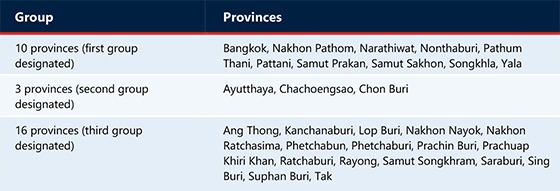
Two types of relief measures have been announced—one for parties under section 33 of the SSA, and one for parties under sections 39 and 40.


Section 33 (Regular Employees)

Monetary assistance is available for Thai nationals insured under section 33 of the SSA (and their employers) engaged in the following business activities:

  • Administrative and support activities
  • Arts, entertainment, and recreation
  • Automotive repair
  • Construction
  • Food and accommodation
  • Information and communication activities
  • Professional activities in science and academia
  • Services
  • Transportation and storage
  • Wholesale/retail

Employers must submit an application to the Social Security Office (SSO) through the online portal (www.sso.go.th/eservices) in order for them and their employees to receive the assistance payments. Each qualifying employee receives THB 2,500 per month if they are registered with the SSO within the deadline, while registered employers receive THB 3,000 per qualifying employee, up to a maximum of 200 employees (i.e., THB 600,000), as summarized in the table below.
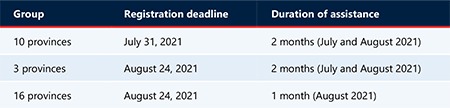
 

Section 39 (Former Employees Still Paying SSO Contributions) and Section 40 (Freelancers)

THB 5,000 assistance payments are available for Thai employees insured under sections 39 and 40 of the SSA. Government officers and those who receive a government pension are not eligible to receive the payments. Although the payments are classified as monthly, the current regulations authorize only one month of payments for qualifying insured persons who register with the SSO by the deadlines below.
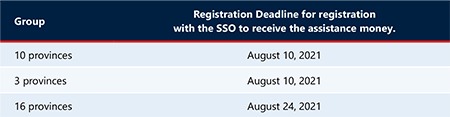
Both of the relief measures described above are likely to be renewed on a monthly basis if the pandemic remains severe. However, as of August 19, no resolution has yet been issued to approve an extension for September.

Tilleke & Gibbins will continue to monitor the situation for developments. Questions on Thailand’s COVID-19 relief measures for employers and employees can be directed to Chusert Supasitthumrong at [email protected] or Piyawat Vitooraporn at [email protected].

RELATED INSIGHTS​ 

December 4, 2024
Thailand Legal Basics, a valuable primer for foreign investors, explores all aspects of living and doing business in Thailand. Written by specialists at Tilleke & Gibbins in Bangkok, it is the only comprehensive English-language guide to the Thai legal system with a focus on the concerns of foreign business and investment.
October 1, 2024
Three of Tilleke & Gibbins’ labor and employment specialists in Vietnam have contributed the Vietnam chapter to the newly issued Labor and Employment Disputes 2024, a comprehensive guide from Lexology Panoramic to labor and employment dispute resolution in various jurisdictions around the world. The Vietnam chapter covers the following topics: Pre-action considerations: Key requirements, third-party funding, contingency fee arrangements Issuing a claim: Forum, territorial jurisdiction, standing, commencing claims, fees, service Defendants and legal personality: Types of claims, time limits, counterclaims Case management: Procedure, rules, amendments to claims, adding parties to proceedings, consolidating proceedings Class and collective actions: Special considerations Evidence: Witnesses, tactical considerations Interim relief: Availability, requirements Trial: Hearings conduct and typical time frames, confidentiality and public access, media reporting Elements of successful claims and burden of proof Alternative dispute resolution: Available types, requirements and expectations Enforcement: Collective employment and labor rights, enforcement of collective rights, standing Remedies and enforcement: Available remedies, assessing compensation, enforcement mechanisms Appeals: Appeal procedure and time frames, other means of challenge Update and trends: Recent cases and developments, technology developments, other issues The Vietnam chapter was authored by Truc Thi Thanh, Linh Ngoc Nguyen, and Kien Trung Trinh. Tilleke & Gibbins also contributed the Cambodia and Thailand chapters to Labor and Employment Disputes 2024.
October 1, 2024
Four of Tilleke & Gibbins’ labor and employment specialists in Bangkok have contributed the Thailand chapter to the newly issued Labor and Employment Disputes 2024, a comprehensive guide from Lexology Panoramic to labor and employment dispute resolution in various jurisdictions around the world. The Thailand chapter covers the following topics: Pre-action considerations: Key requirements, third-party funding, contingency fee arrangements Issuing a claim: Forum, territorial jurisdiction, standing, commencing claims, fees, service Defendants and legal personality: Types of claims, time limits, counterclaims Case management: Procedure, rules, amendments to claims, adding parties to proceedings, consolidating proceedings Class and collective actions: Special considerations Evidence: Witnesses, tactical considerations Interim relief: Availability, requirements Trial: Hearings conduct and typical time frames, confidentiality and public access, media reporting Elements of successful claims and burden of proof Alternative dispute resolution: Available types, requirements and expectations Enforcement: Collective employment and labor rights, enforcement of collective rights, standing Remedies and enforcement: Available remedies, assessing compensation, enforcement mechanisms Appeals: Appeal procedure and time frames, other means of challenge Update and trends: Recent cases and developments, technology developments, other issues The Thailand chapter was authored by Eric M. Meyer, Chusert Supasitthumrong, Pathanin Sornchangwat, and Chayathorn Kruatao, all in the Thailand dispute resolution and litigation team. Tilleke & Gibbins also contributed the Cambodia and Vietnam chapters to Labor and Employment Disputes 2024. The full Thailand chapter is available below as a PDF.
August 14, 2024
Myanmar has once again made significant amendments to its minimum-wage framework by introducing additional allowances for both public- and private-sector workers. On August 9, 2024, the National Committee for Setting the Minimum Wage issued Notification No. 1/2024, which entitles private-sector workers to a new additional daily allowance of MMK 1,000 (approximately USD 0.48). This increase is on top of the MMK 1,000 additional daily allowance introduced last year. As a result, workers at private-sector employers with more than 10 employees are now entitled to the base minimum wage of MMK 4,800 plus additional allowances of MMK 2,000, for a total of MMK 6,800 (approximately USD 3.20) per day for an eight-hour workday, effective August 1, 2024. A similar additional allowance had been announced for workers in government departments and organizations on July 26, 2024. Background The MMK 4,800 (approximately USD 2.29) minimum wage for an eight-hour workday (equivalent to MMK 600 per hour) was established in May 2018 for all workers, irrespective of location or job type. In September 2023, the Ministry of Planning and Finance announced an additional daily benefit of MMK 1,000 for workers in government departments and organizations, and on October 9, 2023, the National Committee for Setting the Minimum Wage extended this benefit to workers at private-sector employers with more than 10 employees, bringing the effective minimum daily wage to MMK 5,800 (approximately USD 2.77). These changes took effect on October 1, 2023. Applicability of Additional Allowances for Private-Sector Workers The latest announcement also entitles employees to the base minimum wage and additional allowances for days used from their entitlement to leave and holidays, in accordance with the 1951 Leave and Holidays Act. However, the daily allowances—totaling MMK 2,000—are not to be included when calculating overtime payments. Instead, overtime payments must be calculated based on