You are using an outdated browser and your browsing experience will not be optimal. Please update to the latest version of Microsoft Edge, Google Chrome or Mozilla Firefox. Install Microsoft Edge

August 23, 2021

Thailand Deploys Relief Measures to Help Insured Persons under the Social Security Act

Since July 13, 2021, the Thai government has issued a series of resolutions offering relief measures for persons insured under sections 33 (regular employees), 39 (former employees still paying contributions to the SSO) and 40 (freelancers) of the Social Security Act B.E. 2533 (1990) (the SSA) who have been affected by the COVID-19 prevention measures under the Emergency Decree on Public Administration in Emergency Situations B.E. 2548 (2005), including the business closures required in some provinces.

The latest cabinet resolution extends relief measures to SSA-insured persons in 29 provinces designated as maximum control areas (or “dark red” provinces). The provinces are grouped into three categories based on when they received that designation (which, in turn, impacts the duration of the relief which they receive):
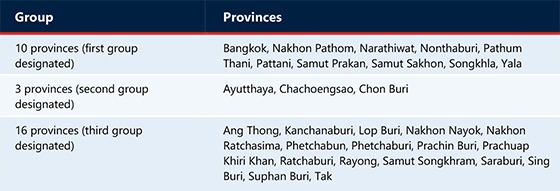
Two types of relief measures have been announced—one for parties under section 33 of the SSA, and one for parties under sections 39 and 40.


Section 33 (Regular Employees)

Monetary assistance is available for Thai nationals insured under section 33 of the SSA (and their employers) engaged in the following business activities:

  • Administrative and support activities
  • Arts, entertainment, and recreation
  • Automotive repair
  • Construction
  • Food and accommodation
  • Information and communication activities
  • Professional activities in science and academia
  • Services
  • Transportation and storage
  • Wholesale/retail

Employers must submit an application to the Social Security Office (SSO) through the online portal (www.sso.go.th/eservices) in order for them and their employees to receive the assistance payments. Each qualifying employee receives THB 2,500 per month if they are registered with the SSO within the deadline, while registered employers receive THB 3,000 per qualifying employee, up to a maximum of 200 employees (i.e., THB 600,000), as summarized in the table below.
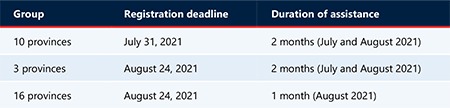
 

Section 39 (Former Employees Still Paying SSO Contributions) and Section 40 (Freelancers)

THB 5,000 assistance payments are available for Thai employees insured under sections 39 and 40 of the SSA. Government officers and those who receive a government pension are not eligible to receive the payments. Although the payments are classified as monthly, the current regulations authorize only one month of payments for qualifying insured persons who register with the SSO by the deadlines below.
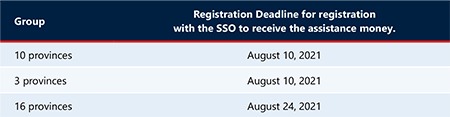
Both of the relief measures described above are likely to be renewed on a monthly basis if the pandemic remains severe. However, as of August 19, no resolution has yet been issued to approve an extension for September.

Tilleke & Gibbins will continue to monitor the situation for developments. Questions on Thailand’s COVID-19 relief measures for employers and employees can be directed to Chusert Supasitthumrong at [email protected] or Piyawat Vitooraporn at [email protected].

RELATED INSIGHTS​ 

December 8, 2025
As Thailand transitions into an aged society, retirement policy and workplace protections for older workers have come into sharper focus. With public sentiment increasingly open to working beyond the traditional retirement age, questions about employee rights and employer obligations are more relevant than ever. In October 2025, Prime Minister Anutin Charnvirakul proposed increasing the statutory retirement age to 65 for government officers, citing Thailand’s aged-society status and the potential social and economic benefits of longer working lives. While academics and stakeholders have raised concerns about systemic impacts, public opinion remains divided, with many workers signaling a willingness to continue working beyond the current norm. Against this backdrop, it’s worth revisiting what the Labor Protection Act B.E. 2541 (1998) (LPA) requires in regard to retirement and severance pay. This article explains the current legal landscape under the LPA, with a focus on retirement and severance pay for employees over 60, recent judicial developments, and practical options for structuring postretirement engagements. Retirement as Termination Under the LPA Under the LPA, retirement—whether set by agreement between employer and employee or unilaterally stipulated by the employer—is deemed a termination of employment. As a result, employees who retire under such terms are entitled to severance pay. The law also adds a default rule: if there is no agreed or prescribed retirement age, or if the prescribed retirement age exceeds 60, an employee aged 60 or older may declare an intention to retire. The declaration takes effect 30 days after notice, and the employer must pay severance accordingly. In short, retirement triggered by agreement, the employer’s work rules, or an employee’s valid notice is treated as a termination, and statutory severance pay is owed. Hiring or Rehiring Employees Over 60 Practical issues arise when an employer’s work rules set a retirement age that does not
December 2, 2025
Investing in Mainland Southeast Asia is Tilleke & Gibbins’ essential guide for investors looking to do business in this vibrant region, whether it’s starting operations as a newly established entity or expanding into new territories or business models.
November 20, 2025
Lawyers from Tilleke & Gibbins’ labor and employment team have contributed a new Vietnam chapter to Thomson Reuters Practical Law’s Employment and Employee Benefits Global Guide. The guide provides a high-level comparative overview of employment laws and regulations across various jurisdictions around the world. Tilleke & Gibbins also contributed the Myanmar chapter of the guide. The Vietnam chapter covers a wide range of typical employment matters, such as limitations on working hours, paid leave requirements, minimum wage, and health and safety obligations. In addition, the guide provides insight on various topics of special interest to foreign investors doing business in Vietnam, including the following: Mandatory contents of a labor contract; Visas and permits required for expatriate employees; Employers’ obligations for protecting employees’ privacy and personal data; Procedural requirements for the dismissal of an employee; Employer and parent company liability. To view the latest version of the Employment and Employee Benefits Vietnam chapter, please visit the Practical Law website and enroll in the free Practical Law trial to gain full access.
November 12, 2025
Thailand has amended the Labor Protection Act to significantly expand family leave benefits and strengthen employment protections, effective December 7, 2025. The Labor Protection Act (No. 9) B.E. 2568 (2025), published in the Government Gazette on November 7, 2025, provides enhanced maternity and paternity benefits, introduces new childcare leave provisions, and extends labor protections to certain public sector contractors. Key changes introduced by the amendments are detailed below. Extended Maternity Leave Female employees are now entitled to up to 120 days of maternity leave per pregnancy, increased from 98 days. Employers must pay full wages for 60 days, increased from the current 45 days. New Childcare Leave for Health Complications Female employees who have taken maternity leave are entitled to an additional 15 days of leave to care for newborns with health complications, disabilities, or conditions that could lead to future medical risks. This leave requires a medical certificate and is compensated at 50% of the employee’s regular wage. New Paternity Leave Male employees are now entitled to 15 days of paid paternity leave to support their spouse or partner during childbirth. This new leave allowance may be taken before or within 90 days after childbirth, with employers required to pay full wages for all 15 days. Protection for Public Sector Contractors The law extends protection to individuals engaged under service contracts with government agencies, including central, regional, and local administrations, state enterprises, and public organizations. When such workers are supervised or controlled in a manner similar to employees, the contracting government agencies must provide them with rights and benefits equivalent to those under the Labor Protection Act, including remuneration, weekly holidays, public holidays, annual leave, sick leave, regulated working hours, and rest periods. New Annual Reporting Requirement All employers with 10 or more employees must now submit an