
You are using an outdated browser and your browsing experience will not be optimal. Please update to the latest version of Microsoft Edge, Google Chrome or Mozilla Firefox. Install Microsoft Edge

January 12, 2021

Thailand Announces Social Security Assistance for Second Wave of COVID-19

Due to the resurgence of the COVID-19 pandemic in Thailand since December, 2020, Thailand’s Ministry of Labor recently published two regulations under the Social Security Act (SSA) in the Government Gazette:

  • The Regulation on Entitlement to Compensatory Benefits in the Event of Unemployment Due to Force Majeure from the Pandemic of Dangerous Communicable Disease Under Relevant Law Relating to Communicable Diseases B.E. 2563 (2020) (the Force Majeure Regulation); and
  • The Regulation on Determination of the Amount of Contributions to the Social Security Funds B.E. 2563 (2020) (the SSF Contribution Regulation).

Details of the two regulations are provided below.

The Force Majeure Regulation

This regulation is similar to a previous regulation from April, 2020, during the first wave of the pandemic, stating that the definition of force majeure under the Social Security Act B.E. 2533 (1990) (the SSA) includes hazards from pandemics of dangerous communicable diseases (including COVID-19). This definition therefore affords protection to insured persons (i.e., employees) in the event that the COVID-19 pandemic results in their being unable to work, or their employers being unable to operate their business normally.

This regulation allows the Social Security Office (SSO) to pay compensation to employees who:

  • are insured persons who qualify to receive compensatory benefit in case of unemployment in accordance with the SSA;
  • have to cease working temporarily during the period from December 19, 2020 onwards; and
  • do not receive wages from their employer during the temporary cessation.

This applies only if the circumstances above result from the following force majeure events related to hazards from COVID-19 (or other pandemics of dangerous communicable diseases that affect the public under the Communicable Diseases Act B.E. 2558 (2015)):

  • The employee cannot work, or the employer does not allow the employee to work, because of quarantine or to comply with a COVID-19 preventative measure; or,
  • The employee cannot work because the employer temporarily ceases operations, wholly or partially, due to a government order to close the premises temporarily under the Communicable Diseases Act preventing the business from operating as normal.

The affected employee will be entitled to compensation at a rate of 50% of their daily wages during the quarantine period, period of compliance with a COVID-19 preventative measure, or period of temporary premises closure, for not more than 90 days. The payment will be calculated based on daily wages in accordance with section 57 paragraph 1 of the SSA, but will be paid monthly.

The SSO will cease payment of the compensation if the employee resigns or is terminated by an employer, or the employment contract expires. In addition, the employer is obligated to issue a certificate letter to request compensation in the event of unemployment resulting from force majeure. The certificate must be in accordance with a form letter prescribed in the regulation, can be made and sent electronically, and must be retained by the employer as evidence.

The SSF Contribution Regulation

This regulation reduces the rate of mandatory Social Security Fund contributions under section 33 of the SSA effective from January 1, 2021 to March 31, 2021. Contribution rates are calculated as a percentage of each employees’ monthly wages, based on a minimum monthly wage of THB 1,650 and a maximum monthly wage of THB 15,000. The reduced rates are as follows:
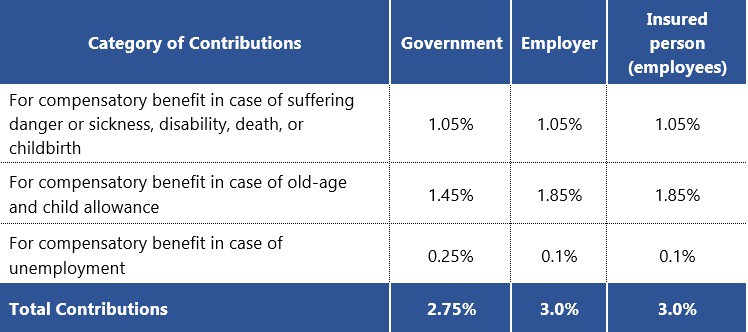
The rates of mandatory Social Security Fund contributions under section 33 of the SSA effective from April 1, 2021 onward, are as follows:
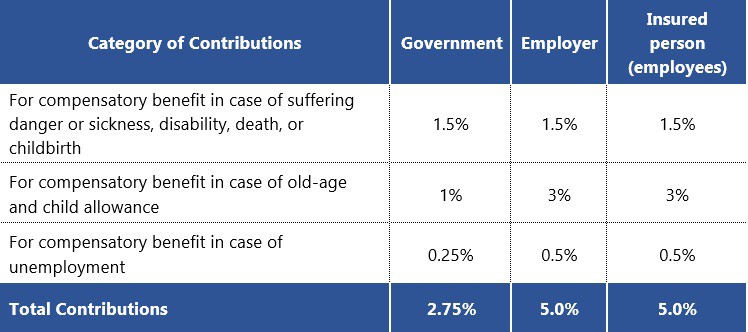
Therefore, based on the minimum and maximum wages allowed for calculation, from January 1 to March 31, 2021, the contributions would range from THB 49.5 to THB 450 per month for both the employer and the employees. From April 1, 2021 onwards, this will increase to THB 82.5 to THB 750.

RELATED INSIGHTS​ 

March 18, 2024
Lawyers from Tilleke & Gibbins’ labor and employment team have contributed a new Vietnam chapter to Thomson Reuters Practical Law’s Employment and Employee Benefits Global Guide. The guide provides a high-level comparative overview of employment laws and regulations across various jurisdictions around the world. Tilleke & Gibbins also contributed the Myanmar chapter of the guide. The Vietnam chapter covers a wide range of typical employment matters, such as limitations on working hours, paid leave requirements, minimum wage, and health and safety obligations. In addition, the guide provides insight on a number of topics of special interest to foreign investors doing business in Vietnam, including the following: Mandatory contents of a labor contract; Visas and permits required for expatriate employees; Employers’ obligations for protecting employees’ privacy and personal data; Procedural requirements for the dismissal of an employee; Employer and parent company liability. To view the latest version of Employment and Employee Benefits, please visit the Practical Law website and enroll in the free Practical Law trial to gain full access.
February 28, 2024
The Myanmar Investment Commission (MIC) has announced the opening of the trial period for MIC-permitted or MIC-endorsed companies to reenter investment data for using the Myanmar Investment Online (MyInO) system. The trial period is open until June 30, 2024. The MyInO system allows for the submission and recordal of applications for investment under the Myanmar Investment Law. With the implementation of phase 2 from September 1, 2023, applications for the appointment or resignation of foreign experts and employees within MIC-permitted or MIC-endorsed companies can now be submitted manually or through the Investment Monitoring System available on MyInO. To initiate the application process in MyInO, applicants are required to create an account on the platform. Subsequently, companies holding an MIC permit or endorsement must reenter all investment-related data since the obtaining of the relevant permits/endorsements, in compliance with the announcement. Following this data update, applications can be filed through MyInO. After this trial period, the submission of applications for appointments will be available online. The benefit of using MyInO to submit a foreign expert or employee appointment or resignation application is that the application can be submitted within 30 days of the foreign expert’s arrival in Myanmar. In contrast, hard copy applications must be submitted within seven working days of arrival. According to the Myanmar Investment Law, a foreign expert is one who qualifies as a senior manager, technical or operational expert, or advisor in permitted or endorsed companies within Myanmar. For assistance with completing the investment data reentry process or filing applications for appointment or resignation of foreign experts or employees, or for further details on any aspect of the Investment Monitoring System under MyInO, please contact Tilleke & Gibbins at [email protected].
February 9, 2024
Tilleke & Gibbins employment specialists in Myanmar have contributed an updated Employment and Employee Benefits in Myanmar overview for Thomson Reuters Practical Law, an online publication that provides an overview of employment and employee benefits in jurisdictions worldwide. The Myanmar overview was written by members of Tilleke & Gibbins’ Yangon office, including Yuwadee Thean-ngarm, director; Nwe Oo, senior associate; and Kyaw Min Tun, associate. The chapter covers a wide range of key employment topics, including employment status, background checks, regulation of the employment relationship, minimum wage, working hours and holidays, illness and injury of employees, discrimination and harassment, termination of employment, resolution of employer-employee disputes, redundancy/layoffs, employee representation and consultation, business transfer and insolvency, employee relocation, health and safety obligations, taxation of employment income, intellectual property issues, and more. Practical Law, one of the many legal reference resources from Thomson Reuters, publishes a wide range of guides for hundreds of jurisdictions and practice areas. The Employment and Employee Benefits Global Guide covers 44 jurisdictions around the world, with Tilleke & Gibbins also providing the Vietnam chapter of the guide. To view the latest version of the Employment and Employee Benefits in Myanmar overview, please visit the Practical Law website and enroll in the free Practical Law trial to gain full access.
January 12, 2024
On December 28, 2023, Cambodia’s Ministry of Labor and Vocational Training (MLVT) issued Notification No. 110/23 on the issuance of work permits for foreign employees, in accordance with the country’s Labor Law and Prakas 195 dated August 20, 2014, on work permits and employment cards for foreign employees. This is a more comprehensive notification than existed previously, as it specifically clarifies the parties that are required to apply for work permits and employment cards. Notification No. 110/23 specifies that the following types of foreign individuals must hold a valid foreign work permit and/or employment card in order to work in Cambodia: A foreign employer whose name is stated in an enterprise’s patent tax certificate must hold a foreign work permit. A foreign employee whose name is stated in an enterprise’s patent tax certificate must hold a foreign work permit and an employment card. Self-employed individuals must hold a foreign work permit and an employment card. Applications for work permits and employment cards can be submitted through the MLVT’s online portal, accompanied by the following required documents: Valid passport; Latest patent tax certificate; Physical examination form; and Photo (4×6 cm) However, foreign shareholders and members of the board of directors as defined in the company’s articles of incorporation who do not have a Cambodian resident visa are not required to obtain a work permit or employment card. For more information on regulations and requirements for foreign employees in Cambodia, please contact Tilleke & Gibbins at [email protected].