
You are using an outdated browser and your browsing experience will not be optimal. Please update to the latest version of Microsoft Edge, Google Chrome or Mozilla Firefox. Install Microsoft Edge

January 12, 2021

Thailand Announces Social Security Assistance for Second Wave of COVID-19

Due to the resurgence of the COVID-19 pandemic in Thailand since December, 2020, Thailand’s Ministry of Labor recently published two regulations under the Social Security Act (SSA) in the Government Gazette:

  • The Regulation on Entitlement to Compensatory Benefits in the Event of Unemployment Due to Force Majeure from the Pandemic of Dangerous Communicable Disease Under Relevant Law Relating to Communicable Diseases B.E. 2563 (2020) (the Force Majeure Regulation); and
  • The Regulation on Determination of the Amount of Contributions to the Social Security Funds B.E. 2563 (2020) (the SSF Contribution Regulation).

Details of the two regulations are provided below.

The Force Majeure Regulation

This regulation is similar to a previous regulation from April, 2020, during the first wave of the pandemic, stating that the definition of force majeure under the Social Security Act B.E. 2533 (1990) (the SSA) includes hazards from pandemics of dangerous communicable diseases (including COVID-19). This definition therefore affords protection to insured persons (i.e., employees) in the event that the COVID-19 pandemic results in their being unable to work, or their employers being unable to operate their business normally.

This regulation allows the Social Security Office (SSO) to pay compensation to employees who:

  • are insured persons who qualify to receive compensatory benefit in case of unemployment in accordance with the SSA;
  • have to cease working temporarily during the period from December 19, 2020 onwards; and
  • do not receive wages from their employer during the temporary cessation.

This applies only if the circumstances above result from the following force majeure events related to hazards from COVID-19 (or other pandemics of dangerous communicable diseases that affect the public under the Communicable Diseases Act B.E. 2558 (2015)):

  • The employee cannot work, or the employer does not allow the employee to work, because of quarantine or to comply with a COVID-19 preventative measure; or,
  • The employee cannot work because the employer temporarily ceases operations, wholly or partially, due to a government order to close the premises temporarily under the Communicable Diseases Act preventing the business from operating as normal.

The affected employee will be entitled to compensation at a rate of 50% of their daily wages during the quarantine period, period of compliance with a COVID-19 preventative measure, or period of temporary premises closure, for not more than 90 days. The payment will be calculated based on daily wages in accordance with section 57 paragraph 1 of the SSA, but will be paid monthly.

The SSO will cease payment of the compensation if the employee resigns or is terminated by an employer, or the employment contract expires. In addition, the employer is obligated to issue a certificate letter to request compensation in the event of unemployment resulting from force majeure. The certificate must be in accordance with a form letter prescribed in the regulation, can be made and sent electronically, and must be retained by the employer as evidence.

The SSF Contribution Regulation

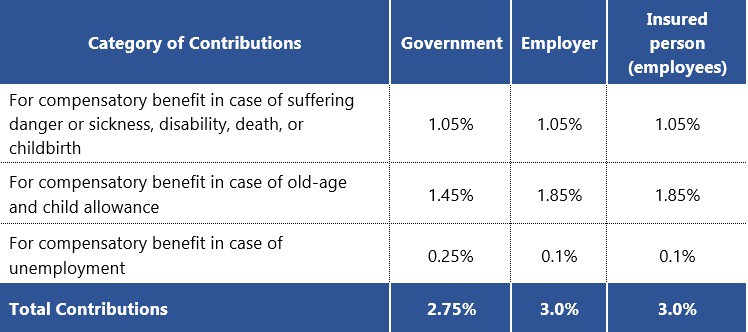
This regulation reduces the rate of mandatory Social Security Fund contributions under section 33 of the SSA effective from January 1, 2021 to March 31, 2021. Contribution rates are calculated as a percentage of each employees’ monthly wages, based on a minimum monthly wage of THB 1,650 and a maximum monthly wage of THB 15,000. The reduced rates are as follows:
The rates of mandatory Social Security Fund contributions under section 33 of the SSA effective from April 1, 2021 onward, are as follows:
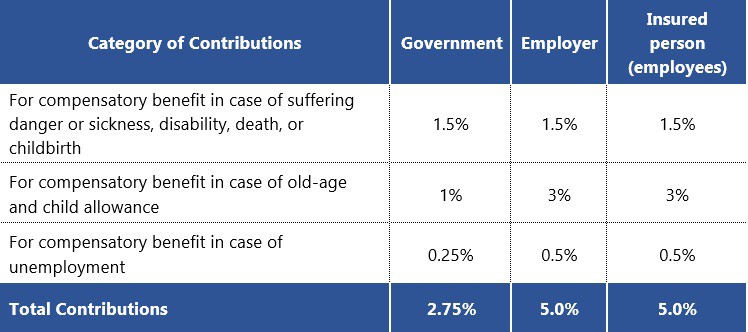
Therefore, based on the minimum and maximum wages allowed for calculation, from January 1 to March 31, 2021, the contributions would range from THB 49.5 to THB 450 per month for both the employer and the employees. From April 1, 2021 onwards, this will increase to THB 82.5 to THB 750.

RELATED INSIGHTS​ 

September 25, 2025
Tilleke & Gibbins’ labor and employment team in Hanoi and Ho Chi Minh City has contributed the Vietnam chapter to Labor and Employment Disputes 2026. Drawing on the expertise of three of the firm’s employment specialists, the chapter provides practical guidance for navigating employment disputes in Vietnam and covers: Pre-action considerations: key requirements, third-party funding, contingency fee arrangements Issuing a claim: forum, territorial jurisdiction, standing, commencing claims, fees, service, defendants and legal personality, types of claims, time limits, counterclaims Case management: procedure, rules, amendments to claims, adding parties, consolidating proceedings, class and collective actions, evidence, witnesses, tactical considerations Interim relief: availability, requirements Trial: hearings conduct and time frames, confidentiality and public access, media reporting, elements of successful claims and burden of proof Alternative dispute resolution: available types, requirements and expectations, enforcement Collective employment and labor rights: enforcement and standing Remedies and enforcement: available remedies, assessing compensation, enforcement mechanisms Appeals: procedure, time frames, other means of challenge Updates and trends: recent cases and developments, technology developments, other issues The Vietnam chapter is available for download below. Tilleke & Gibbins also contributed the Cambodia and Thailand chapters to Labor and Employment Disputes 2026. Readers can also gain 30 days of complementary access to the full Labor and Employment Disputes 2026 guide and the rest of Lexology Panoramic’s varied offerings through this link.
September 25, 2025
In the Thailand contribution to Labor and Employment Disputes 2026, four members of Tilleke & Gibbins’ Bangkok labor and employment team outline key aspects of dispute resolution in Thailand. Their analysis, part of Lexology Panoramic’s comparative guide covering jurisdictions worldwide, addresses the following areas: Pre-action considerations: key requirements, third-party funding, contingency fee arrangements Issuing a claim: forum, territorial jurisdiction, standing, commencing claims, fees, service, defendants and legal personality, types of claims, time limits, counterclaims Case management: procedure, rules, amendments to claims, adding parties, consolidating proceedings, class and collective actions, evidence, witnesses, tactical considerations Interim relief: availability, requirements Trial: hearings conduct and time frames, confidentiality and public access, media reporting, elements of successful claims and burden of proof Alternative dispute resolution: available types, requirements and expectations, enforcement Collective employment and labor rights: enforcement and standing Remedies and enforcement: available remedies, assessing compensation, enforcement mechanisms Appeals: procedure, time frames, other means of challenge Updates and trends: recent cases and developments, technology developments, other issues The complete Thailand chapter can be downloaded below. Tilleke & Gibbins also contributed the Cambodia and Vietnam chapters to Labor and Employment Disputes 2026. Readers can also gain 30 days of complementary access to the full Labor and Employment Disputes 2026 guide and the rest of Lexology Panoramic’s varied offerings through this link.
September 25, 2025
Four of Tilleke & Gibbins’ labor and employment specialists in Phnom Penh have authored the Cambodia chapter of Labor and Employment Disputes 2026, the latest edition of Lexology Panoramic’s global guide to handling labor and employment disputes. The chapter provides practical insights on a wide range of dispute resolution issues, including: Pre-action considerations: key requirements, third-party funding, contingency fee arrangements Issuing a claim: forum, territorial jurisdiction, standing, commencing claims, fees, service, defendants and legal personality, types of claims, time limits, counterclaims Case management: procedure, rules, amendments to claims, adding parties, consolidating proceedings, class and collective actions, evidence, witnesses, tactical considerations Interim relief: availability, requirements Trial: hearings conduct and time frames, confidentiality and public access, media reporting, elements of successful claims and burden of proof Alternative dispute resolution: available types, requirements and expectations, enforcement Collective employment and labor rights: enforcement and standing Remedies and enforcement: available remedies, assessing compensation, enforcement mechanisms Appeals: procedure, time frames, other means of challenge Updates and trends: recent cases and developments, technology developments, other issues The full Cambodia chapter is available for download below. Tilleke & Gibbins also contributed the Thailand and Vietnam chapters to Labor and Employment Disputes 2026. Readers can also gain 30 days of complementary access to the full Labor and Employment Disputes 2026 guide and the rest of Lexology Panoramic’s varied offerings through this link.
September 2, 2025
On August 26, 2025, the Thai cabinet approved a one-year postponement of mandatory contributions to the Employee Welfare Fund. Originally scheduled to take effect on October 1, 2025, the enforcement date has been deferred to October 1, 2026. The decision to delay the implementation stems from ongoing economic uncertainties in Thailand, driven by several external and domestic factors. These include increased trade tariffs imposed by the United States, the recent rise in the national minimum wage, and continued geopolitical tensions resulting from unresolved disputes with neighboring countries. These challenges have placed significant pressure on both businesses and the labor market, prompting the government to offer temporary relief through this deferral. As a result of the postponement, the following regulations will now come into effect on October 1, 2026: Royal Decree determining the Commencement Period for Savings and Contributions to the Employee Welfare Fund; Ministerial Notification specifying the Rates of Savings and Contributions; and Ministerial Notification outlining the Criteria and Procedures for Employers to Provide Assistance in Cases of Termination of Employment or Death. The Labour Welfare Fund Committee has formally endorsed the postponement. Contribution Rates Unchanged Although the implementation has been delayed, the contribution rates remain unchanged: October 1, 2026–September 30, 2031: Employers and employees each contribute 0.25% of the employee’s wage to the fund. From October 1, 2031, onward: Contributions increase to 0.5% of the employee’s wage for both parties. All other rules and conditions concerning the Employee Welfare Fund remain in full effect.