
You are using an outdated browser and your browsing experience will not be optimal. Please update to the latest version of Microsoft Edge, Google Chrome or Mozilla Firefox. Install Microsoft Edge

January 12, 2021

Thailand Announces Social Security Assistance for Second Wave of COVID-19

Due to the resurgence of the COVID-19 pandemic in Thailand since December, 2020, Thailand’s Ministry of Labor recently published two regulations under the Social Security Act (SSA) in the Government Gazette:

  • The Regulation on Entitlement to Compensatory Benefits in the Event of Unemployment Due to Force Majeure from the Pandemic of Dangerous Communicable Disease Under Relevant Law Relating to Communicable Diseases B.E. 2563 (2020) (the Force Majeure Regulation); and
  • The Regulation on Determination of the Amount of Contributions to the Social Security Funds B.E. 2563 (2020) (the SSF Contribution Regulation).

Details of the two regulations are provided below.

The Force Majeure Regulation

This regulation is similar to a previous regulation from April, 2020, during the first wave of the pandemic, stating that the definition of force majeure under the Social Security Act B.E. 2533 (1990) (the SSA) includes hazards from pandemics of dangerous communicable diseases (including COVID-19). This definition therefore affords protection to insured persons (i.e., employees) in the event that the COVID-19 pandemic results in their being unable to work, or their employers being unable to operate their business normally.

This regulation allows the Social Security Office (SSO) to pay compensation to employees who:

  • are insured persons who qualify to receive compensatory benefit in case of unemployment in accordance with the SSA;
  • have to cease working temporarily during the period from December 19, 2020 onwards; and
  • do not receive wages from their employer during the temporary cessation.

This applies only if the circumstances above result from the following force majeure events related to hazards from COVID-19 (or other pandemics of dangerous communicable diseases that affect the public under the Communicable Diseases Act B.E. 2558 (2015)):

  • The employee cannot work, or the employer does not allow the employee to work, because of quarantine or to comply with a COVID-19 preventative measure; or,
  • The employee cannot work because the employer temporarily ceases operations, wholly or partially, due to a government order to close the premises temporarily under the Communicable Diseases Act preventing the business from operating as normal.

The affected employee will be entitled to compensation at a rate of 50% of their daily wages during the quarantine period, period of compliance with a COVID-19 preventative measure, or period of temporary premises closure, for not more than 90 days. The payment will be calculated based on daily wages in accordance with section 57 paragraph 1 of the SSA, but will be paid monthly.

The SSO will cease payment of the compensation if the employee resigns or is terminated by an employer, or the employment contract expires. In addition, the employer is obligated to issue a certificate letter to request compensation in the event of unemployment resulting from force majeure. The certificate must be in accordance with a form letter prescribed in the regulation, can be made and sent electronically, and must be retained by the employer as evidence.

The SSF Contribution Regulation

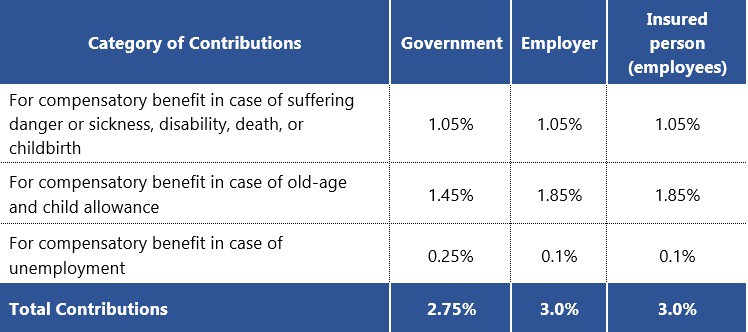
This regulation reduces the rate of mandatory Social Security Fund contributions under section 33 of the SSA effective from January 1, 2021 to March 31, 2021. Contribution rates are calculated as a percentage of each employees’ monthly wages, based on a minimum monthly wage of THB 1,650 and a maximum monthly wage of THB 15,000. The reduced rates are as follows:
The rates of mandatory Social Security Fund contributions under section 33 of the SSA effective from April 1, 2021 onward, are as follows:
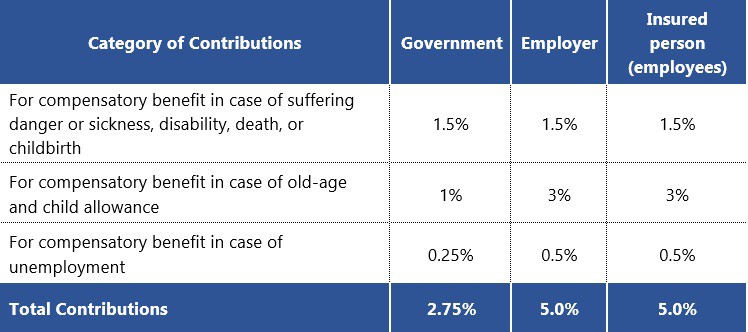
Therefore, based on the minimum and maximum wages allowed for calculation, from January 1 to March 31, 2021, the contributions would range from THB 49.5 to THB 450 per month for both the employer and the employees. From April 1, 2021 onwards, this will increase to THB 82.5 to THB 750.

RELATED INSIGHTS​ 

October 20, 2025
Attorneys from Tilleke & Gibbins’ Yangon office have contributed Employment and Employee Benefits in Myanmar: Overview, a Q&A-style guide published by Thomson Reuters Practical Law. The resource provides a concise overview of key legal and practical considerations for employers operating in Myanmar and reflects the country’s most recent regulatory developments in employment law. The chapter addresses the following core topics: Scope of employment regulation: Application of Myanmar labor laws to foreign nationals and Myanmar citizens working abroad. Employment status: Classification of workers, statutory employment rights, and requirements for official employment contracts. Regulation of the employment relationship: Mandatory contract provisions, collective agreements, and procedures for amending employment terms. Wages and working hours: National minimum wage updates, overtime rules, and leave entitlements. Termination of employment: Notice requirements, severance payments, and protections against dismissal. Discrimination and harassment: Statutory protections and remedies under Myanmar labor law. Health and safety: Employer obligations under the Occupational Safety and Health Law and related regulations. Tax and social security: Income tax rates for resident and non-resident employees, and mandatory employer and employee contributions. Intellectual property and post-employment restrictions: Ownership of employee-created IP and enforceability of non-compete clauses. Practical Law, a leading legal reference resource from Thomson Reuters, publishes a wide range of comparative guides for jurisdictions and practice areas worldwide. Its Employment and Employee Benefits series provides practical insights into employment law regimes across numerous countries. To view the latest version of the Myanmar overview, please visit the Practical Law website and enroll in a free trial for full access.
October 15, 2025
Myanmar’s National Committee for Setting the Minimum Wage has introduced another MMK 1,000 daily allowance for private-sector workers, bringing the total minimum daily wage to MMK 7,800 (approx. USD 3.72). Notification No. 1/2025 marks the third such increase in recent years as the government continues adjusting compensation across both public and private sectors. Although the notification was issued on October 14, 2025, it takes retroactive effect from October 1, 2025. Current Minimum Wage Structure In May 2018, the committee established a base minimum wage of MMK 4,800 (approximately USD 2.29) for an eight-hour workday (MMK 600 per hour), applying to all workers regardless of location or job type. The committee has subsequently announced additional daily allowances for private-sector workers: MMK 1,000 effective October 1, 2023, and another MMK 1,000 effective August 1, 2024. With the latest MMK 1,000 daily allowance from October 1, 2025, the total additional allowance reaches MMK 3,000, resulting in a new combined minimum daily wage of MMK 7,800. Alignment with Public Sector Increases The new allowance aligns with increases granted to government personnel. The Ministry of Finance and Revenue’s Notification No. 110/2025 previously granted monthly increases of MMK 30,000 to service and Tatmadaw personnel starting in October 2023 and August 2024. With the latest increase effective October 1, 2025, the total monthly allowance for these personnel now amounts to MMK 90,000. Daily wage employees in government departments received MMK 1,000 increases in the same periods, totaling MMK 3,000 in daily allowances—mirroring the private-sector adjustment. Key Implementation Details The latest announcement confirms several important aspects of the allowance structure: Employees are entitled to the base wage and additional allowances during their entitled leave and holidays, in accordance with the 1951 Leave and Holidays Act. The MMK 3,000 daily allowance is excluded from overtime calculations, which must
October 8, 2025
On September 24, 2025, Thailand’s House of Representatives voted to approve two draft amendments to the Labor Protection Act in their first reading, aiming to enhance workers’ rights and quality of life through improved working conditions, expanded leave entitlements, and stronger antidiscrimination protections. Key provisions of the draft amendments are outlined below. Draft Bill on Workers’ Rights This draft bill focuses on improving working conditions, working hours, and annual leave entitlements. The key provisions include: Limiting normal working hours to no more than 40 hours per week, reduced from the current 48 hours per week. For hazardous work, as defined by ministerial regulations, the maximum working hours are set at 35 hours per week, reduced from the current 42 hours per week. Mandating at least 2 days off per week, with no more than 5 consecutive working days between rest days. This is an increase from the current requirement of at least 1 day off per week, with the interval between days off not exceeding 6 days. Providing annual leave entitlement of at least 10 working days after the completion of 120 consecutive working days, compared to the current entitlement of 6 days after 1 year of employment. Draft Bill on Workers’ Quality of Life This draft bill is designed to enhance workers’ quality of life and promote equality and nondiscrimination in the workplace. The new additions to the Labor Protection Act include: Menstrual leave for female employees: Up to 3 days per month, which shall not be counted as sick leave or deducted from other statutory leave entitlements. Family caregiving leave: Employees are entitled to up to 15 working days per year to care for close family members or loved ones. For absences of 5 or more days, employers may request supporting documents such as a medical certificate
September 30, 2025
Over the past several years, during and after the COVID-19 pandemic, Thai employees and labor unions have faced reductions in benefits and welfare from their employers. Consequently, they have pursued various strategies to enhance their compensation packages. One such approach involves establishing employee committees to negotiate with employers regarding benefits and welfare. Additionally, companies with existing unions typically nominate representatives to serve on these employee committees. Many employers, however, remain unfamiliar with both the committee’s role and the heightened procedural requirements that apply when disciplinary measures are contemplated against committee members. Because any violation of a committee member’s statutory rights can expose the employer—and its directors or authorized representatives—to criminal liability, a clear understanding of the relevant legal framework is essential. The Labor Relations Act B.E. 2518 (LRA) provides the statutory foundation for establishing employee committees. The purpose of the committee is to promote harmonious industrial relations and create a formal channel through which employees and employers can discuss workplace matters on a regular basis. Any workplace that employs at least fifty employees must, upon request by employees or the labor union, facilitate the creation of a committee. Members may be elected directly by employees or, where applicable, appointed by the labor union. Each member serves a three-year term. The LRA prescribes minimum committee sizes based on the employer’s headcount, as shown in the table below. If union members constitute more than 20 percent of the total workforce, the union must appoint at least one more committee member than the number of nonunion members elected by the general workforce. If union membership exceeds 50 percent of the workforce, the union acquires the exclusive right to appoint every committee member. Where multiple unions exist and their combined appointments would exceed the statutory committee size, the employer may lawfully refuse to