
You are using an outdated browser and your browsing experience will not be optimal. Please update to the latest version of Microsoft Edge, Google Chrome or Mozilla Firefox. Install Microsoft Edge

February 19, 2026

Thai SEC Issues New Regulation on Material Transactions

Thailand’s Securities and Exchange Commission (SEC) has issued a new regulation on material transactions (MTs) to govern asset acquisitions and disposals by listed companies and their subsidiaries. The new notification on MT criteria (No. TorJor. 45/2568) from the Capital Market Supervisory Board replaces the long-standing notification (No. TorJor. 20/2551) that has governed such matters. The SEC has also introduced parallel amendments to the country’s related-party transaction rules.

The new regulation will take effect on July 1, 2026. Any MT matters approved by a company’s board of directors for shareholders’ approval before that date remain subject to Notification No. TorJor. 20/2551.

Following that date, the new MT rules will introduce several significant changes that market participants should carefully consider.

Expanded Scope of Material Transactions

One of the key changes under the new regulation is the expansion of the definition of MTs, which now expressly covers financial assistance and certain lease and business lease arrangements that are not in the ordinary course of business of the listed company or its subsidiaries.

For financial assistance, this includes lending, granting credit, providing guarantees, or entering into any arrangement that increases the company’s financial obligations, particularly where the recipient is facing liquidity issues or unable to repay debts. Other forms of financial support also fall within scope. However, whether the provision of collateral for others qualifies as an MT remains somewhat unclear, since no disposal of assets occurs for the provider of collateral. This issue remains to be carefully considered.

For lease-related transactions, the MT rules now specifically include the lease or hire-purchase of all or part of a business or assets operated by or belonging to a listed company or its subsidiaries.

New Exemptions

The new regulation introduces clearer exemptions for transactions between a listed company and its subsidiaries or among subsidiaries, which were not explicitly addressed under the old regime. Other exempt transactions include the establishment of a new subsidiary and liquidity management investments by a listed company or its subsidiaries.

In addition, if a subsidiary that is also a listed company fully complies with the MT requirements, the parent listed company is not required to separately comply for that same transaction (dual approval exemption).

Changes to Transaction Aggregation Rules

The new regulation extends the aggregation period from 6 months to 12 months. However, aggregation is now required only for transactions that are related or form part of the same project. Transactions that have already received shareholder approval remain excluded.

Revised Approval Thresholds and Process

The new regulation lowers the shareholder approval triggering threshold, meaning more transactions may now require shareholder approval compared to the previous regulation, as detailed in the table below.
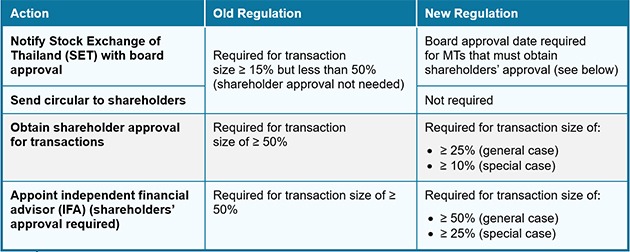
Under the new framework, a key shift is the reduction of the shareholder approval threshold for transactions from 50% to 25% in general cases, with an even lower 10% threshold for companies with negative net assets or operating losses, where the transaction may have an adverse impact (special case). At the same time, certain procedural steps have been streamlined, including the removal of the shareholder circular requirement.

Minority Veto Mechanism

The new regulation introduces a clearer minority protection mechanism. If the audit committee or the independent financial advisor opines that shareholders should not approve the transaction, the transaction cannot proceed if shareholders holding at least 10% of the voting rights present and eligible to vote object to it.

Progress Reporting Requirement

After obtaining shareholder approval, the company must disclose progress reports every six months (by January 31 and July 31) and include such updates in their Form 56-1 One Report until the transaction is completed.

The company must immediately report if it is unable to materially proceed with the transaction as approved, or if the transaction is canceled.

Next Steps

Market participants should review their internal policies, approval processes, and transaction monitoring practices in light of the expanded scope, revised thresholds, and new aggregation rules. In particular, financial assistance arrangements and transaction grouping analyses will require closer scrutiny under the new framework.

Given the scope of the amendments, further clarification from the SEC is expected. A formal guideline is likely to be issued, and both the SEC and the SET are expected to hold seminars to explain the new compliance framework in more detail. We will continue to monitor developments and provide updates as further clarification becomes available.


RELATED INSIGHTS​ 

June 29, 2026
Thailand’s Securities and Exchange Commission (SEC) is seeking public input on significant amendments to the Securities and Exchange Act B.E. 2535 (1992) that would address recurring market abuses and eroded investor confidence observed by the SEC. Published on June 24, 2026, the consultation document targets share-pledging disclosure failures, hidden beneficial ownership, and fraudulent transactions by listed companies, all of which are issues that have threatened share prices and market stability across the Thai capital markets. Comments on the proposals are due by July 24, 2026. Mandatory Disclosure of Short Sales and Share Pledges The draft amendments introduce new reporting obligations for both short sales and share pledges. Persons who sell listed securities without having such securities in their possession (“short sales”) must comply with rules prescribed by the Capital Market Supervisory Board, ensuring standardized practices and preventing risks from such transactions. Major shareholders who pledge or encumber their shares in significant amounts must report those arrangements to the SEC, which may then disclose the information to the public. These amendments directly respond to recent market abuses, including short selling without proper safeguards and instances where directors or major shareholders have pledged large share blocks without disclosure to investors, only to have those shares forcibly sold when collateral was called, causing dramatic share price declines and disrupting ownership structures and market stability. Reportable transactions for share pledges include the following: Shares used as margin account collateral Shares pledged as loan security, with immediate transfer upon default Shares formally pledged under the Civil and Commercial Code or registered with the Thailand Securities Depository Failure to report share pledges triggers criminal penalties, as does failure to comply with short sale requirements. By requiring advance disclosure and standardized short sale procedures, the SEC aims to enable investors to assess ownership stability and default
June 23, 2026
Thailand’s Board of Investment (BOI) has significantly revised its post-approval compliance framework for projects that receive investment promotion incentives, replacing the previous semiannual reporting system for project progress with a new quarterly reporting regime. The initial report is due by July 30, 2026, covering the second-quarter reporting period of April to June 2026. The new requirements—implemented through BOI Announcement No. 8/2569 and Office of the BOI Notification No. Por. 8/2569, both of which became effective on March 30, 2026—apply both to newly promoted projects and to existing promoted projects that remain in the implementation stage. Background Under the previous reporting framework, BOI-promoted companies that had not yet commenced full operations were generally required to submit reports on project progress to the BOI twice a year (February and July) through the BOI’s e-Monitoring system. By adopting a quarterly reporting regime, the BOI seeks to strengthen monitoring and evaluation of investment progress and project implementation. Reporting Requirements Under the new regulations, BOI-promoted companies must submit project progress reports on a quarterly basis during the implementation phase of a promoted project. The reporting periods and submission deadlines are: Q1 (January–March): April 30 Q2 (April–June): July 30 Q3 (July–September): October 30 Q4 (October–December): January 30 of the following year The quarterly reporting obligation runs from the date the BOI promotion certificate is issued until the BOI grants approval for commencement of full operations. For newly promoted projects, no quarterly report is required for the quarter in which the BOI promotion certificate is issued—the first reporting obligation arises in the immediately following reporting period. All project progress reports must be submitted electronically through the BOI’s e-Monitoring system. The existing annual reporting requirement also remains in effect, requiring promoted companies to submit an annual operating results report through the e-Monitoring system by July 31 of
June 18, 2026
Thailand’s Securities and Exchange Commission (SEC) has released a detailed draft notification expanding its oversight to cover the funding sources behind major shareholdings in licensed securities and digital asset business operators. Published on June 8, 2026, as Public Hearing Document No. 30/2569, the draft builds on funding-source principles introduced in an April hearing and on recently amended Ministry of Finance notifications issued in February 2026 that broadened the definition of major shareholder of licensed securities and digital asset business operators. A public comment period on the draft closes on June 23, 2026. An earlier version of the SEC’s proposal brought the issue of funding behind significant shareholdings within the SEC’s regulatory perimeter, signaling intent to look beyond shareholding to the persons and capital ultimately financing major shareholdings in licensed securities and digital asset business operators. The concern is that control may be exercised through financing arrangements rather than through equity ownership alone. The draft notification advances that initiative into a more detailed regulatory framework, as summarized below. Expanded Definition Captures Funding Sources Throughout Ownership Chains The draft regulation introduces a “material funding source” concept. A material funding source is the principal capital that enables a major shareholder to acquire its shareholding, without which the shareholding could not be obtained. Under the proposed rules, any person who provides such funding, whether directly to the major shareholder or indirectly through any tier of the ownership chain above the operator, is deemed a controller subject to SEC approval. The draft also captures any person acting as a conduit or intermediary in facilitating financial assistance to a major shareholder, deeming each of these persons to be a material funding source and aggregating it into the same control group as the ultimate funding source. The definition covers not only cash loans and equity investments,
June 9, 2026
On April 28, 2026, the Central Bank of Myanmar (CBM) issued Notification No. 18/2026 introducing the new Foreign Remittance Business Regulations. The new regulations apply to companies intending to operate foreign remittance businesses in Myanmar that are not licensed banks, non-bank financial institutions, or other financial institutions. The regulations supersede and replace the previous regulatory framework governing foreign remittance businesses under CBM Notification No. 21/2019. While the overall structure remains familiar, the new regulations introduce more detailed requirements for licensing, operations, reporting, and compliance, with a stronger focus on transparency and regulatory oversight. Broader Licensing Requirements Under the new regulations, applicants must submit detailed business plans describing the use of information technology and mobile platforms, along with clear plans for handling remittances from workers abroad and resolving customer complaints. Financial Thresholds and Reporting Requirements The baseline financial thresholds remain unchanged. Licensees must maintain a security deposit of MMK 100 million in an escrow account, along with a separate revolving fund dedicated solely to remittance operations. The new regulations introduce more structured reporting obligations. Licensees are now required to submit daily remittance transaction data by the next business day before noon, in addition to monthly and periodic reporting requirements. Foreign bank account statements must also be submitted regularly, and licensees must provide updates on business operations every six months. Strengthened AML and CFT Framework The new regulations place a greater emphasis on anti-money laundering (AML) and counter financing of terrorism (CFT), with tighter controls over management changes. Any changes in shareholding, share transfers, or the appointment of key management personnel such as the managing director require prior approval from the CBM. Licensing Fees and Validity The new regulations increase licensing costs, while maintaining the same validity period of three years. The new regulations provide more detailed grounds for suspension and