
You are using an outdated browser and your browsing experience will not be optimal. Please update to the latest version of Microsoft Edge, Google Chrome or Mozilla Firefox. Install Microsoft Edge

February 19, 2026

Thai SEC Issues New Regulation on Material Transactions

Thailand’s Securities and Exchange Commission (SEC) has issued a new regulation on material transactions (MTs) to govern asset acquisitions and disposals by listed companies and their subsidiaries. The new notification on MT criteria (No. TorJor. 45/2568) from the Capital Market Supervisory Board replaces the long-standing notification (No. TorJor. 20/2551) that has governed such matters. The SEC has also introduced parallel amendments to the country’s related-party transaction rules.

The new regulation will take effect on July 1, 2026. Any MT matters approved by a company’s board of directors for shareholders’ approval before that date remain subject to Notification No. TorJor. 20/2551.

Following that date, the new MT rules will introduce several significant changes that market participants should carefully consider.

Expanded Scope of Material Transactions

One of the key changes under the new regulation is the expansion of the definition of MTs, which now expressly covers financial assistance and certain lease and business lease arrangements that are not in the ordinary course of business of the listed company or its subsidiaries.

For financial assistance, this includes lending, granting credit, providing guarantees, or entering into any arrangement that increases the company’s financial obligations, particularly where the recipient is facing liquidity issues or unable to repay debts. Other forms of financial support also fall within scope. However, whether the provision of collateral for others qualifies as an MT remains somewhat unclear, since no disposal of assets occurs for the provider of collateral. This issue remains to be carefully considered.

For lease-related transactions, the MT rules now specifically include the lease or hire-purchase of all or part of a business or assets operated by or belonging to a listed company or its subsidiaries.

New Exemptions

The new regulation introduces clearer exemptions for transactions between a listed company and its subsidiaries or among subsidiaries, which were not explicitly addressed under the old regime. Other exempt transactions include the establishment of a new subsidiary and liquidity management investments by a listed company or its subsidiaries.

In addition, if a subsidiary that is also a listed company fully complies with the MT requirements, the parent listed company is not required to separately comply for that same transaction (dual approval exemption).

Changes to Transaction Aggregation Rules

The new regulation extends the aggregation period from 6 months to 12 months. However, aggregation is now required only for transactions that are related or form part of the same project. Transactions that have already received shareholder approval remain excluded.

Revised Approval Thresholds and Process

The new regulation lowers the shareholder approval triggering threshold, meaning more transactions may now require shareholder approval compared to the previous regulation, as detailed in the table below.
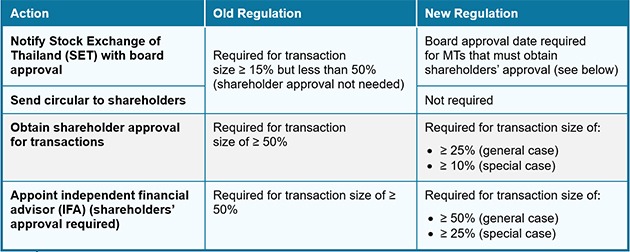
Under the new framework, a key shift is the reduction of the shareholder approval threshold for transactions from 50% to 25% in general cases, with an even lower 10% threshold for companies with negative net assets or operating losses, where the transaction may have an adverse impact (special case). At the same time, certain procedural steps have been streamlined, including the removal of the shareholder circular requirement.

Minority Veto Mechanism

The new regulation introduces a clearer minority protection mechanism. If the audit committee or the independent financial advisor opines that shareholders should not approve the transaction, the transaction cannot proceed if shareholders holding at least 10% of the voting rights present and eligible to vote object to it.

Progress Reporting Requirement

After obtaining shareholder approval, the company must disclose progress reports every six months (by January 31 and July 31) and include such updates in their Form 56-1 One Report until the transaction is completed.

The company must immediately report if it is unable to materially proceed with the transaction as approved, or if the transaction is canceled.

Next Steps

Market participants should review their internal policies, approval processes, and transaction monitoring practices in light of the expanded scope, revised thresholds, and new aggregation rules. In particular, financial assistance arrangements and transaction grouping analyses will require closer scrutiny under the new framework.

Given the scope of the amendments, further clarification from the SEC is expected. A formal guideline is likely to be issued, and both the SEC and the SET are expected to hold seminars to explain the new compliance framework in more detail. We will continue to monitor developments and provide updates as further clarification becomes available.


RELATED INSIGHTS​ 

March 31, 2026
Thailand’s Department of Business Development (DBD) has issued a regulation imposing additional requirements for amending a company’s directors and signatory power to designate a foreign national as an authorized signatory of the company. This measure, effective April 1, 2026, has been introduced in response to the widespread use of Thai nationals as nominees to conduct business on behalf of foreigners, a practice considered to have an adverse impact on the country’s economic stability and security. The new measures are particularly concerned with changes to the authorized signatory structure of companies that originally had only Thai directors authorized to sign for and bind the company. Under the new rules, any amendment that results in a foreign national becoming an authorized signatory—whether solely or jointly—for such a company will be subject to additional verification. Directors signing an application to register such an amendment to the company’s authorized signatory structure are now also required to provide a statement confirming that all shareholders of the company have made genuine contributions and no Thai national has assisted with, supported, or participated in business activities in a nominee capacity. Implications Companies intending to appoint foreign directors as authorized signatories should be aware of the increased regulatory requirements and assessments. Additional documentation and confirmations may be required as part of the registration process.
March 31, 2026
On December 10, 2025, the National Assembly of Vietnam adopted Law on Vocational Education No. 124/2025/QH15, which took effect on January 1, 2026, replacing Law on Vocational Education No. 74/2014/QH13 of 2014. The new law broadens the categories of institutions eligible to deliver vocational training, introduces vocational upper secondary schools, and shifts governance structures for private institutions from ownership-representative boards of management to stakeholder-based school councils. These reforms aim to diversify training providers, align programs with labor market needs, and create a more flexible, open vocational education ecosystem, offering expanded opportunities for foreign and domestic investors, universities, and enterprises. Some highlights of the new Law on Vocational Education are presented below. Expansion of Vocational Training Levels and Programs In addition to elementary, intermediate, and college—the three levels of vocational training program set out under the 2014 Law on Vocational Education—the new law expands the structure by introducing two new levels: Vocational high school training programs are placed between elementary and intermediate levels, and are aimed at combining upper secondary education with vocational training, expanding options for learners after graduating from the lower secondary level. Other vocational training programs are not specified in detail under the new law, but aim to equip learners with the capability to perform and handle one or several simple tasks of an occupation. Expansion of Vocational Education Providers The new law reclassifies and extends vocational education providers by classifying them into two distinct categories: Vocational education institutions, which include colleges, intermediate schools, and vocational high schools. Establishments participating in vocational education activities, which include vocational education centers, vocational-continuing education centers, continuing education centers, other centers with vocational education functions, enterprises, cooperatives, and higher education institutions. Vocational education providers may provide one vocational training level only, or several/all levels, depending on the type of provider. The
March 31, 2026
Thailand’s Office of the Consumer Protection Board has opened a public hearing period on draft regulations governing the transfer of direct sales and direct marketing businesses. The draft Notification of the Direct Sales and Direct Marketing Committee: Criteria and Procedures for Business Transfer and Amendment of Registration for Direct Sales or Direct Marketing Businesses establishes a compliance-focused process with strict documentation requirements and timelines for transferring direct sales and direct marketing businesses. The proposed framework also defines the roles of transferors and transferees and establishes application procedures with the Office of the Consumer Protection Board. Applications may be submitted in person or electronically and will be examined to confirm they are complete, authentic, and compliant with legal requirements. This includes verification that: The transferee meets all required qualifications; No disqualifying factors apply; and The applicant is not subject to legal restrictions. The public hearing period is open until April 29, 2026. Direct sales and direct marketing business operators should prepare for these proposed requirements to ensure compliant implementation once the regulations are finalized.
March 27, 2026
Thailand’s National Broadcasting and Telecommunications Commission (NBTC) has publicly indicated that it is preparing a new regulatory framework for data center operators that may introduce foreign-ownership restrictions. In particular, the NBTC is considering reclassifying data center operations from a type 1 telecommunications business license to a type 3 license. If implemented, this change would subject data center operators to a significantly more stringent regulatory regime, especially in relation to foreign ownership and control. The NBTC has indicated that it intends to propose a draft framework to the NBTC board. This would be followed by a public hearing process, with a view to implementing the new rules within 2026. Under the Telecommunications Business Act B.E. 2544 (2001), as amended, telecommunications businesses operating under type 3 licenses are subject to foreign ownership restrictions, including a requirement that less than 50% of the total issued shares be held by foreign shareholders. In addition, type 3 licensees are subject to foreign dominance restrictions, which prohibit arrangements that allow foreigners to dominate the business. These foreign dominance restrictions are broad in scope and may capture various forms of direct and indirect control or influence. This includes circumstances in which a foreign national is able to influence or control the formulation of policy, management, or business operations, or the appointment of directors or senior executives. At this stage, the exact scope of the proposed rules remains unclear. Businesses with existing or planned data center operations in Thailand should therefore monitor upcoming NBTC developments in this regard and prepare for the expected public hearing process.