
You are using an outdated browser and your browsing experience will not be optimal. Please update to the latest version of Microsoft Edge, Google Chrome or Mozilla Firefox. Install Microsoft Edge

February 19, 2026

Thai SEC Issues New Regulation on Material Transactions

Thailand’s Securities and Exchange Commission (SEC) has issued a new regulation on material transactions (MTs) to govern asset acquisitions and disposals by listed companies and their subsidiaries. The new notification on MT criteria (No. TorJor. 45/2568) from the Capital Market Supervisory Board replaces the long-standing notification (No. TorJor. 20/2551) that has governed such matters. The SEC has also introduced parallel amendments to the country’s related-party transaction rules.

The new regulation will take effect on July 1, 2026. Any MT matters approved by a company’s board of directors for shareholders’ approval before that date remain subject to Notification No. TorJor. 20/2551.

Following that date, the new MT rules will introduce several significant changes that market participants should carefully consider.

Expanded Scope of Material Transactions

One of the key changes under the new regulation is the expansion of the definition of MTs, which now expressly covers financial assistance and certain lease and business lease arrangements that are not in the ordinary course of business of the listed company or its subsidiaries.

For financial assistance, this includes lending, granting credit, providing guarantees, or entering into any arrangement that increases the company’s financial obligations, particularly where the recipient is facing liquidity issues or unable to repay debts. Other forms of financial support also fall within scope. However, whether the provision of collateral for others qualifies as an MT remains somewhat unclear, since no disposal of assets occurs for the provider of collateral. This issue remains to be carefully considered.

For lease-related transactions, the MT rules now specifically include the lease or hire-purchase of all or part of a business or assets operated by or belonging to a listed company or its subsidiaries.

New Exemptions

The new regulation introduces clearer exemptions for transactions between a listed company and its subsidiaries or among subsidiaries, which were not explicitly addressed under the old regime. Other exempt transactions include the establishment of a new subsidiary and liquidity management investments by a listed company or its subsidiaries.

In addition, if a subsidiary that is also a listed company fully complies with the MT requirements, the parent listed company is not required to separately comply for that same transaction (dual approval exemption).

Changes to Transaction Aggregation Rules

The new regulation extends the aggregation period from 6 months to 12 months. However, aggregation is now required only for transactions that are related or form part of the same project. Transactions that have already received shareholder approval remain excluded.

Revised Approval Thresholds and Process

The new regulation lowers the shareholder approval triggering threshold, meaning more transactions may now require shareholder approval compared to the previous regulation, as detailed in the table below.
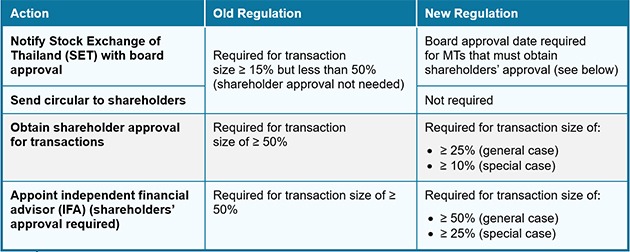
Under the new framework, a key shift is the reduction of the shareholder approval threshold for transactions from 50% to 25% in general cases, with an even lower 10% threshold for companies with negative net assets or operating losses, where the transaction may have an adverse impact (special case). At the same time, certain procedural steps have been streamlined, including the removal of the shareholder circular requirement.

Minority Veto Mechanism

The new regulation introduces a clearer minority protection mechanism. If the audit committee or the independent financial advisor opines that shareholders should not approve the transaction, the transaction cannot proceed if shareholders holding at least 10% of the voting rights present and eligible to vote object to it.

Progress Reporting Requirement

After obtaining shareholder approval, the company must disclose progress reports every six months (by January 31 and July 31) and include such updates in their Form 56-1 One Report until the transaction is completed.

The company must immediately report if it is unable to materially proceed with the transaction as approved, or if the transaction is canceled.

Next Steps

Market participants should review their internal policies, approval processes, and transaction monitoring practices in light of the expanded scope, revised thresholds, and new aggregation rules. In particular, financial assistance arrangements and transaction grouping analyses will require closer scrutiny under the new framework.

Given the scope of the amendments, further clarification from the SEC is expected. A formal guideline is likely to be issued, and both the SEC and the SET are expected to hold seminars to explain the new compliance framework in more detail. We will continue to monitor developments and provide updates as further clarification becomes available.


RELATED INSIGHTS​ 

March 23, 2026
In March 2026, the Myanmar Investment Commission (MIC) introduced two regulatory updates affecting investors planning new investments or implementing MIC-approved projects. Minimum Investment Conditions for Tax Incentives MIC Notification No. 1/202 clarifies the minimum conditions for investments in promoted sectors to qualify for tax exemptions or relief under the Myanmar Investment Law. The notification establishes the following requirements: Investors must contribute at least 35% of the total investment amount in cash, as reflected in the relevant proposal or endorsement application. Where an investment involves a foreign loan, the investor must obtain approval from the Central Bank of Myanmar, together with a loan repayment schedule, and provide evidence that both the foreign loan proceeds and the capital contribution have been remitted in cash through an authorized dealer bank. Chinese Yuan Accepted for Investment Capital The MIC also issued Investment News Bulletin No. 1/2026, confirming that Chinese yuan (CNY) is now accepted as foreign investment capital for applications for MIC permits and endorsements, in addition to US dollars (USD). Investment funds contributed in CNY may be remitted through banks authorized to deal in foreign currency in CNY, following the same process currently applied to investments made in USD. These developments may affect how foreign investment capital is structured and remitted, as well as the availability of tax incentives for investments under the MIC framework.
March 20, 2026
Thailand’s Board of Investment (BOI) now requires data center projects to demonstrate measurable benefits for local workforce development, R&D, SME capability, and domestic supply chains to qualify for corporate income tax (CIT) exemptions. BOI Notification No. Por. 3/2569, issued on February 6, 2026, updates the requirements for projects seeking promotion under BOI category 8.2.1 (data centers). All data center projects must now submit and implement plans covering development of Thai human resources and domestic supply chain support before benefiting from any CIT exemption. Human Resources Development Plan The BOI seeks to promote local talent development beyond basic training. Plans must include the following elements: Training for data center design, construction, and operations targeting vocational students, engineering and ICT undergraduates and postgraduates, and energy and building personnel in Thailand. Joint curricula with Thai universities and technical institutes. Collaborative R&D with Thai nationals or institutions in areas including AI, resource allocation, high-performance computing, and data center hardware and systems. Thai SME upskilling in electrical and energy systems and IT services. Domestic Supply Chain Support Plan Plans must demonstrate knowledge transfer in design, construction, cooling, security, and power and water management. Projects must also include usage or installation of domestically manufactured equipment or engage specialist domestic entities. Criteria for BOI Evaluation The BOI will assess data center operators’ eligibility for CIT incentives based on two criteria: Scale requirement: Training and joint-curriculum initiatives must reach a total participants equal to at least 10 times the project headcount and run for the duration of the CIT incentive. If this threshold is not met, the applicant must also implement continuous R&D or SME skills-development plans throughout the incentive period. Substantiality test: Supply-chain plans must be substantive, meet industry standards, and show measurable development of the domestic digital and data center supply base. To ensure compliance,
March 16, 2026
Thailand’s Securities and Exchange Commission (SEC) has broadened the definition of institutional investors, expanded the types of qualifying investments, and updated financial qualification thresholds for various investor categories through a revised notification on the definitions of institutional investors, ultra-high net worth investors, and high net worth investors. The amended framework, which came into force on March 1, 2026, adds digital asset business operators, investment planners, and investment consultants to the roster of entities recognized as institutional investors, and broadens the definition of investment to account for digital tokens. Expanded Definition of Institutional Investors Under the SEC’s revised notification, the category of institutional investors now expressly includes digital asset business operators licensed under the Royal Decree on Digital Asset Businesses B.E. 2561 (2018). This addition recognizes the growing role of digital asset platforms and service providers in Thailand’s investment ecosystem and aligns the regulatory treatment of digital markets with that of traditional markets. The definition of institutional investors now also encompasses investment planners and investment consultants approved by the SEC. Previously, only SEC-approved investment analysts held this status; the expansion covers a broader scope of professionals who possess comparable expertise and experience in evaluating investment opportunities. Broadened Investment Definition The revised framework now defines investment to mean direct or indirect investment in a wider range of assets beyond deposits. Specifically, the definition covers: Securities under the Securities and Exchange Act Derivatives under the Derivatives Act Investment tokens offered to the public Government-issued digital tokens (G-tokens) as specified in a separate SEC notification This expansion ensures that financial status assessments reflect the full spectrum of an investor’s holdings, including emerging digital assets. Updated Financial Qualification Thresholds The amended SEC notification also provides updated qualification thresholds for angel investors, ultra-high net worth investors, and high net worth investors. While the core criteria
March 10, 2026
Thailand’s Ministry of Finance and Securities and Exchange Commission (SEC) have issued regulations broadening the criteria for determining who qualifies as a “major shareholder” of licensed securities and digital asset business operators. Under relevant SEC regulations, major shareholders of a regulated entity must obtain regulatory approval and undergo screening by the SEC. The revised framework introduces both shareholding-based and control-based tests to determine which shareholders require regulatory approval for a wider range of indirect ownership structures and de facto control. The Ministry of Finance notification took effect on February 21, 2026, while the SEC’s clarifying rules took effect on March 4, 2026. These changes aim to enhance transparency around beneficial ownership and strengthen regulatory oversight of entities operating in Thailand’s capital markets. Expanded Definition Under the revised framework, a “major shareholder” now includes persons who directly or indirectly hold more than 10% of the voting rights in a regulated company, as well as persons who exercise control over the regulated company or its shares. This system of two separate tests, based on both shareholding and control, differs from the prior regime, which focused primarily on shareholding thresholds and applied a more limited method for determining indirect shareholdings. The two tests (detailed below) operate independently of each other, and any person identified by either of the tests will be deemed a major shareholder. Shareholding-Based Test Broadens Indirect Ownership Attribution For the shareholding-based test, the SEC recognizes two existing methods for identifying indirect ownership, together with a new proportional attribution method. Any person captured under these methods, which are described below, will be regarded as a major shareholder of the regulated company and must obtain SEC approval as a major shareholder. First, the existing framework continues to apply to both first-tier and chain ownership structures. Approval is required for (1) first-tier