
You are using an outdated browser and your browsing experience will not be optimal. Please update to the latest version of Microsoft Edge, Google Chrome or Mozilla Firefox. Install Microsoft Edge

March 2, 2021

Thai Employment Law: The Employee Committee and the Special Rights of Its Members

Informed Counsel

Maintaining positive employee relations is a top concern for virtually all companies. Many companies in Thailand—especially those located in the country’s industrial estates—have labor unions, while others rely on other non-union pathways for attending to the concerns of employees. In all of these cases, the union or collective group of employees also chooses members of the “employee committee” that is charged with fostering good relations and open communications with the employer through regular meetings dedicated to discussion of workplace matters.

Companies with a workforce of 50 or more employees need to understand the roles of the employee committee and the specific rights accorded to the committee members, which are different from the rights of the other employees. Besides the obvious benefits that this understanding has for relations with their employees, it is also important if an employer takes disciplinary action against employee committee members, as violation of a committee member’s rights could result in the employer facing criminal penalties.

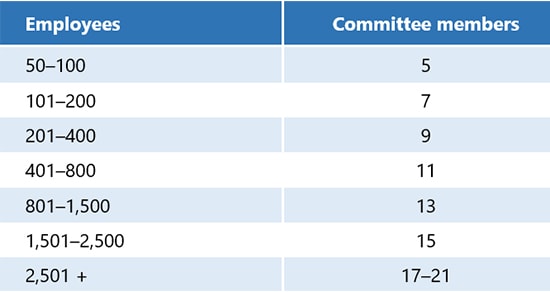
The legal basis for these employee committees is the Labor Relations Act B.E. 2518 (LRA), which stipulates that in any workplace with at least 50 employees, the employees or their labor union of the business establishment is entitled to establish an employee committee. Members are elected (or, in the case of a labor union, appointed) to three-year terms on the committee, with the total number of committee members depending on the size of the workforce, as shown in the table.

Membership Requirements
Among partially unionized workforces, labor unions are generally given precedence when it comes to control of the committee. If a labor union whose members account for more than 20% of the total employees in a workplace, the union gets to appoint the majority of the employee committee members (e.g., four out of a seven-person committee, five of a nine-person committee, etc.). Moreover, if a union’s membership accounts for more than 50% of the employees, it is entitled to appoint all employee committee members. Any labor union appointees would have their term begin on the date of their appointment, regardless of when an election is held for the non-union members of the employment committee.

In a situation where a workplace has multiple labor unions that have appointed separate employee committees, exceeding the number of the employee committee members stated by the LRA, the employer is entitled to refuse to recognize the employee committees.

Employers must meet with their employee committee at least once every three months, or whenever the labor union or more than 50% of employee committee members request it. The topics to be discussed include employee welfare, new work rules, employee complaints, and disputes and compromises in the workplace.

If an employee committee considers that an employer has acted unfairly against or caused excessive trouble for employees, the committee (or the relevant employee or the labor union) may lodge a petition with the Labor Court.

Protection of the employee committee

The LRA requires employers to first obtain permission from the Labor Court before terminating the employment of committee members, reducing their wages, taking disciplinary actions against them, otherwise obstructing them from carrying out their duties, or performing any act resulting in a committee member being unable to continue working.  If an employer breaches the LRA by doing one of these things without permission from the court, the employer (including directors or authorized persons who act on behalf of the juristic person) risks facing criminal penalties, such as imprisonment for up to one month, a fine of up to THB 1,000, or both. These penalties will remain even if the employer later succeeds in obtaining permission from the Labor Court to terminate the employee—a position upheld by the Supreme Court because the offense was committed before the court issued an order, thus constituting a violation of the LRA.

This court order requirement extends to any scenario wherein an employee committee member violates company work rules, and the disciplinary action ultimately taken against that employee depends on both the employer’s work rules and the consideration of the court. This means that even if the work rules state that an offence can be punished by termination, the court may still opt to punish the offender less severely than what the rules would otherwise prescribe, particularly if it considers that the offence is not grievous enough to warrant outright termination. (This position is again supported by Supreme Court precedent.) If, on the other hand, the court does issue an order permitting the termination of an employee, any subsequent termination would not be considered an unfair labor practice, and the employee would not be entitled to submit a complaint to the Labor Relations Committee.

Some employers may also be surprised to learn that even if they close down their business permanently and terminate all employees, they must ask the Labor Court for permission to terminate the employee committee as well. Otherwise, the employer may face the criminal penalties described above.

Consequently, an employer should be aware of the potential risks before considering any type of disciplinary or other action against a member of an employee committee, as it can be construed as a violation of the LRA and punished with criminal penalties accordingly. Some might find this difficult to remember when involved in the thick of a labor dispute, a situation of employee wrongdoing, or simply the day-to-day challenges of running a business with a large workforce, but staying in control and acting prudently—with foresight into legal requirements and consequences—can help employers stay on the right side of the law.

RELATED INSIGHTS​ 

September 2, 2025
On August 26, 2025, the Thai cabinet approved a one-year postponement of mandatory contributions to the Employee Welfare Fund. Originally scheduled to take effect on October 1, 2025, the enforcement date has been deferred to October 1, 2026. The decision to delay the implementation stems from ongoing economic uncertainties in Thailand, driven by several external and domestic factors. These include increased trade tariffs imposed by the United States, the recent rise in the national minimum wage, and continued geopolitical tensions resulting from unresolved disputes with neighboring countries. These challenges have placed significant pressure on both businesses and the labor market, prompting the government to offer temporary relief through this deferral. As a result of the postponement, the following regulations will now come into effect on October 1, 2026: Royal Decree determining the Commencement Period for Savings and Contributions to the Employee Welfare Fund; Ministerial Notification specifying the Rates of Savings and Contributions; and Ministerial Notification outlining the Criteria and Procedures for Employers to Provide Assistance in Cases of Termination of Employment or Death. The Labour Welfare Fund Committee has formally endorsed the postponement. Contribution Rates Unchanged Although the implementation has been delayed, the contribution rates remain unchanged: October 1, 2026–September 30, 2031: Employers and employees each contribute 0.25% of the employee’s wage to the fund. From October 1, 2031, onward: Contributions increase to 0.5% of the employee’s wage for both parties. All other rules and conditions concerning the Employee Welfare Fund remain in full effect.
August 29, 2025
On August 15, 2025, Laos’ Immigration Police Department introduced a pilot online arrival registration system for foreign passport holders entering the country. Under the new system, visitors to Laos will be able to register their arrival online up to three days in advance and will be exempt from filling out paper forms at the border. Starting September 1, 2025, online registrations will be accepted at four major international border checkpoints: Wattay International Airport in Vientiane, Luang Prabang International Airport, Pakse International Airport in Champasak Province, and the First Lao-Thai Friendship Bridge linking Vientiane and Nong Khai Province in Thailand. Foreign passport holders arriving in Laos from this date onward will be able to complete the online registration via the official website of the Department of Immigration: http://www.immigration.gov.la/. Upon successful registration, travelers will receive a QR code valid for three days, which must be presented to border authorities upon arrival to verify the registration. During the pilot phase, which is expected to run until early 2026, travelers who have not registered online will still have the option to complete a paper form at the checkpoint. After the pilot phase, the online registration system will become mandatory nationwide, and paper forms will no longer be accepted. This initiative marks a significant step toward modernizing Laos’ immigration procedures. Transitioning from traditional paper-based entry forms to a streamlined digital system will greatly enhance efficiency at border checkpoints. The submission of traveler information ahead of arrival is expected to drastically reduce processing times and alleviate congestion at arrival counters, especially during peak travel periods.
August 20, 2025
On August 7, 2025, the government of Vietnam promulgated Decree No. 219/2025/ND-CP on foreign workers working in Vietnam (Decree 219), introducing substantial reforms to the management of foreign employees. Taking immediate effect upon issuance, and superseding earlier regulations on foreign employees under Decree No. 152/2020/ND-CP as amended by Decree No. 70/2023/ND-CP (collectively referred to as “Decree 152”), Decree 219 sets out clear timeframes and application requirements for work permit issuance, while adopting more flexible policies to support business operations. The key new provisions are as follows: 1. Relaxed Requirements Regarding Job-Posting Under Decree 152, employers were required to follow a complex process to apply for work permits or work permit exemption certificates for foreign employees. This included posting an advertisement for any position the employer wished to fill with a foreign employee on a designated online portal for a given amount of time, to demonstrate that the company tried, but failed, to find a suitable Vietnamese candidate for the position. This job-posting step now only applies when the foreigner will work in Vietnam under a local labor contract. Foreigners coming to Vietnam as intra-corporate transferees (i.e., as secondees) or working under service contracts are exempt. The job-posting period is also reduced from 15 calendar days to five business days. Employers may also now post the advertisements on multiple websites instead of only the online portal of the Ministry of Labor, Invalids and Social Affairs (now the Ministry of Home Affairs after government restructuring) or the provincial-level employment service center. 2. Work Permit Application Dossier Previously, employers were required to complete a preapproval step, whereby they had to submit a dossier explaining their foreign labor demand that required approval from the labor authority. Once approval for the foreign labor demand was granted, the approval dossier was an integral part of
August 20, 2025
With the shift in US policy to discourage DEI programs among government and private-sector employers, some companies have been cutting back. But US companies should be cautious in eliminating their DEI programs globally, as some elements of these programs are obligations under local laws in Vietnam, Thailand, and Cambodia.