
You are using an outdated browser and your browsing experience will not be optimal. Please update to the latest version of Microsoft Edge, Google Chrome or Mozilla Firefox. Install Microsoft Edge

March 2, 2021

Thai Employment Law: The Employee Committee and the Special Rights of Its Members

Informed Counsel

Maintaining positive employee relations is a top concern for virtually all companies. Many companies in Thailand—especially those located in the country’s industrial estates—have labor unions, while others rely on other non-union pathways for attending to the concerns of employees. In all of these cases, the union or collective group of employees also chooses members of the “employee committee” that is charged with fostering good relations and open communications with the employer through regular meetings dedicated to discussion of workplace matters.

Companies with a workforce of 50 or more employees need to understand the roles of the employee committee and the specific rights accorded to the committee members, which are different from the rights of the other employees. Besides the obvious benefits that this understanding has for relations with their employees, it is also important if an employer takes disciplinary action against employee committee members, as violation of a committee member’s rights could result in the employer facing criminal penalties.

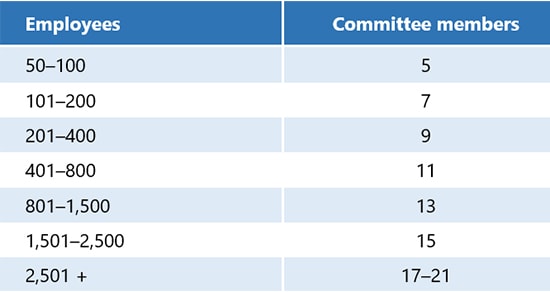
The legal basis for these employee committees is the Labor Relations Act B.E. 2518 (LRA), which stipulates that in any workplace with at least 50 employees, the employees or their labor union of the business establishment is entitled to establish an employee committee. Members are elected (or, in the case of a labor union, appointed) to three-year terms on the committee, with the total number of committee members depending on the size of the workforce, as shown in the table.

Membership Requirements
Among partially unionized workforces, labor unions are generally given precedence when it comes to control of the committee. If a labor union whose members account for more than 20% of the total employees in a workplace, the union gets to appoint the majority of the employee committee members (e.g., four out of a seven-person committee, five of a nine-person committee, etc.). Moreover, if a union’s membership accounts for more than 50% of the employees, it is entitled to appoint all employee committee members. Any labor union appointees would have their term begin on the date of their appointment, regardless of when an election is held for the non-union members of the employment committee.

In a situation where a workplace has multiple labor unions that have appointed separate employee committees, exceeding the number of the employee committee members stated by the LRA, the employer is entitled to refuse to recognize the employee committees.

Employers must meet with their employee committee at least once every three months, or whenever the labor union or more than 50% of employee committee members request it. The topics to be discussed include employee welfare, new work rules, employee complaints, and disputes and compromises in the workplace.

If an employee committee considers that an employer has acted unfairly against or caused excessive trouble for employees, the committee (or the relevant employee or the labor union) may lodge a petition with the Labor Court.

Protection of the employee committee

The LRA requires employers to first obtain permission from the Labor Court before terminating the employment of committee members, reducing their wages, taking disciplinary actions against them, otherwise obstructing them from carrying out their duties, or performing any act resulting in a committee member being unable to continue working.  If an employer breaches the LRA by doing one of these things without permission from the court, the employer (including directors or authorized persons who act on behalf of the juristic person) risks facing criminal penalties, such as imprisonment for up to one month, a fine of up to THB 1,000, or both. These penalties will remain even if the employer later succeeds in obtaining permission from the Labor Court to terminate the employee—a position upheld by the Supreme Court because the offense was committed before the court issued an order, thus constituting a violation of the LRA.

This court order requirement extends to any scenario wherein an employee committee member violates company work rules, and the disciplinary action ultimately taken against that employee depends on both the employer’s work rules and the consideration of the court. This means that even if the work rules state that an offence can be punished by termination, the court may still opt to punish the offender less severely than what the rules would otherwise prescribe, particularly if it considers that the offence is not grievous enough to warrant outright termination. (This position is again supported by Supreme Court precedent.) If, on the other hand, the court does issue an order permitting the termination of an employee, any subsequent termination would not be considered an unfair labor practice, and the employee would not be entitled to submit a complaint to the Labor Relations Committee.

Some employers may also be surprised to learn that even if they close down their business permanently and terminate all employees, they must ask the Labor Court for permission to terminate the employee committee as well. Otherwise, the employer may face the criminal penalties described above.

Consequently, an employer should be aware of the potential risks before considering any type of disciplinary or other action against a member of an employee committee, as it can be construed as a violation of the LRA and punished with criminal penalties accordingly. Some might find this difficult to remember when involved in the thick of a labor dispute, a situation of employee wrongdoing, or simply the day-to-day challenges of running a business with a large workforce, but staying in control and acting prudently—with foresight into legal requirements and consequences—can help employers stay on the right side of the law.

RELATED INSIGHTS​ 

December 8, 2025
As Thailand transitions into an aged society, retirement policy and workplace protections for older workers have come into sharper focus. With public sentiment increasingly open to working beyond the traditional retirement age, questions about employee rights and employer obligations are more relevant than ever. In October 2025, Prime Minister Anutin Charnvirakul proposed increasing the statutory retirement age to 65 for government officers, citing Thailand’s aged-society status and the potential social and economic benefits of longer working lives. While academics and stakeholders have raised concerns about systemic impacts, public opinion remains divided, with many workers signaling a willingness to continue working beyond the current norm. Against this backdrop, it’s worth revisiting what the Labor Protection Act B.E. 2541 (1998) (LPA) requires in regard to retirement and severance pay. This article explains the current legal landscape under the LPA, with a focus on retirement and severance pay for employees over 60, recent judicial developments, and practical options for structuring postretirement engagements. Retirement as Termination Under the LPA Under the LPA, retirement—whether set by agreement between employer and employee or unilaterally stipulated by the employer—is deemed a termination of employment. As a result, employees who retire under such terms are entitled to severance pay. The law also adds a default rule: if there is no agreed or prescribed retirement age, or if the prescribed retirement age exceeds 60, an employee aged 60 or older may declare an intention to retire. The declaration takes effect 30 days after notice, and the employer must pay severance accordingly. In short, retirement triggered by agreement, the employer’s work rules, or an employee’s valid notice is treated as a termination, and statutory severance pay is owed. Hiring or Rehiring Employees Over 60 Practical issues arise when an employer’s work rules set a retirement age that does not
December 2, 2025
Investing in Mainland Southeast Asia is Tilleke & Gibbins’ essential guide for investors looking to do business in this vibrant region, whether it’s starting operations as a newly established entity or expanding into new territories or business models.
November 20, 2025
Lawyers from Tilleke & Gibbins’ labor and employment team have contributed a new Vietnam chapter to Thomson Reuters Practical Law’s Employment and Employee Benefits Global Guide. The guide provides a high-level comparative overview of employment laws and regulations across various jurisdictions around the world. Tilleke & Gibbins also contributed the Myanmar chapter of the guide. The Vietnam chapter covers a wide range of typical employment matters, such as limitations on working hours, paid leave requirements, minimum wage, and health and safety obligations. In addition, the guide provides insight on various topics of special interest to foreign investors doing business in Vietnam, including the following: Mandatory contents of a labor contract; Visas and permits required for expatriate employees; Employers’ obligations for protecting employees’ privacy and personal data; Procedural requirements for the dismissal of an employee; Employer and parent company liability. To view the latest version of the Employment and Employee Benefits Vietnam chapter, please visit the Practical Law website and enroll in the free Practical Law trial to gain full access.
November 12, 2025
Thailand has amended the Labor Protection Act to significantly expand family leave benefits and strengthen employment protections, effective December 7, 2025. The Labor Protection Act (No. 9) B.E. 2568 (2025), published in the Government Gazette on November 7, 2025, provides enhanced maternity and paternity benefits, introduces new childcare leave provisions, and extends labor protections to certain public sector contractors. Key changes introduced by the amendments are detailed below. Extended Maternity Leave Female employees are now entitled to up to 120 days of maternity leave per pregnancy, increased from 98 days. Employers must pay full wages for 60 days, increased from the current 45 days. New Childcare Leave for Health Complications Female employees who have taken maternity leave are entitled to an additional 15 days of leave to care for newborns with health complications, disabilities, or conditions that could lead to future medical risks. This leave requires a medical certificate and is compensated at 50% of the employee’s regular wage. New Paternity Leave Male employees are now entitled to 15 days of paid paternity leave to support their spouse or partner during childbirth. This new leave allowance may be taken before or within 90 days after childbirth, with employers required to pay full wages for all 15 days. Protection for Public Sector Contractors The law extends protection to individuals engaged under service contracts with government agencies, including central, regional, and local administrations, state enterprises, and public organizations. When such workers are supervised or controlled in a manner similar to employees, the contracting government agencies must provide them with rights and benefits equivalent to those under the Labor Protection Act, including remuneration, weekly holidays, public holidays, annual leave, sick leave, regulated working hours, and rest periods. New Annual Reporting Requirement All employers with 10 or more employees must now submit an