
You are using an outdated browser and your browsing experience will not be optimal. Please update to the latest version of Microsoft Edge, Google Chrome or Mozilla Firefox. Install Microsoft Edge

March 2, 2021

Thai Employment Law: The Employee Committee and the Special Rights of Its Members

Informed Counsel

Maintaining positive employee relations is a top concern for virtually all companies. Many companies in Thailand—especially those located in the country’s industrial estates—have labor unions, while others rely on other non-union pathways for attending to the concerns of employees. In all of these cases, the union or collective group of employees also chooses members of the “employee committee” that is charged with fostering good relations and open communications with the employer through regular meetings dedicated to discussion of workplace matters.

Companies with a workforce of 50 or more employees need to understand the roles of the employee committee and the specific rights accorded to the committee members, which are different from the rights of the other employees. Besides the obvious benefits that this understanding has for relations with their employees, it is also important if an employer takes disciplinary action against employee committee members, as violation of a committee member’s rights could result in the employer facing criminal penalties.

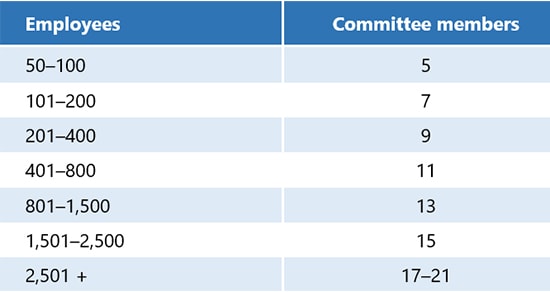
The legal basis for these employee committees is the Labor Relations Act B.E. 2518 (LRA), which stipulates that in any workplace with at least 50 employees, the employees or their labor union of the business establishment is entitled to establish an employee committee. Members are elected (or, in the case of a labor union, appointed) to three-year terms on the committee, with the total number of committee members depending on the size of the workforce, as shown in the table.

Membership Requirements
Among partially unionized workforces, labor unions are generally given precedence when it comes to control of the committee. If a labor union whose members account for more than 20% of the total employees in a workplace, the union gets to appoint the majority of the employee committee members (e.g., four out of a seven-person committee, five of a nine-person committee, etc.). Moreover, if a union’s membership accounts for more than 50% of the employees, it is entitled to appoint all employee committee members. Any labor union appointees would have their term begin on the date of their appointment, regardless of when an election is held for the non-union members of the employment committee.

In a situation where a workplace has multiple labor unions that have appointed separate employee committees, exceeding the number of the employee committee members stated by the LRA, the employer is entitled to refuse to recognize the employee committees.

Employers must meet with their employee committee at least once every three months, or whenever the labor union or more than 50% of employee committee members request it. The topics to be discussed include employee welfare, new work rules, employee complaints, and disputes and compromises in the workplace.

If an employee committee considers that an employer has acted unfairly against or caused excessive trouble for employees, the committee (or the relevant employee or the labor union) may lodge a petition with the Labor Court.

Protection of the employee committee

The LRA requires employers to first obtain permission from the Labor Court before terminating the employment of committee members, reducing their wages, taking disciplinary actions against them, otherwise obstructing them from carrying out their duties, or performing any act resulting in a committee member being unable to continue working.  If an employer breaches the LRA by doing one of these things without permission from the court, the employer (including directors or authorized persons who act on behalf of the juristic person) risks facing criminal penalties, such as imprisonment for up to one month, a fine of up to THB 1,000, or both. These penalties will remain even if the employer later succeeds in obtaining permission from the Labor Court to terminate the employee—a position upheld by the Supreme Court because the offense was committed before the court issued an order, thus constituting a violation of the LRA.

This court order requirement extends to any scenario wherein an employee committee member violates company work rules, and the disciplinary action ultimately taken against that employee depends on both the employer’s work rules and the consideration of the court. This means that even if the work rules state that an offence can be punished by termination, the court may still opt to punish the offender less severely than what the rules would otherwise prescribe, particularly if it considers that the offence is not grievous enough to warrant outright termination. (This position is again supported by Supreme Court precedent.) If, on the other hand, the court does issue an order permitting the termination of an employee, any subsequent termination would not be considered an unfair labor practice, and the employee would not be entitled to submit a complaint to the Labor Relations Committee.

Some employers may also be surprised to learn that even if they close down their business permanently and terminate all employees, they must ask the Labor Court for permission to terminate the employee committee as well. Otherwise, the employer may face the criminal penalties described above.

Consequently, an employer should be aware of the potential risks before considering any type of disciplinary or other action against a member of an employee committee, as it can be construed as a violation of the LRA and punished with criminal penalties accordingly. Some might find this difficult to remember when involved in the thick of a labor dispute, a situation of employee wrongdoing, or simply the day-to-day challenges of running a business with a large workforce, but staying in control and acting prudently—with foresight into legal requirements and consequences—can help employers stay on the right side of the law.

RELATED INSIGHTS​ 

April 3, 2023
Most employers know that terminating employees for poor job performance is not easy. But it is actually legally possible—if employers have the right approach and take specific precautionary measures. However, failing to take these precautions can mean that an employer is either stuck with an incompetent employee or on the losing end of a lawsuit for unfair termination. This article will lay out some essential considerations for employers in Thailand regarding termination of employment for poor performance. First, understand that “poor work performance” is a lack of performance or ability, or an inability to work with other employees. It does not constitute a violation of work rules or regulations. In some cases, however, an employee’s failure to act in accordance with lawful instructions or commands of the employer, resulting in poor work performance, could also be considered a violation of work rules or regulations. This may be the case if the work rules or regulations clearly state that an employee must strictly comply with the employer’s instructions or commands. Second, an employer can, in fact, terminate an employee due to poor work performance. For example, this may be possible in the following scenarios: Records show that an employee’s work performance has fallen below the employer’s required standards, and the employee has not tried to improve his or her work performance for three consecutive years. In addition, it does not appear that the employer was biased when giving ratings or scores for the employee’s work performance. The job description of the employee includes coordination with employees in other departments, but the employee has not been able to do so. Therefore, the employee was reassigned to a new job function, but the employee still did not improve. This suggests that the employee has a lack of interpersonal skills and is not
March 23, 2023
On March 19, 2023, Thailand’s new work-from-home (WFH) legislation amending the Labour Protection Act (No. 8) B.E. 2566 (2023) was published in the Government Gazette. It will come into effect on April 18, 2023. The amendment aims to enhance employee protections to accord with current global standards, provide alternative working arrangements for employers and employees, increase workforce efficiency, and strengthen employees’ job security and a better quality of life. As we detailed previously, the new WFH legislation allows employers and employees to reach agreements that permit employees to work remotely. Since there are no accompanying criminal punishments relating to this new provision, and the legislation incorporates the term “may agree,” it appears that this WFH provision is not mandatory but is primarily intended to facilitate and encourage remote working agreements between employers and employees. For more details on the WFH legislation, or on any aspect of employment law in Thailand, please contact Tilleke & Gibbins at [email protected].
February 24, 2023
Many companies have moved to Southeast Asia to benefit from the advantages of this vibrant and diverse market. The region is already a manufacturing hub for a multitude of industries—computer and automotive products in Thailand, textiles in Cambodia, and footwear and electrical goods in Vietnam, to name a few—and an increasing number of companies worldwide are reconfiguring their supply chains to include regional suppliers. A key challenge is keeping up to date with employment law trends in these jurisdictions to ensure compliance with local regulations—and avoid costly, time-consuming business interruption. Here we outline trends and recent regulatory developments in Cambodia, Thailand, and Vietnam, and consider what they mean for employers. Cambodia The Ministry of Labour and Vocational Training (MLVT) is likely to pursue a more proactive enforcement strategy in 2023. Last May, the MLVT announced companies would be required to submit a twice yearly self-declaration on labour compliance through a new online system. The self-declaration form requires companies to confirm and upload evidence of compliance, and the MLVT online system—through which the ministry can easily determine if a company is compliant –generates a report that lists all fines. Companies should comply with the self-declaration requirement and carefully review the form to understand what fines will apply for non-compliance. On 1 October 2022, regulations relating to the National Social Security Fund (NSSF) pension system came into effect, and employers and employees began making NSSF pension contributions. Over the next five years, total compulsory pension contributions will amount to 4% of an employee’s wage, half of which is paid by the employer and half deducted from the employee’s salary. The contribution wage is capped at KHR 1.2m (USD 300). Employers are currently required to pay a relatively small amount (KHR 24,000, or around USD 6). This will increase to 10.75% over
January 19, 2023
The Thai parliament has passed the so-called Work from Home Bill—formally known as Labour Protection Act (No. 8) B.E. 2566 (2023)—which amends the country’s Labour Protection Act (LPA) to reflect current circumstances. The accompanying legislative remark states that the proposed amendments to the LPA will provide additional options for work arrangements between employers and employees, upgrade the level of labor protection, increase work stability, and improve quality of life for employees in Thailand. The legislation adds a single section to the LPA providing that an employer and an employee “may agree in the employment contract” that the employee is allowed “to bring work . . . to perform at home or at the residence of the employee or anywhere that the employee can work remotely through information technology, if the nature of the work permits.” The provision further provides that employers are responsible for ensuring that remote work agreements are in writing, either physically or electronically, and may include the following details: Period of the agreement; Normal working hours, rest periods, and overtime work; Criteria for overtime work, holiday work, and various types of leave; Scope of work and control or supervision by the employer; and Responsibility for arranging supplies and equipment, including necessary costs relating to the work. The amended LPA gives employees who work from home the right to refuse contact from the employer or the supervisor beyond working hours. In addition, employers must treat remote employees equally to on-premise employees. The most notable question surrounding this legislation is whether employers must allow employees to work remotely. The phrase “may agree” suggests that employers do not have to agree to allow an employee to work remotely. Another important aspect of the amendment is that there is no criminal punishment attached to it, which suggests that the legislation