
You are using an outdated browser and your browsing experience will not be optimal. Please update to the latest version of Microsoft Edge, Google Chrome or Mozilla Firefox. Install Microsoft Edge

March 2, 2021

Thai Employment Law: The Employee Committee and the Special Rights of Its Members

Informed Counsel

Maintaining positive employee relations is a top concern for virtually all companies. Many companies in Thailand—especially those located in the country’s industrial estates—have labor unions, while others rely on other non-union pathways for attending to the concerns of employees. In all of these cases, the union or collective group of employees also chooses members of the “employee committee” that is charged with fostering good relations and open communications with the employer through regular meetings dedicated to discussion of workplace matters.

Companies with a workforce of 50 or more employees need to understand the roles of the employee committee and the specific rights accorded to the committee members, which are different from the rights of the other employees. Besides the obvious benefits that this understanding has for relations with their employees, it is also important if an employer takes disciplinary action against employee committee members, as violation of a committee member’s rights could result in the employer facing criminal penalties.

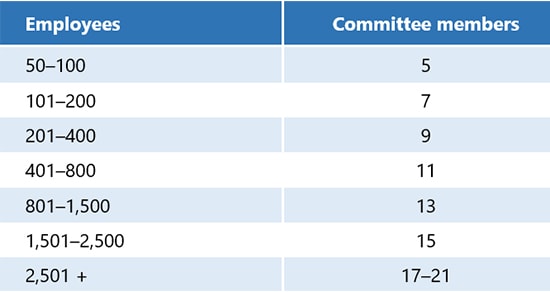
The legal basis for these employee committees is the Labor Relations Act B.E. 2518 (LRA), which stipulates that in any workplace with at least 50 employees, the employees or their labor union of the business establishment is entitled to establish an employee committee. Members are elected (or, in the case of a labor union, appointed) to three-year terms on the committee, with the total number of committee members depending on the size of the workforce, as shown in the table.

Membership Requirements
Among partially unionized workforces, labor unions are generally given precedence when it comes to control of the committee. If a labor union whose members account for more than 20% of the total employees in a workplace, the union gets to appoint the majority of the employee committee members (e.g., four out of a seven-person committee, five of a nine-person committee, etc.). Moreover, if a union’s membership accounts for more than 50% of the employees, it is entitled to appoint all employee committee members. Any labor union appointees would have their term begin on the date of their appointment, regardless of when an election is held for the non-union members of the employment committee.

In a situation where a workplace has multiple labor unions that have appointed separate employee committees, exceeding the number of the employee committee members stated by the LRA, the employer is entitled to refuse to recognize the employee committees.

Employers must meet with their employee committee at least once every three months, or whenever the labor union or more than 50% of employee committee members request it. The topics to be discussed include employee welfare, new work rules, employee complaints, and disputes and compromises in the workplace.

If an employee committee considers that an employer has acted unfairly against or caused excessive trouble for employees, the committee (or the relevant employee or the labor union) may lodge a petition with the Labor Court.

Protection of the employee committee

The LRA requires employers to first obtain permission from the Labor Court before terminating the employment of committee members, reducing their wages, taking disciplinary actions against them, otherwise obstructing them from carrying out their duties, or performing any act resulting in a committee member being unable to continue working.  If an employer breaches the LRA by doing one of these things without permission from the court, the employer (including directors or authorized persons who act on behalf of the juristic person) risks facing criminal penalties, such as imprisonment for up to one month, a fine of up to THB 1,000, or both. These penalties will remain even if the employer later succeeds in obtaining permission from the Labor Court to terminate the employee—a position upheld by the Supreme Court because the offense was committed before the court issued an order, thus constituting a violation of the LRA.

This court order requirement extends to any scenario wherein an employee committee member violates company work rules, and the disciplinary action ultimately taken against that employee depends on both the employer’s work rules and the consideration of the court. This means that even if the work rules state that an offence can be punished by termination, the court may still opt to punish the offender less severely than what the rules would otherwise prescribe, particularly if it considers that the offence is not grievous enough to warrant outright termination. (This position is again supported by Supreme Court precedent.) If, on the other hand, the court does issue an order permitting the termination of an employee, any subsequent termination would not be considered an unfair labor practice, and the employee would not be entitled to submit a complaint to the Labor Relations Committee.

Some employers may also be surprised to learn that even if they close down their business permanently and terminate all employees, they must ask the Labor Court for permission to terminate the employee committee as well. Otherwise, the employer may face the criminal penalties described above.

Consequently, an employer should be aware of the potential risks before considering any type of disciplinary or other action against a member of an employee committee, as it can be construed as a violation of the LRA and punished with criminal penalties accordingly. Some might find this difficult to remember when involved in the thick of a labor dispute, a situation of employee wrongdoing, or simply the day-to-day challenges of running a business with a large workforce, but staying in control and acting prudently—with foresight into legal requirements and consequences—can help employers stay on the right side of the law.

RELATED INSIGHTS​ 

July 30, 2026
Thailand’s cabinet has approved a draft ministerial regulation introducing significant changes to the calculation of old-age pension and old-age gratuity benefits under the Social Security Fund. The reform would replace the current pension calculation method with a career average revalued earnings (CARE) model designed to better reflect an individual’s lifetime contributions while supporting the long-term financial sustainability of the Social Security Fund. The changes are also intended to improve fairness and align Thailand’s pension framework with international practices. Key proposed changes under the draft ministerial regulation are outlined below. CARE-Based Formula for Old-Age Pension Calculations Currently, old-age pensions are calculated based on the insured person’s average salary over the preceding 60 months. The proposed regulation would replace this approach with the CARE model, under which pension benefits will be calculated based on earnings throughout an individual’s entire working life. Historical earnings will be revalued to reflect their present value before the pension benefit is calculated. According to the Ministry of Labor, this change is intended to better align pension benefits with an individual’s lifetime contribution history and provide a fairer basis for calculating benefits. Pension Accrual Rate for Contributions Exceeding 180 Months Under the current rules, insured persons who contribute for more than 180 months receive an additional pension accrual of 1.5% for each completed 12-month contribution period, with any remaining months disregarded. The proposed regulation would instead calculate the additional accrual on a monthly basis at a rate of 0.125% of actual monthly contributions; this aims to make pension benefits more accurately reflect the actual duration of each individual’s contribution history. Transitional Protections for Insured Persons The draft regulation includes transitional protections for both existing pension recipients and those who will become eligible within five years of the CARE model taking effect. For existing recipients, the following protections
June 4, 2026
On May 19, 2026, the Cabinet of the Royal Thai Government approved, in principle, revisions to Thailand’s visa exemption scheme and visa on arrival (VOA) program, as proposed by the Ministry of Foreign Affairs and the Ministry of Tourism and Sports. The revisions represent a tightening of Thailand’s immigration framework and will affect a broad range of short-term visitors. Background On July 15, 2024, Thailand expanded its visa exemption scheme by increasing the permitted period of visa-exempt stay from 30 days to 60 days in order to promote tourism, support the country’s post-pandemic economic recovery, and facilitate international travel. Under this revised scheme, passport holders from 93 countries and territories (an increase from the previous 57 countries and territories) have been permitted to enter Thailand without a visa and remain in the country for up to 60 days per entry for purposes including tourism, business engagements, urgent work, and ad hoc assignments. In addition, eligible visitors may apply at the Thai Immigration Bureau for a further 30-day extension of stay. Key Changes The proposed revisions would revoke the current 60-day exemption and reinstate the previous stay period, thereby reducing the maximum permitted stay for eligible travelers to 30 days per entry. In addition, the number of countries and territories eligible under the 30-day visa-exemption scheme is expected to be reduced to 54. The scope of the VOA scheme would likewise be significantly narrowed, with the number of eligible countries reduced from 31 countries to just four (Azerbaijan, Belarus, Serbia, and India). Further, Thailand is expected to introduce a new 15-day visa exemption category for nationals of Seychelles, the Maldives, and Mauritius. The revised framework would also limit each country or territory to a single visa exemption privilege in order to simplify Thailand’s immigration framework and reduce overlapping immigration privileges.
April 29, 2026
Vietnam’s education sector is entering a new regulatory era. On December 10, 2025, the National Assembly adopted a series of new and amended laws in the field of education, including the 2025 Law on Vocational Education, the 2025 Law on Higher Education, and the amended Law on Education No. 123/2025/QH15 (Amended Law on Education). These laws together took effect on January 1, 2026, marking a significant reform of Vietnam’s legal framework governing the education sector. The legislative package introduces a new lawmaking approach under which foundational and principle-based provisions are codified in the Amended Law on Education, while the Law on Higher Education and the Law on Vocational Education serve as specialized statutes providing supplementary, sector-specific regulatory detail tailored to their respective subsectors. The Amended Law on Education fundamentally restructures how educational institutions are established, governed, and licensed, with direct implications for private investors, foreign-invested entities, and education service providers operating in Vietnam. Below are several highlights of the key changes under the amended law, especially in the private sector, that stakeholders should understand: Change in the National Education System In addition to primary education, lower secondary (junior high school) education is now compulsory in Vietnam. Accordingly, diplomas are no longer awarded upon completion of lower secondary school but only for upper education levels. The national education system is also expanded through the introduction of vocational high school as a new level of vocational education. Such reform creates additional learning pathways that not only enable learners to pursue both further education and participate in the labor market, but also better align education and training with socioeconomic development needs. New Hurdle for Joint Investors: Mandatory Corporate Entity Requirement Where two or more investors jointly establish an education institution, the investors are no longer permitted to directly establish such an institution.
March 31, 2026
Against the backdrop of Vietnam’s rapid economic and technological transformation and its ambition to build a knowledge-driven economy, the National Assembly of Vietnam adopted Law on Higher Education No. 125/2025/QH15 on December 10, 2025, The new law took effect on January 1, 2026, replacing Law on Higher Education No. 08/2012/QH13 of 2012 and its subsequent amendments after more than a decade of implementation. The new law reflects a significant policy shift toward enhancing the institutional autonomy of higher education institutions (“HEIs”)—universities and other university-level institutions. By granting broader autonomy, Vietnam aims to enable HEIs to operate more proactively, better respond to market needs, and improve the quality and efficiency of education and research activities. Comprehensive Institutional Autonomy in HEIs The new law marks a significant shift by granting HEIs comprehensive autonomy as a statutory right, within the bounds of the licensed scope of educational operation and the legal framework, rather than a conditional right as provided under the former law. Under the new law, HEIs are empowered to exercise autonomy over their academic expertise, training, scientific research, international cooperation, organizational structure, personnel, finance, and other higher education activities. The expansion of institutional autonomy is also accompanied by a correspondingly strengthened framework of institutional accountability. However, Vietnam maintains a certain degree of control and imposes restrictions on institutional autonomy in sensitive and strategically important areas. These controls and restrictions include limitations on training autonomy in the majors of teacher training, national defense, and security; and restrictions on financial and personnel management autonomy for HEIs under the administration of the Ministry of National Defense and the Ministry of Public Security. New Model for Curriculum Development The new law removes the concept of “opening a training major” and focuses regulation on how training programs are developed and delivered. Under the previous regime,