Thailand’s Central Intellectual Property and International Trade (IP&IT) Court has delivered a favorable ruling for Sumitomo Rubber Industries, Ltd., a major player in the tire manufacturing industry, regarding the registration of its motorcycle tire design patent. In this case, Tilleke & Gibbins represented Sumitomo in successfully advocating for recognition of the unique design elements in the company’s motorcycle tire products.
Case Overview
The case revolved around Sumitomo’s two design patent applications for motorcycle tire designs, which were initially rejected by the Department of Intellectual Property (DIP) on the grounds that they were similar to prior art. Based on an examination of the design elements, primarily focusing on the tire tread patterns, the DIP’s Patent Board had concluded that Sumitomo’s designs were not sufficiently unique to warrant patent protection, as the tread patterns of the new designs were deemed too similar to one found in prior art for tire products.
In response, Tilleke & Gibbins filed a complaint with the IP&IT Court on behalf of Sumitomo, seeking a revocation of the Patent Board’s decision and requesting that the court compel the DIP, as the defendant, to proceed with the registration of Sumitomo’s design patents. The complaint emphasized that the designs were novel and distinct, warranting patent protection under Thai law.
Legal Strategy
The firm’s legal argument focused on the interpretation of Thai patent law, particularly regarding the protection of a product’s external appearance, and emphasized that the determination of a design’s novelty must consider the product’s overall appearance rather than isolating individual features. This approach is consistent with international guidelines on design patents, which require the evaluation of novelty and distinctiveness based on how an informed user would perceive the design as a whole.
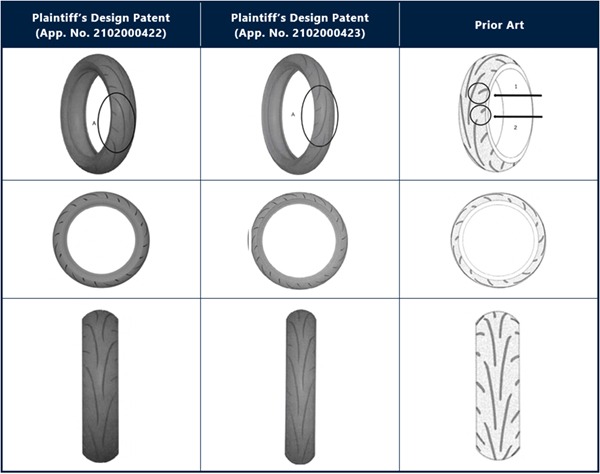
While Sumitomo’s tire tread patterns may share some superficial similarities to existing designs, the overall impression of the designs was unique. The grooves in the tread of Sumitomo’s design were arranged diagonally—with sharp, narrow ends—and extended fully to the tire edge, features absent in existing designs. These unique elements contributed to a distinctive appearance that set Sumitomo’s designs apart.
During the trial, Tilleke & Gibbins provided detailed technical testimony regarding the design features, aiming to show how the design’s unique diagonal grooves and sharp, pointed ends made it look noticeably different from the more rounded and thicker lines in the existing designs. This testimony was essential in convincing the IP&IT Court that the designs were novel and deserved patent protection under Thai law.
Court Ruling
The IP&IT Court issued a favorable ruling revoking the DIP’s rejection of Sumitomo’s design patent applications. In its judgment, the IP&IT Court considered the definition of “product design” under the Patent Act B.E. 2522 (1979), which refers to the shape, pattern, or color of the product having special characteristics that make it suitable as a model for industrial products. Therefore, product design patents protect the external appearance of products, including their shape, pattern, and color. When assessing whether a product design is similar to an existing design, only the product’s external appearance should be compared. This principle further supported the court’s ruling that Sumitomo’s designs were distinct and deserving of patent protection.
The IP&IT Court further agreed with the argument that the DIP had failed to assess the overall appearance of the tire designs properly. The IP&IT Court emphasized that a design patent protects a product’s external appearance and identified some critical differences between Sumitomo’s designs and the prior art. For instance:
- The groove patterns in Sumitomo’s designs were narrower and sharper, with the grooves extending fully to the tire edges, while the grooves in the existing designs were thicker and more rounded and did not reach the tire edges.
- The side pattern of Sumitomo’s tires, which featured alternating short and long diagonal grooves, was a feature absent in the existing designs.
The court’s consideration and thoughtfulness aligned with the diagram the firm presented to the court during the trial.
Based on these considerations, the IP&IT Court ruled that Sumitomo’s tire designs were indeed novel and not mere imitations of the prior art. As a result, the IP&IT Court ordered the DIP to proceed with the registration of Sumitomo’s design patents.
Key Takeaways
The IP&IT Court judgment emphasized the need to assess the overall appearance of a design when determining its eligibility for patent protection, aligning Thai law with international standards. The judgment clarifies that even functional products, like tire tread patterns, can have distinctive design features worthy of patent protection.
The favorable decision in Sumitomo’s motorcycle tire case is a significant win and demonstrates the importance of a legal strategy that considers both the technical and visual aspects of product design.
This article first appeared in Managing Intellectual Property.