You are using an outdated browser and your browsing experience will not be optimal. Please update to the latest version of Microsoft Edge, Google Chrome or Mozilla Firefox. Install Microsoft Edge

July 7, 2021

Thailand Introduces Online Ride-Hailing Services Regulations

Thailand’s Transport Ministry has issued new rules for ride-hailing services, aiming to strictly regulate the types of vehicle that can be registered, the number of registered vehicles per user, and the fees that are levied and collected. These rules are laid out in the Ministerial Regulation Re: Ride-Hailing Service Vehicle via an Electronic System B.E. 2564 (2021), which was published in the Royal Gazette on June 23, 2021.

Under the regulation, a personal vehicle transporting no more than seven passengers can be subsequently registered as a “ride-hailing service vehicle via an electronic system.” An individual is only allowed to register one private vehicle under the regulation. The vehicle registrations are classified as follows:

  • Small vehicles with a maximum engine power of 50–90 kilowatts;
  • Medium vehicles with a maximum engine power of 91–120 kilowatts; or
  • Large vehicles with a maximum engine power of more than 120 kilowatts.

In the case of an electric vehicle, it must be able to travel at a speed of at least 90 km/h.

Each ride-hailing vehicle must be covered by a service-providing communication system operated by an electronic service provider (e.g., a ride-hailing app) that has been endorsed and approved by the Department of Land Transport (DLT). This system must communicate the following details:

  • Car and driver information;
  • Driver’s identity system;
  • Pre-calculated fare;
  • Car tracking system;
  • Time and location validation system; and
  • Complaint and emergency system.

All data records must be retained for at least one month for examination purposes.

The regulation further prescribes that the vehicle must display a sign indicating that it is a ride-hailing service vehicle operating via an electronic system, and the vehicle must be the same color as appears in the personal vehicle registration certificate prior to its registration as a ride-hailing vehicle.

Registration under the regulation is valid for nine years. The ride-hailing vehicle registration plate’s size, specifications, and color are identical to the criteria for registering personal vehicles carrying no more than seven people, meaning that the same vehicle registration plate can be used for the ride-hailing vehicle. The condition of the ride-hailing vehicle must also be examined annually, as prescribed by ministerial regulations under the Vehicle Act B.E. 2522 (1979), and both the interior and exterior must be kept clean and tidy.

Service Fees

The regulation empowers the minister of transport to prescribe the fees for ride-hailing vehicles; the current fees are outlined in the table below.
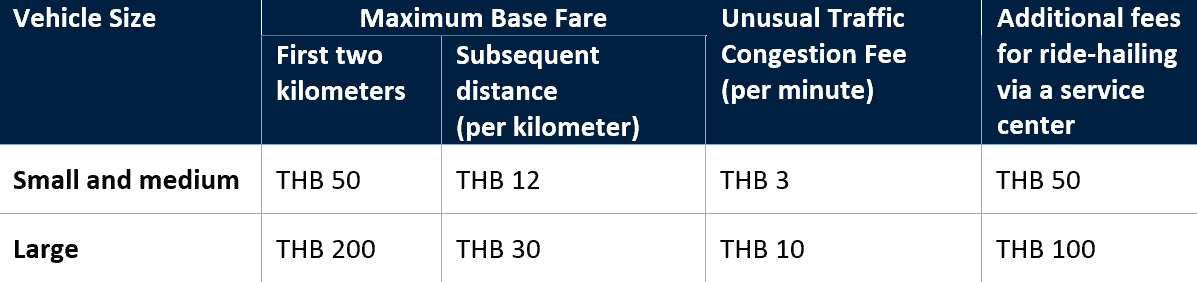
All fees must be shown to the passenger before the provision of any service, and only this same amount can be charged and collected.

For more details about this regulation, or about any aspect of transportation and technology laws in Thailand, please contact Charuwan Charoonchitsathian at [email protected] or +66 2056 5657, or Panchanit Trakarnvanich at [email protected] or +66 2056 5531.

RELATED INSIGHTS​ 

September 11, 2026
Thailand’s National Broadcasting and Telecommunications Commission (NBTC) has published a new five-year master plan that will bring significant regulatory changes to the broadcasting and digital media sectors, including formal licensing requirements for internet-based audiovisual services. The Master Plan for Broadcasting and Television, 3rd Edition (B.E. 2569–2573/2026–2030) was published in the Government Gazette on September 1, 2026, and will affect OTT platforms, internet-based audiovisual service providers, and traditional broadcasters. Licensing Reform The NBTC will develop new licensing frameworks ahead of existing digital television license expirations, which are slated to occur between 2028 and 2030. This creates both uncertainty and opportunity for incumbents and new market entrants. New licensing criteria will also be developed for audiovisual services delivered over the internet, meaning previously unregulated internet-based providers may face licensing, fee, and content obligations for the first time. The plan also calls for a new law to govern converged communications services. OTT Regulation and Content Oversight The plan explicitly acknowledges and aims to lessen the regulatory asymmetry between traditional broadcasters—which are subject to licensing, fees, and content regulation—and internet-based services that currently face fewer obligations. The NBTC intends to develop regulatory frameworks to bring internet-based audiovisual services, including OTT platforms, streaming services, and user-generated content platforms, under content, consumer protection, and licensing requirements. Consumer Protection and Digital Rights The NBTC will strengthen its oversight of broadcasting, television, and telecommunications operators to ensure compliance with consumer protection and personal data protection requirements. This includes updating relevant notifications and orders and more strictly enforcing rules against practices that unfairly exploit consumers. These measures may layer NBTC-specific requirements on top of Thailand’s existing Personal Data Protection Act obligations. Stricter enforcement against practices that exploit consumers is a priority, with particular scrutiny on advertising practices. The NBTC will modernize complaint resolution processes, meaning service providers should
September 7, 2026
On September 4, 2026, Thailand’s prime minister convened the first meeting of the Data Center Business Policy Committee. The committee endorsed a draft policy framework for the data center industry and tasked four subcommittees with developing the standards that would sit beneath it, shifting away from fragmented, agency-by-agency approvals toward a unified national strategy aiming to maximize economic value while managing environmental and infrastructure concerns. Proposed Scope and Pillars of the National Data Center Policy Framework The proposed framework would cover all types of data centers, including internal or captive facilities operated within a company or its affiliates, rather than only commercial third-party providers. If adopted in this form, companies running private data centers purely for internal purposes would also become subject to regulatory oversight. Minimum safety and operational standards would be established, with uniform enforcement across all categories. The committee endorsed a draft policy framework with four key pillars: Industrial classification: Data centers exceeding 2 MW would be classified as industrial operations, which may require factory licenses and environmental impact assessments under the Factory Act. Resource pricing: Utility rates would be structured to reflect both direct and indirect costs, supporting green energy and green data center standards. Centralized screening: A centralized review would evaluate project suitability and resource allocation. Operators may be required to submit proposals through periodic “pitching” rounds, where projects are competitively assessed on their potential economic and strategic benefits to Thailand. Digital ecosystem: The framework would prioritize data sovereignty, tax incentives, and conditions promoting domestic digital businesses, AI, and cloud infrastructure. Multidimensional Evaluation Criteria and Subcommittees Four subcommittees will be established to develop standards responsible for the following dimensions: Economic: Criteria for assessing the economic viability of data center projects, for use in prioritizing data centers based on infrastructure readiness, demand type (including AI factories),
September 4, 2026
Foreign business restrictions on telecommunications, treasury center businesses, and intragroup support services were eased when Thailand published the Ministerial Regulation Prescribing Service Businesses Not Requiring Permission for Foreign Business Operations (No. 5) B.E. 2569 (2026) in the Government Gazette on August 28, 2026. The ministerial regulation expands the categories of service businesses that foreign investors may operate without a foreign business license (FBL) under the Foreign Business Act B.E. 2542 (1999) (FBA). Of particular relevance to the telecommunications, fintech, and technology sectors, the ministerial regulation exempts: Type 1 telecommunications licensees, which do not have their own networks; Treasury center businesses operated in accordance with Thailand’s exchange control regulations; and Certain intragroup administrative, human resources, and information technology management services. Telecommunications Services Foreign-owned businesses providing telecommunications services under a type 1 telecommunications license may now operate without obtaining an FBL. This may streamline market entry for qualifying telecommunications and digital infrastructure businesses. The exemption applies only to the FBA licensing requirement. Operators must continue to comply with applicable requirements under the Telecommunications Business Act and the regulations of the National Broadcasting and Telecommunications Commission, and the change does not affect foreign ownership restrictions applicable to type 2 or type 3 telecommunications businesses. Treasury Center Businesses The ministerial regulation also exempts qualifying treasury center businesses from the FBL requirement. This may facilitate centralized treasury functions in Thailand, including liquidity management, foreign exchange management, and intragroup funding arrangements. Treasury center operations remain subject to applicable requirements of the Bank of Thailand and other competent authorities. Intragroup Administrative, HR, and IT Services Certain administrative, human resources, and information technology management services provided between affiliated entities are also exempt, provided the relevant entities satisfy prescribed ownership or management criteria. The exemption is available where the service provider and recipient are related through specified ownership
September 2, 2026
Thailand and China have a longstanding and significant trade relationship, which increasingly extends to e-commerce and digitally enabled supply chains. While these channels create new opportunities for businesses to reach consumers across borders, their growth also brings greater exposure to intellectual property (IP) infringement across jurisdictions and online platforms. Effective cooperation between the two countries’ enforcement authorities has therefore become increasingly important. To strengthen cooperation in this area, Thailand and China signed a memorandum of understanding (MOU) on IP enforcement in Beijing on July 20, 2026, during the Thai prime minister’s official visit to China. Officially titled “Memorandum of Understanding Between the State Administration for Market Regulation of the People’s Republic of China and the Ministry of Commerce of the Kingdom of Thailand on Cooperation in the Field of Intellectual Property Enforcement,” the MOU forms part of a broader bilateral agenda covering industrial and supply chains, participation by micro, small, and medium-sized enterprises (MSMEs), cooperation associated with the ASEAN–China Free Trade Area 3.0, and progress on the registration of Thai geographical indications in China. The MOU establishes a bilateral framework for cooperation and coordination in five broad areas: Strengthening dialogue in IP enforcement; Enhancing information sharing; Facilitating the enforcement of IP rights in cases arising in the parties’ domestic markets and on online platforms, in accordance with their respective domestic laws; Promoting cooperation in IP enforcement training and human resource development; and Undertaking other cooperation activities agreed upon by both sides. The Department of Intellectual Property (DIP) will serve as the principal coordinating agency for Thailand, while the Bureau of Law Enforcement and Inspection in China’s State Administration for Market Regulation (SAMR) will serve in that role for China. The framework is particularly relevant to the growth of e-commerce, as it covers infringement in the domestic markets and on