You are using an outdated browser and your browsing experience will not be optimal. Please update to the latest version of Microsoft Edge, Google Chrome or Mozilla Firefox. Install Microsoft Edge

October 21, 2024

Thai Court Decision Moves Design Assessment Closer to International Standards

Managing Intellectual Property

Thailand’s Central Intellectual Property and International Trade (IP&IT) Court has delivered a favorable ruling for Sumitomo Rubber Industries, Ltd., a major player in the tire manufacturing industry, regarding the registration of its motorcycle tire design patent. In this case, Tilleke & Gibbins represented Sumitomo in successfully advocating for recognition of the unique design elements in the company’s motorcycle tire products.

Case Overview

The case revolved around Sumitomo’s two design patent applications for motorcycle tire designs, which were initially rejected by the Department of Intellectual Property (DIP) on the grounds that they were similar to prior art. Based on an examination of the design elements, primarily focusing on the tire tread patterns, the DIP’s Patent Board had concluded that Sumitomo’s designs were not sufficiently unique to warrant patent protection, as the tread patterns of the new designs were deemed too similar to one found in prior art for tire products.

In response, Tilleke & Gibbins filed a complaint with the IP&IT Court on behalf of Sumitomo, seeking a revocation of the Patent Board’s decision and requesting that the court compel the DIP, as the defendant, to proceed with the registration of Sumitomo’s design patents. The complaint emphasized that the designs were novel and distinct, warranting patent protection under Thai law.

Legal Strategy

The firm’s legal argument focused on the interpretation of Thai patent law, particularly regarding the protection of a product’s external appearance, and emphasized that the determination of a design’s novelty must consider the product’s overall appearance rather than isolating individual features. This approach is consistent with international guidelines on design patents, which require the evaluation of novelty and distinctiveness based on how an informed user would perceive the design as a whole.

While Sumitomo’s tire tread patterns may share some superficial similarities to existing designs, the overall impression of the designs was unique. The grooves in the tread of Sumitomo’s design were arranged diagonally—with sharp, narrow ends—and extended fully to the tire edge, features absent in existing designs. These unique elements contributed to a distinctive appearance that set Sumitomo’s designs apart.

During the trial, Tilleke & Gibbins provided detailed technical testimony regarding the design features, aiming to show how the design’s unique diagonal grooves and sharp, pointed ends made it look noticeably different from the more rounded and thicker lines in the existing designs. This testimony was essential in convincing the IP&IT Court that the designs were novel and deserved patent protection under Thai law.

Court Ruling

The IP&IT Court issued a favorable ruling revoking the DIP’s rejection of Sumitomo’s design patent applications. In its judgment, the IP&IT Court considered the definition of “product design” under the Patent Act B.E. 2522 (1979), which refers to the shape, pattern, or color of the product having special characteristics that make it suitable as a model for industrial products. Therefore, product design patents protect the external appearance of products, including their shape, pattern, and color. When assessing whether a product design is similar to an existing design, only the product’s external appearance should be compared. This principle further supported the court’s ruling that Sumitomo’s designs were distinct and deserving of patent protection.

The IP&IT Court further agreed with the argument that the DIP had failed to assess the overall appearance of the tire designs properly. The IP&IT Court emphasized that a design patent protects a product’s external appearance and identified some critical differences between Sumitomo’s designs and the prior art. For instance:

  • The groove patterns in Sumitomo’s designs were narrower and sharper, with the grooves extending fully to the tire edges, while the grooves in the existing designs were thicker and more rounded and did not reach the tire edges.
  • The side pattern of Sumitomo’s tires, which featured alternating short and long diagonal grooves, was a feature absent in the existing designs.

The court’s consideration and thoughtfulness aligned with the diagram the firm presented to the court during the trial.
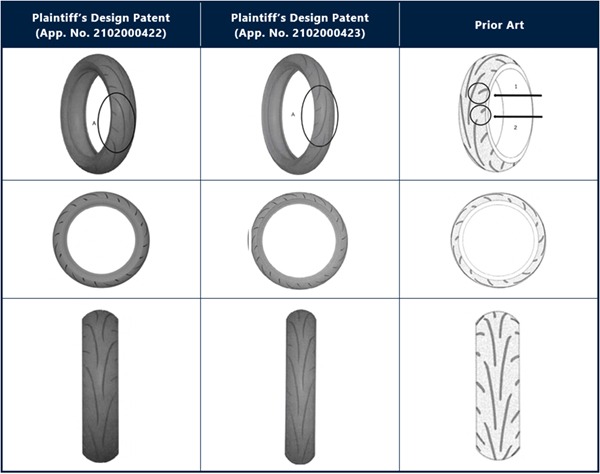
Based on these considerations, the IP&IT Court ruled that Sumitomo’s tire designs were indeed novel and not mere imitations of the prior art. As a result, the IP&IT Court ordered the DIP to proceed with the registration of Sumitomo’s design patents.

Key Takeaways

The IP&IT Court judgment emphasized the need to assess the overall appearance of a design when determining its eligibility for patent protection, aligning Thai law with international standards. The judgment clarifies that even functional products, like tire tread patterns, can have distinctive design features worthy of patent protection.

The favorable decision in Sumitomo’s motorcycle tire case is a significant win and demonstrates the importance of a legal strategy that considers both the technical and visual aspects of product design.

This article first appeared in Managing Intellectual Property.

RELATED INSIGHTS​ 

December 2, 2022
On November 11, 2022, Myanmar’s Ministry of Commerce (MOC) announced a pilot period for importing electric vehicles into Myanmar, which came into force with MOC Order No. 62/2022, issued under the Import and Export Law. A separate order (No. 61/2022) issued on the same day specifies rules for importation of motorcycles by companies that do not have a certificate to open a showroom, as well as rules for opening motorcycle showrooms. Electric Vehicle Importation According to the order, which takes effect January 1, 2023, “electric vehicles” includes only battery electric vehicles (BEVs) for both personal use and passenger use. In order to import electric vehicles into Myanmar without having a certificate to open a showroom, companies must: Be registered as a company, either wholly owned by nationals or a joint venture, at the Directorate of Investment and Company Administration (DICA); Be able to present the purchase and sales agreement for each brand of imported electric vehicles; Receive approval from the National Steering Committee for Development of Electric Vehicles and Associated Businesses, and import according to the quality and quantity of electric vehicles permitted by the committee; Arrange the necessary warranty, spare parts availability, and after-sales service for the imported electric vehicles; Deposit a bank guarantee of MMK 50 million at a bank recognized by the Central Bank of Myanmar; and Apply for a purchase permit at the MOC, for the purpose of registering the imported vehicles with the Road Transport Administration Department. BEV Tax Exemption Following MOC Order No. 62/2022, BEVs and their batteries are now exempted from commercial tax and special goods tax, which came into force with the Law Amending the Union Tax Law 2022 (State Administrative Council Law No. 48/2022) dated November 17, 2022. These tax exemptions will be effective from October 1, 2022, to March
October 19, 2022
The Factory Act B.E. 2535 (1992) is one of the most important laws regulating manufacturing businesses in Thailand. It applies to businesses either with machinery of 50 horsepower or more in total, or with a minimum of 50 workers in a facility that conducts “factory work” as defined under related ministerial regulations. The act was recently amended to extend the period of validity for factory licenses and to make other miscellaneous changes that facilitate business. However, the act’s criminal liabilities were left unchanged, and they remain a vital tool for the authorities to exert control over relevant standards and prosecute violations. Both fines and imprisonment are available as sanctions under the law. Examples of common violations of the Factory Act and their potential penalties include: Setting up and operating a factory without acquiring a license: up to two years’ imprisonment, a fine of up to THB 200,000 (approx. USD 5,365), or both. Operating with noise level exceeding the standard set by the Ministry of Industry: a fine of up to THB 200,000. Not displaying a factory license in an open and easily visible location in the factory: a fine of up to THB 5,000 (approx. USD 134). Doing a test run of machinery prior to the start of the factory operations without notifying the authorities: a fine of up to THB 20,000. As factory activities are regulated in considerable detail, overlooking a minor change could potentially put the company at risk. The risk of violating the Factory Act increases when compliance is not a proactive policy—such as by instituting systems or safeguards to ensure adherence to the rules. Criminal Liability Violation of the Factory Act is especially a concern because criminal liability under the act is not limited to juristic persons (i.e., companies) but also applies to the director,
September 27, 2022
The Bank of Thailand (BOT) and the Fiscal Policy Office have drafted a royal decree that will regulate the hire purchase and leasing of cars and motorcycles under the Financial Institution Business Act B.E. 2551 (2008). This draft royal decree, which comes at a time when the level of household debt is surging in Thailand, aims to address the rise in outstanding debts related to hire purchase and leasing of cars and motorcycles. In recent years, there has been growing concern about such financing for cars and motorcycles, as these arrangements conducted by non-banks are currently unregulated and have sparked many public complaints relating to fees and practices. Scope of Regulated Businesses By virtue of the draft royal decree, businesses carrying out hire purchase and leasing of cars and motorcycles will become regulated businesses under the Financial Institution Business Act B.E. 2551 (2008). The draft royal decree defines “hire purchase” and “leasing” as follows: “Hire purchase” refers to hire purchase of cars and motorcycles according to the Civil and Commercial Code—that is, a contract whereby an owner of a car or motorcycle hires out the vehicle to a customer, and either promises to sell it to the customer or promises that it will become the property of the customer, on the condition that the customer makes a certain number of payments. “Leasing” refers to renting of a car or motorcycle under a financial lease contract in which the lessor procures a car or motorcycle according to the lessee’s request from a manufacturer, distributor, or other party, or a car or motorcycle repossessed from another lessee, in order to allow the lessee to utilize the vehicle. The lessee is obligated to maintain and repair the leased car or motorcycle during the leasing term. However, the lessee cannot terminate the contract unilaterally before maturity. Upon
March 8, 2022
On February 15, 2022, Thailand’s cabinet approved in principle a package of incentives to promote electric vehicle (EV) adoption in Thailand, with the aim of making the country an EV manufacturing hub in Asia. A week later, the cabinet approved further draft regulations including specific information on customs duty reductions and exemptions for certain types of imported EVs. The plan includes both tax and non-tax incentives from 2022 until 2025. In the first two years (2022–2023), the package incentivizes the widespread use of EVs in Thailand by providing exemption or reduction of import duties and excise tax, as well as subsidies to increase the demand for EVs and attract investment in the EV industry. These incentives will cover the importation of completely built up (CBU) cars and motorcycles, and the local manufacturing of completely knocked down (CKD) vehicles in Thailand. For the following two years (2024–2025), the plan promotes the use of domestically produced EVs by eliminating the exemption or reduction of import duties for CBU vehicles while maintaining the other incentives (e.g., reduced excise tax rates, and subsidies). The aim of this is to make the cost of CBU vehicles higher than locally produced vehicles to encourage operators to produce EVs in the country to meet increasing demand. Additional measures encourage the manufacturing of EVs in Thailand, including exemption of import duties for parts imported between 2022 and 2025, and treatment of the value of imported battery cells as a cost of local manufacturing (up to 15% of an EV’s retail price). This is beneficial to local manufacturers of EVs, as their activities will be entitled to a more generous incentive package than importation of EVs. At their meeting on February 22, 2022, Thailand’s cabinet further approved draft subordinate regulations, including specific reductions and exemptions of customs duty