You are using an outdated browser and your browsing experience will not be optimal. Please update to the latest version of Microsoft Edge, Google Chrome or Mozilla Firefox. Install Microsoft Edge

October 21, 2024

Thai Court Decision Moves Design Assessment Closer to International Standards

Managing Intellectual Property

Thailand’s Central Intellectual Property and International Trade (IP&IT) Court has delivered a favorable ruling for Sumitomo Rubber Industries, Ltd., a major player in the tire manufacturing industry, regarding the registration of its motorcycle tire design patent. In this case, Tilleke & Gibbins represented Sumitomo in successfully advocating for recognition of the unique design elements in the company’s motorcycle tire products.

Case Overview

The case revolved around Sumitomo’s two design patent applications for motorcycle tire designs, which were initially rejected by the Department of Intellectual Property (DIP) on the grounds that they were similar to prior art. Based on an examination of the design elements, primarily focusing on the tire tread patterns, the DIP’s Patent Board had concluded that Sumitomo’s designs were not sufficiently unique to warrant patent protection, as the tread patterns of the new designs were deemed too similar to one found in prior art for tire products.

In response, Tilleke & Gibbins filed a complaint with the IP&IT Court on behalf of Sumitomo, seeking a revocation of the Patent Board’s decision and requesting that the court compel the DIP, as the defendant, to proceed with the registration of Sumitomo’s design patents. The complaint emphasized that the designs were novel and distinct, warranting patent protection under Thai law.

Legal Strategy

The firm’s legal argument focused on the interpretation of Thai patent law, particularly regarding the protection of a product’s external appearance, and emphasized that the determination of a design’s novelty must consider the product’s overall appearance rather than isolating individual features. This approach is consistent with international guidelines on design patents, which require the evaluation of novelty and distinctiveness based on how an informed user would perceive the design as a whole.

While Sumitomo’s tire tread patterns may share some superficial similarities to existing designs, the overall impression of the designs was unique. The grooves in the tread of Sumitomo’s design were arranged diagonally—with sharp, narrow ends—and extended fully to the tire edge, features absent in existing designs. These unique elements contributed to a distinctive appearance that set Sumitomo’s designs apart.

During the trial, Tilleke & Gibbins provided detailed technical testimony regarding the design features, aiming to show how the design’s unique diagonal grooves and sharp, pointed ends made it look noticeably different from the more rounded and thicker lines in the existing designs. This testimony was essential in convincing the IP&IT Court that the designs were novel and deserved patent protection under Thai law.

Court Ruling

The IP&IT Court issued a favorable ruling revoking the DIP’s rejection of Sumitomo’s design patent applications. In its judgment, the IP&IT Court considered the definition of “product design” under the Patent Act B.E. 2522 (1979), which refers to the shape, pattern, or color of the product having special characteristics that make it suitable as a model for industrial products. Therefore, product design patents protect the external appearance of products, including their shape, pattern, and color. When assessing whether a product design is similar to an existing design, only the product’s external appearance should be compared. This principle further supported the court’s ruling that Sumitomo’s designs were distinct and deserving of patent protection.

The IP&IT Court further agreed with the argument that the DIP had failed to assess the overall appearance of the tire designs properly. The IP&IT Court emphasized that a design patent protects a product’s external appearance and identified some critical differences between Sumitomo’s designs and the prior art. For instance:

  • The groove patterns in Sumitomo’s designs were narrower and sharper, with the grooves extending fully to the tire edges, while the grooves in the existing designs were thicker and more rounded and did not reach the tire edges.
  • The side pattern of Sumitomo’s tires, which featured alternating short and long diagonal grooves, was a feature absent in the existing designs.

The court’s consideration and thoughtfulness aligned with the diagram the firm presented to the court during the trial.
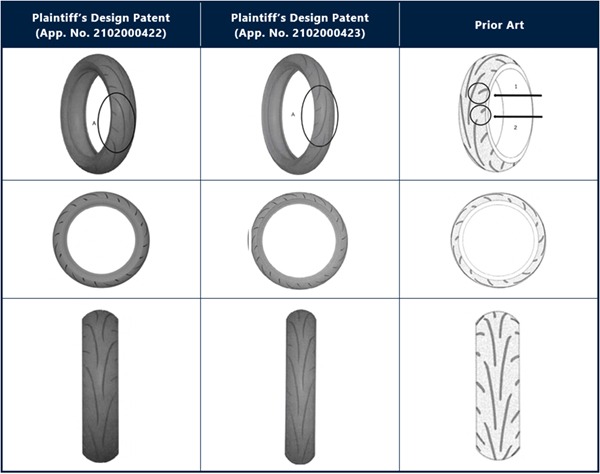
Based on these considerations, the IP&IT Court ruled that Sumitomo’s tire designs were indeed novel and not mere imitations of the prior art. As a result, the IP&IT Court ordered the DIP to proceed with the registration of Sumitomo’s design patents.

Key Takeaways

The IP&IT Court judgment emphasized the need to assess the overall appearance of a design when determining its eligibility for patent protection, aligning Thai law with international standards. The judgment clarifies that even functional products, like tire tread patterns, can have distinctive design features worthy of patent protection.

The favorable decision in Sumitomo’s motorcycle tire case is a significant win and demonstrates the importance of a legal strategy that considers both the technical and visual aspects of product design.

This article first appeared in Managing Intellectual Property.

RELATED INSIGHTS​ 

December 15, 2023
As part of its membership in Lex Mundi, Tilleke & Gibbins has published an updated edition of its Guide to Doing Business in Thailand for 2023. This guide outlines the key factors for starting and operating a business in the Thai market. Issues covered include: Investment incentives Financial facilities Exchange controls Import and export regulations Structures for doing business Requirements for the Establishment of a Business Operation of the Business Cessation or Termination of the Business Labor legislation, relations, and supply Tax Immigration requirements This publication is part of Lex Mundi’s Country Guides series prepared by member firms in more than 100 jurisdictions worldwide. The guides serve as a useful resource for planning international business strategy and researching new markets. The full Guide to Doing Business in Thailand is available through the button below.
October 30, 2023
On October 9, 2023, Laos issued Presidential Decree No. 003, which raised excise tax rates for certain goods, effective immediately. The move to increase excise tax rates comes amid the marked depreciation of the Lao kip (LAK). The Lao government is trying to monitor and discourage imports of non-essential products in order to reduce the outflow of foreign currency from the country. Increasing the tax rate for some of these products is part of these efforts. The specific products and excise tax rates are listed in the table below.   This new rate policy is also in line with recent government efforts to encourage avoiding payment in foreign currency to prevent the depletion of foreign currency reserves in Laos. In this regard, commercial banks have already taken action to ration the supply of foreign currency by prioritizing imports of essential goods, such as fuel. The products listed above formalize this impetus to prioritize certain imports and discourage others deemed not essential. In addition, the increased excise tax rates on fuel-powered vehicles show the commitment of the Lao government to move toward electric vehicles, which would also lessen the country’s dependence on fuel imports. For more information on these excise tax changes, or on any aspect of Laos’ international trade regulations, please contact Tilleke & Gibbins at [email protected].
October 4, 2023
Extended producer responsibility (“EPR”), a strategy whereby producers are held accountable for the environmental impact of their products throughout their entire life cycle, including disposal and recycling, has become more and more familiar to manufacturers in Vietnam. According to the director of the legal department of the Ministry of Environment and Natural Resources, EPR is an alternative financial solution for managing waste and increasing recycling without raising environmental protection taxes and fees, which may help Vietnam to maintain a closed loop of resources in manufacturing. New EPR Regulations Applicable to Producers and Importers In 2020 and 2022, the new Law on Environmental Protection 2020 and its guiding Decree No. 08/2022/ND-CP were promulgated, introducing a legal framework for EPR (“New EPR Regulations”) imposed on not only producers but also importers. Under the New EPR Regulations, producers and importers of certain types of products and packaging are responsible to collect and treat waste and recycle their products and packaging. The responsibility to collect and treat waste took effect on January 10, 2022, while there are different timelines being phased in from 2024 to 2027 for the recycling of products and packaging, depending on the type. For the purpose of compliance with the recycling requirement under the New EPR Regulations, the producers and importers can implement the recycling obligation by themselves, or engage a third party to recycle or organize the recycling, or make a financial contribution to the Vietnam Environment Protection Fund to support the recycling process. This will cause an increase in cost and, hence, an impact on prices of certain products in the near future. Exceptions to the recycling obligation include: Producers and importers of products and packaging for (i) export or temporary import for re-export or (ii) manufacture or import for research, study, or testing purposes. Packaging producers
May 17, 2023
In Myanmar, a Union Tax Law is enacted each year to announce the rates of tax set out in the Income Tax Law 1974, the Commercial Tax Law 1990, and the Special Goods Tax Law 2016. The Union Tax Law 2023 (UTL 2023) came into force on April 1, 2023. It sets the rates of special goods tax (SGT), income tax (IT), and commercial tax (CT) for the period of April 1, 2023, to March 31, 2024, and exempts certain goods and services from these taxes. The key changes implemented by the UTL 2023 are summarized below. Special Goods Tax The UTL 2023 exempts battery electric vehicles (BEVs) from SGT. At the same time, it increases the rate of SGT on imported liquor. Previously, the rate of SGT ranged from 190 MMK per liter to 60 percent of the per-liter price of imported liquor in the previous fiscal year. The UTL 2023 raises the minimum rate to 209 MMK per liter while leaving the upper rate unchanged. Commercial Tax and Customs Tariffs BEVs imported into Myanmar were made exempt from CT under the Law Amending the Union Tax Law 2022. The UTL 2023 extends the exemption until the end of the 2023–24 fiscal year, along with two- and three-wheeler BEVs, BEV batteries, and related parts for specific use in BEVs. The CT exemption for battery charging services for BEVs, also introduced in 2022, has similarly been extended. Following enactment of the UTL 2023, the Ministry of Planning and Finance (MOPF) issued Notification No. 31/2023, reducing to zero the customs tariffs on imported BEVs, including those imported completely built up (CBU), completely knocked down (CKD), or semi-knocked down (SKD). The tariffs on spare parts and materials for BEVs have also been reduced to zero. In addition to exempting BEVs from