You are using an outdated browser and your browsing experience will not be optimal. Please update to the latest version of Microsoft Edge, Google Chrome or Mozilla Firefox. Install Microsoft Edge

October 21, 2024

Thai Court Decision Moves Design Assessment Closer to International Standards

Managing Intellectual Property

Thailand’s Central Intellectual Property and International Trade (IP&IT) Court has delivered a favorable ruling for Sumitomo Rubber Industries, Ltd., a major player in the tire manufacturing industry, regarding the registration of its motorcycle tire design patent. In this case, Tilleke & Gibbins represented Sumitomo in successfully advocating for recognition of the unique design elements in the company’s motorcycle tire products.

Case Overview

The case revolved around Sumitomo’s two design patent applications for motorcycle tire designs, which were initially rejected by the Department of Intellectual Property (DIP) on the grounds that they were similar to prior art. Based on an examination of the design elements, primarily focusing on the tire tread patterns, the DIP’s Patent Board had concluded that Sumitomo’s designs were not sufficiently unique to warrant patent protection, as the tread patterns of the new designs were deemed too similar to one found in prior art for tire products.

In response, Tilleke & Gibbins filed a complaint with the IP&IT Court on behalf of Sumitomo, seeking a revocation of the Patent Board’s decision and requesting that the court compel the DIP, as the defendant, to proceed with the registration of Sumitomo’s design patents. The complaint emphasized that the designs were novel and distinct, warranting patent protection under Thai law.

Legal Strategy

The firm’s legal argument focused on the interpretation of Thai patent law, particularly regarding the protection of a product’s external appearance, and emphasized that the determination of a design’s novelty must consider the product’s overall appearance rather than isolating individual features. This approach is consistent with international guidelines on design patents, which require the evaluation of novelty and distinctiveness based on how an informed user would perceive the design as a whole.

While Sumitomo’s tire tread patterns may share some superficial similarities to existing designs, the overall impression of the designs was unique. The grooves in the tread of Sumitomo’s design were arranged diagonally—with sharp, narrow ends—and extended fully to the tire edge, features absent in existing designs. These unique elements contributed to a distinctive appearance that set Sumitomo’s designs apart.

During the trial, Tilleke & Gibbins provided detailed technical testimony regarding the design features, aiming to show how the design’s unique diagonal grooves and sharp, pointed ends made it look noticeably different from the more rounded and thicker lines in the existing designs. This testimony was essential in convincing the IP&IT Court that the designs were novel and deserved patent protection under Thai law.

Court Ruling

The IP&IT Court issued a favorable ruling revoking the DIP’s rejection of Sumitomo’s design patent applications. In its judgment, the IP&IT Court considered the definition of “product design” under the Patent Act B.E. 2522 (1979), which refers to the shape, pattern, or color of the product having special characteristics that make it suitable as a model for industrial products. Therefore, product design patents protect the external appearance of products, including their shape, pattern, and color. When assessing whether a product design is similar to an existing design, only the product’s external appearance should be compared. This principle further supported the court’s ruling that Sumitomo’s designs were distinct and deserving of patent protection.

The IP&IT Court further agreed with the argument that the DIP had failed to assess the overall appearance of the tire designs properly. The IP&IT Court emphasized that a design patent protects a product’s external appearance and identified some critical differences between Sumitomo’s designs and the prior art. For instance:

  • The groove patterns in Sumitomo’s designs were narrower and sharper, with the grooves extending fully to the tire edges, while the grooves in the existing designs were thicker and more rounded and did not reach the tire edges.
  • The side pattern of Sumitomo’s tires, which featured alternating short and long diagonal grooves, was a feature absent in the existing designs.

The court’s consideration and thoughtfulness aligned with the diagram the firm presented to the court during the trial.
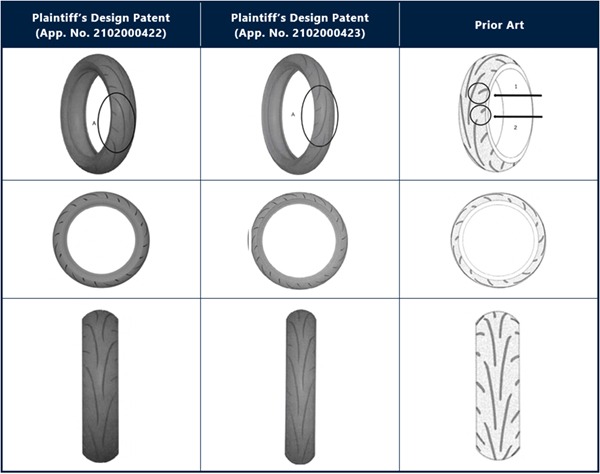
Based on these considerations, the IP&IT Court ruled that Sumitomo’s tire designs were indeed novel and not mere imitations of the prior art. As a result, the IP&IT Court ordered the DIP to proceed with the registration of Sumitomo’s design patents.

Key Takeaways

The IP&IT Court judgment emphasized the need to assess the overall appearance of a design when determining its eligibility for patent protection, aligning Thai law with international standards. The judgment clarifies that even functional products, like tire tread patterns, can have distinctive design features worthy of patent protection.

The favorable decision in Sumitomo’s motorcycle tire case is a significant win and demonstrates the importance of a legal strategy that considers both the technical and visual aspects of product design.

This article first appeared in Managing Intellectual Property.

RELATED INSIGHTS​ 

July 18, 2025
Vietnam’s electric vehicle (EV) industry is experiencing rapid growth, driven by a strong wave of new legislation, strategic plans, and government incentives. The government’s clear commitment to electrification is attracting foreign investment, supporting advanced production, and reducing reliance on internal combustion engine (ICE) imports. Recent national strategies, sector regulations, and technical standards demonstrate a rare level of regulatory momentum in Southeast Asia, positioning Vietnam as a competitive player in the global EV supply chain and an attractive market for foreign investors. An overview of legal developments for the EV sector in Vietnam is presented below. National Action Program for Green Transportation A key driver of Vietnam’s EV growth has been the National Action Program for Green Transportation through 2050 stipulated in Decision No. 876/QD-TTg of the prime minister dated July 22, 2022. The National Action Program sets a detailed roadmap for the green energy transition in road transport. For the period 2022–2030, the focus is on promoting the manufacturing, assembly, import, and conversion of road motor vehicles to electric power, expanding the use of 100% E5 gasoline for road vehicles, developing charging infrastructure to meet the needs of residents and businesses, and encouraging both new and existing bus stations and rest stops to meet green criteria. For the period 2031–2050, the roadmap aims to gradually restrict and ultimately cease by 2040 the manufacturing, assembly, and import of fossil fuel-powered cars, motorcycles, and mopeds for domestic use. By 2050, the goal is for 100% of road motor vehicles and construction vehicles participating in traffic to use electricity or green energy, for all bus stations and rest stops to meet green criteria, and for all machinery and equipment for loading and unloading to transition from fossil fuels to electricity or green energy. The program also calls for the completion of nationwide
June 12, 2025
Thailand’s Ministry of Finance has issued a royal decree placing the business of hire purchase and leasing of cars and motorcycles under the scope of the Financial Institution Business Act B.E. 2551 (2008), effective December 2, 2025. This is to ensure appropriate regulatory oversight of these business activities, as they function similarly to credit granting and serve as a source of funding for the public with a broad impact on the overall economic system and consumers at large. The business operators that this royal decree applies to include corporate entities engaging regularly in the business of hire purchase or leasing of cars or motorcycles, currently excluding: Financial institutions and specialized financial institutions. Individuals operating such businesses (noncorporate entities). Cooperatives. Key regulatory obligations of this royal decree include the following: Business operators must disclose interest rates, service fees, and other relevant business information to the public and report to the Bank of Thailand (BOT). Business operators must display how the annual percentage rate (APR), including all annual charges covering interest and service fees, is calculated. Business operators must maintain accurate accounting records in accordance with recognized accounting standards. The BOT may issue warnings or suspend operations if business operators fail to comply with this royal decree or act unfairly in a way that may result in serious harm to customers. Directors, managers, and responsible persons of any business operator that violates this royal decree may also be subject to the prescribed penalties. Before the royal decree takes effect, business operators should conduct internal assessments and engage with counsel to prepare for regulatory implementation. The BOT is expected to issue further subordinate regulations and guidance regarding: Interest, service fees, deposits, collateral, benefits, and penalties that may be charged by business operators. Contract content, methods of benefit calculation, and format in conducting
June 11, 2025
Myanmar’s Ministry of Commerce has established new regulatory measures for importing electric vehicles (EVs) as part of a pilot project running from January 2025 to March 31, 2026, while the Ministry of Planning and Finance has reduced customs duty rates for fuel-powered vehicles manufactured domestically under semi-knocked down (SKD) and completely knocked down (CKD) systems, effective June 1, 2025, to May 31, 2026. Importation of EVs On May 29, 2025, Myanmar’s Ministry of Commerce (MOC) issued an announcement regarding the importation of EVs from abroad as part of its pilot project, detailed in MOC Notification No. 40/2025. The MOC notification establishes the following regulatory measures to support the development of EVs and related businesses: Approval must be obtained from the National-Level Steering Committee for the Development of Electric Vehicles and Related Enterprises. A registration certificate for an EV sales showroom must be secured. Vehicles must be imported in accordance with the permitted number and standards defined by the National-Level Steering Committee for the Development of Electric Vehicles and Related Enterprises. The importing company must provide necessary arrangements for warranties on imported EVs, spare parts, and after-sales services. For companies wishing to open a sales showroom, the following requirements apply: The company must be a registered national or joint venture entity with the Directorate of Investment and Company Administration. The company must be officially appointed as a distributorship or dealership by the original company or regional office for each brand. A permit from the respective state or regional government and a business license from the respective Municipal Committee must be obtained. The company must provide evidence of tax clearance issued by the Internal Revenue Department. Standards for the showroom, building, and warehouse, as issued periodically by the MOC, must be adhered to, including: Compound area: 10,000 square feet (the total
May 28, 2025
Tilleke & Gibbins attorneys in Vietnam have contributed the 2025 edition of Doing Business in Vietnam, a comprehensive Q&A-style resource from Thomson Reuters Practical Law that provides essential insights for companies navigating business operations in Vietnam. The guide presents a detailed overview of the country’s legal framework and regulatory environment, reflecting recent updates in Vietnamese legislation and practice. This annually updated guide offers key information on the following areas: Legal system: Structure of the Vietnamese judiciary and the role of codified law. Foreign investment: Conditions for market access, licensing requirements, foreign ownership restrictions, and investment incentives. Business vehicles: Formation and operation of legal entities, including limited liability companies, joint-stock companies, and representative offices. Employment: Employment contracts, social insurance, labor rights, and procedures for hiring foreign nationals. Tax: Overview of corporate income tax, personal income tax, value-added tax, and other tax obligations. Intellectual property: Procedures for protecting and enforcing patents, trademarks, copyrights, and other IP rights. Data protection: Compliance requirements under Vietnam’s data privacy laws, including the Personal Data Protection Decree. Competition law: Antitrust rules and regulatory oversight under the Law on Competition. Anti-bribery and corruption: Legal framework and enforcement practices aimed at curbing corrupt activities. E-commerce and digital business: Regulations governing online platforms, digital content, and cross-border services. Marketing and advertising: Laws and guidelines on advertising standards and consumer protection. Product regulation and liability: Safety requirements, product liability issues, and roles of relevant authorities. Doing Business in Vietnam is part of Practical Law’s global series of legal guides designed to support international practitioners and businesses. To access the most recent edition of the Vietnam guide, visit the Practical Law website and sign up for a free trial.